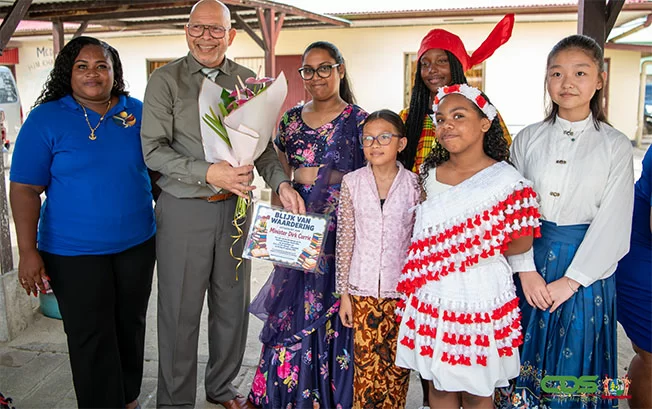
On a recent Tuesday, Suriname officially kicked off its National Heritage Storytelling Days, a flagship interactive initiative designed to bring the country’s rich, layered cultural heritage into school classrooms and connect young learners with the intergenerational stories that shape national identity. The launch event took place at O.S. H.J.M. Khargi-Vishnudattschool, marking the start of weeks of programming that moves cultural storytelling out of family living rooms and into formal learning spaces as a core component of the country’s first ever Heritage Month.
The opening ceremony brought together key stakeholders from government and cultural community groups to formally unveil the initiative’s banner. Suriname’s Minister of Education Dirk Currie joined John Dos Ramos, chair of the Madeiran Descendants association in Suriname, to share firsthand stories of the country’s diverse cultural roots with attending students. Rachel Pinas, who leads the presidential working group organizing Heritage Month, emphasized that oral storytelling is an irreplaceable pillar of cultural preservation.
“Stories from grandparents, tales from generations past, and ancient oral narratives all form an integral part of our collective heritage,” Pinas explained during the event. Over the course of the coming weeks, programming will center on core themes including family history, migration pathways, cultural traditions, and shared community values and norms—topics that reflect Suriname’s long history of diverse cultural convergence.
Unlike static textbook lessons on national history, the National Heritage Storytelling Days prioritize hands-on, interactive engagement for students. At the launch event, learners did not only listen to guest stories; they also took part in a cultural heritage dance workshop led by instructor Winston Adaba, giving them a tangible experience of living tradition. Minister Currie used the occasion to encourage young Surinamese to actively explore their own personal and family backgrounds.
“Ask your mother and father what you were like as a baby. Ask where your family comes from. That shapes who you are. We are all unique, but we are all Surinamese,” Currie told the assembled students. He added that respect for diverse communities begins with understanding one’s own roots, noting that open communication is a far more powerful tool for resolving division than conflict. “What is far stronger than fighting is communicating. By talking with one another, we can solve so many problems,” he said, according to Suriname’s Communication Service.
Dos Ramos brought the specific history of Suriname’s Madeiran community to life for students during the event, sharing the little-known story of Francisco de Freitas, widely known as Mani Schaafijs, and reflecting on the arrival of the first automobile in Suriname back in 1910 and its lasting impact on the country’s transportation development. The initiative’s core goal is to reframe public understanding of heritage: rather than treating it as a static collection of historical facts locked in textbooks, organizers want young people to see it as a living, personal legacy made up of the stories, traditions and values passed down through generations.
“Heritage is everything that is passed down. That is our legacy. That belongs to us. That is who we are,” Currie said of the initiative’s mission.