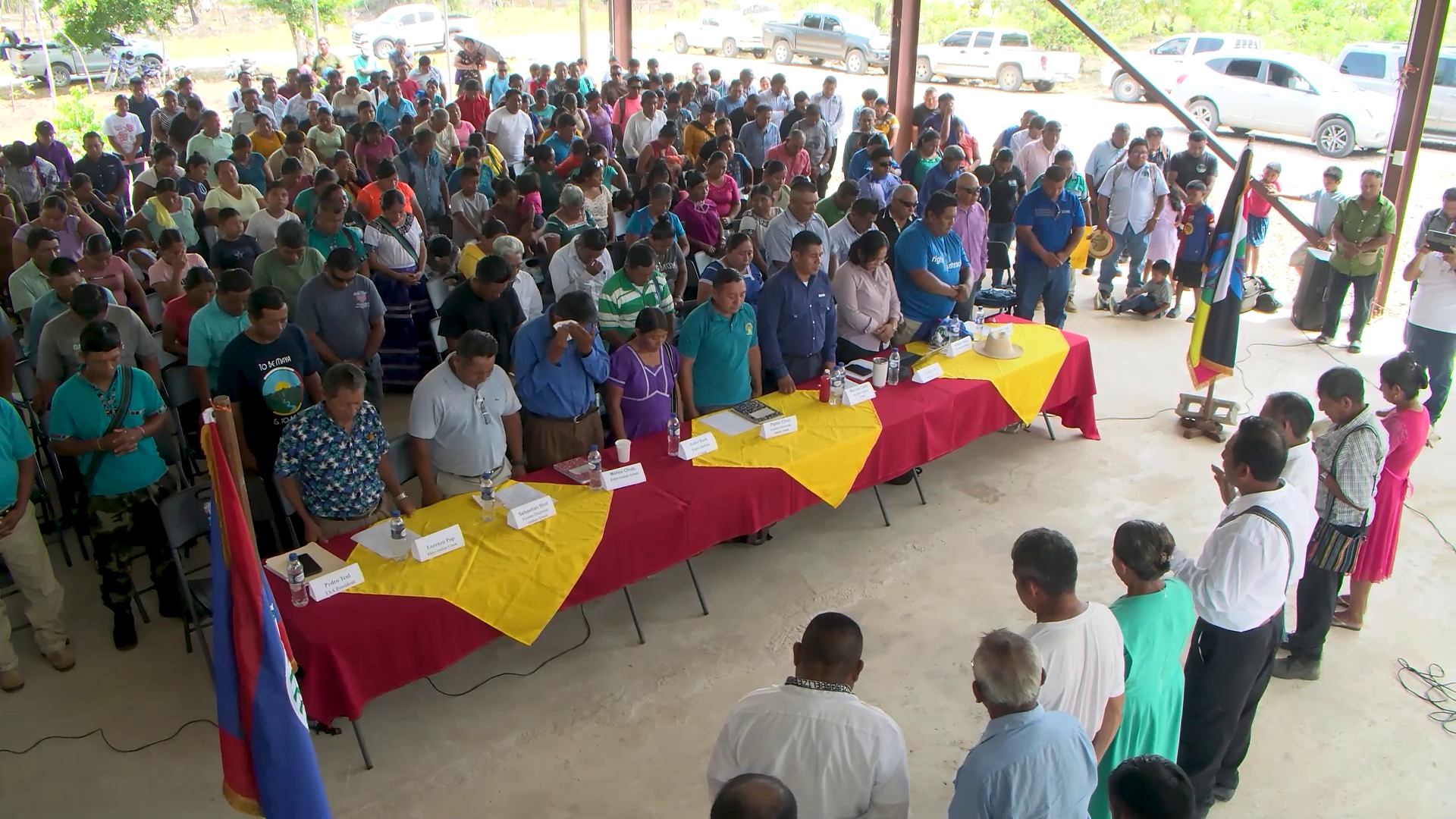
As a judicial review panel prepares to restart deliberations on landmark legislation formalizing Maya customary land rights in southern Belize, a bitter new conflict has erupted over representation at the negotiating table, with Indigenous leaders accusing the government of deliberately stacking the deck against their claims.
The dispute centers on a last-minute government decision to add a private landowner representative to the panel, a move the Maya Leaders Alliance argues fundamentally shifts the balance of power against Indigenous communities that have spent decades fighting for formal legal recognition of their traditional territorial holdings.
Senior government counsel Andrew Marshalleck, who is representing the state’s position, defended the addition of the landowner seat, noting that any final land rights framework must address overlapping third-party claims to the same territories. “The panel was originally structured to include two government-appointed members and two representatives from the Maya Leadership Alliance,” Marshalleck explained in an interview. “When competing claims exist for the same land, all affected interests need a voice at the table to work out a fair shared arrangement.”
But Cristina Coc, spokesperson for the Maya Leaders Alliance, called the move a deliberate tactic to divert from the core conflict at the heart of the dispute. “Our grievance is not with private landowners — it is with the government of Belize, which has continuously failed to recognize and uphold our customary land tenure rights,” Coc emphasized. “By adding a third-party representative opposed to our positions, the government is intentionally forcing us into conflict with private landowners instead of upholding its legal duty to protect our rights. It’s a transparent power grab that makes a mockery of this supposed review process, and proves the government is not negotiating in good faith.”
Beyond the controversy over panel composition, talks on the land rights legislation remain deadlocked over the total amount of territory the government will formally recognize as Maya customary land. Maya communities have already completed full mapping of their traditional boundaries through years of on-the-ground work, but the government has proposed a cap on total recognized land based on a formula tied to current Maya population.
Under the government’s current draft legislation, total recognized land would be capped at five acres per registered Maya resident in southern Belize’s Toledo District. With a Maya population of between 30,000 and 40,000, that would result in between 150,000 and 200,000 acres of formally recognized territory — a fraction of the roughly 1 million total acres that make up the entire district. “At the end of the day, Toledo only has a fixed amount of land to distribute,” Marshalleck argued. “Any fair arrangement requires a rational, sensible approach that accounts for the limited resources available.”
Coc rejected the government’s population-based formula, noting that Indigenous communities have already invested extensive time and effort in marking and harmonizing traditional boundaries between their communities. “There is nothing stopping the government from formally recognizing the boundaries our communities have already established and granting formal title to those territories,” Coc said. “If the review process continues to stall on this core issue with no willingness to consider our position, it is a useless exercise. We will allow the government to pass its unfair legislation, and we will return to the courts to defend our rights, as we have done before.”
This report is a transcribed excerpt from an evening television news broadcast in Belize.