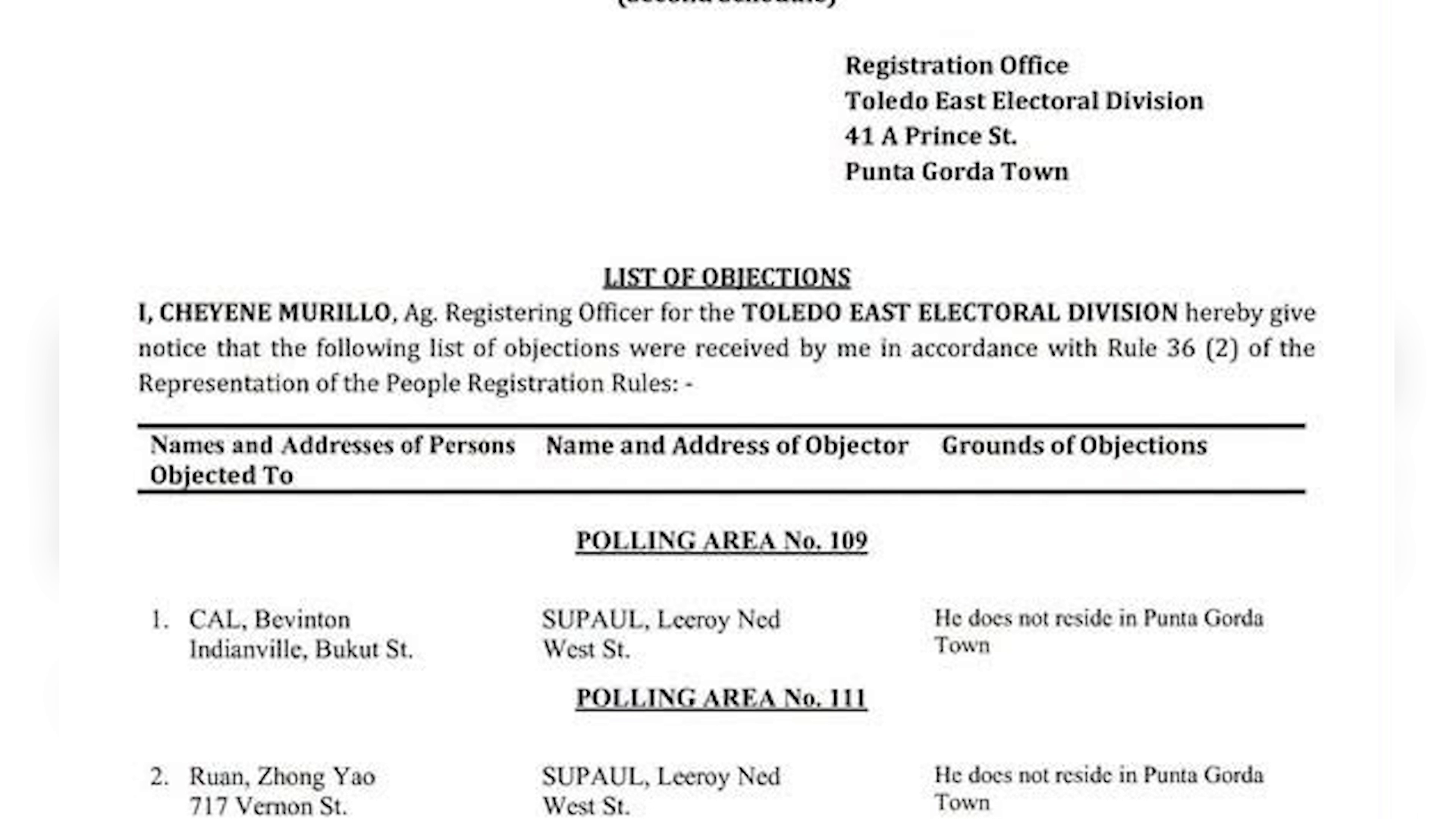
A routine challenge to six names on Punta Gorda, Belize’s provisional voter roll has escalated into a high-stakes conflict over transparency in the country’s electoral registration process, putting alleged illegal voter transfers under the legal microscope. The legal challenge was brought forward by Leeroy Supaul, a local Justice of the Peace and one-time mayoral candidate. Supaul alleges that all six individuals named in the objection—including Bevinton Cal, a former senator from the People’s United Party (PUP)—do not meet residency requirements to register to vote in Punta Gorda Town.
When the case opened before the Punta Gorda Magistrate’s Court on July 30, 2026, debate immediately shifted away from the residency claims themselves to a pivotal refusal from Belize’s Elections and Boundaries Department. The department has rejected a formal request to release the official field inspection report that was used to validate the six disputed voter registrations, leaving the defense without access to the core documentation underpinning the government’s approval of the registrations.
Orson Elrington, the attorney representing Supaul, told reporters that his side’s independent on-the-ground checks have already confirmed the six challenged individuals do not live in the Punta Gorda Town district. “When you register to vote at a new address, the responsible officer from the Elections and Boundaries Department is supposed to conduct an in-person field check to confirm the applicant actually resides at the location they listed,” Elrington explained. “We formally requested access to that inspection report, but Cheyenne Murillo, the representative for the department, denied our application. She claims the document is protected privileged information and cannot be released to our legal team.”
Supaul himself laid out the specific residency rules that he says the six individuals violated. Under Belizean electoral law, any voter transferring their registration to a new district must have resided in that area for a minimum of two months before registering. “I spoke directly to neighbors living next to the addresses these people listed, and none of them had seen these people at the property at any point in the two months leading up to registration,” Supaul said. “These people do not live in Punta Gorda Town at all, but they are trying to register to vote here.”
Frank Polonio, a United Democratic Party (UDP) mayoral candidate for Punta Gorda, echoed Supaul’s concerns, noting that the tight-knit nature of the small town makes it easy to spot non-residents attempting to register fraudulently. “Punta Gorda is a very small community—everyone knows who lives here and who is just visiting,” Polonio said. “When you pad the voter list with names of people who don’t actually live here, you steal the voice of legitimate Punta Gorda voters. Every fraudulent vote cancels out a lawful vote from a resident, eroding the freedom of the people to choose their own representatives.”
This legal challenge carries significant political weight for the region. Polonio narrowly lost the 2024 Punta Gorda Town Council election by just 25 votes after a formal recount, a margin small enough that illegal in-district registrations could have easily swayed the outcome. The Punta Gorda Magistrate’s Court has scheduled oral arguments on the voter registration objections for Monday, August 3, 2026, where the court will rule on whether the Elections and Boundaries Department must release the withheld inspection report before the case can proceed on its merits.
This report is adapted from a transcribed broadcast of original evening television news coverage, with direct quotes preserved from on-the-record interviews with all involved parties.