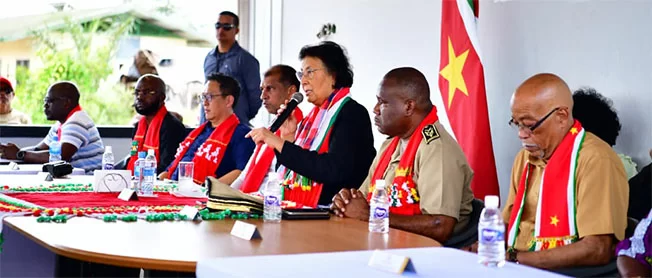
A major pollution event along Suriname’s Saramacca River has exposed critical gaps in the South American nation’s capacity to respond to environmental emergencies, according to President Jennifer Simons. During an official visit Thursday to Pikin Saron, one of the rural riverfront communities hardest hit by the contamination, Simons outlined urgent reforms to address the crisis and prevent future disasters.
Pikin Saron residents have already received emergency food assistance from the president’s cabinet in recent days, as ongoing pollution has killed off large populations of fish and left the river’s water unsafe for drinking or domestic use. Simons emphasized that this event serves as a serious wake-up call for Suriname, laying bare a painful structural weakness the country can no longer ignore: the nation currently lacks the domestic laboratory capacity to identify the source of a pollution emergency quickly.
With no in-country analytical capabilities, water samples collected from the contaminated river have had to be shipped abroad for testing, with results not expected for roughly two weeks. “We have regulations on the books, but if we lack a laboratory to pinpoint the cause of an emergency when it strikes, we are simply not taking this issue seriously,” Simons told residents during her address. To fix this gap, she called for targeted investments in domestic environmental testing laboratories, alongside tighter regulatory oversight of harmful chemical use and expanded protections for the upper watersheds of Suriname’s river systems.
Simons also stressed that both large and small enterprises working with chemical substances carry significant responsibility for preventing contamination. She ordered an investigation into whether the parties responsible for the Saramacca River pollution held valid operating concessions and complied with existing environmental regulations. “If a company holds a concession to operate, it also has a binding responsibility to protect the communities and environment around it,” she stated. The president added that the National Environmental Authority (NMA) must enforce strict requirements for chemical storage and handling, to prevent harmful substances from leaching into the environment during floods or other unforeseen events. Most importantly, she confirmed that any party found responsible for the pollution will be held fully liable for the damage caused, while the government explores mechanisms to compensate affected residents for their losses.
The president also drew a clear connection between the current disaster and the country’s small-scale gold mining sector, an industry that has long been linked to widespread river contamination in Suriname. According to communications from the Suriname Communications Service, Simons noted that the nation currently captures too little revenue from small-scale gold mining, while the harmful chemicals used in unregulated operations degrade ecosystems, damage community water supplies, and even result in avoidable gold waste that cuts into miners’ own profits.
To address these overlapping issues, the Surinamese government plans to support a gradual transition to safer, more sustainable mining methods across the sector. Simons noted that the shift will ultimately deliver higher profits for artisanal miners, ensure fair tax contributions to the national budget, and cut down on avoidable environmental damage. In addition, the Ministry of Land Policy and Forest Management is working to protect vulnerable forest ecosystems in river upper watersheds, a measure designed to stop pollution from spreading across entire river systems and devastating entire rural communities, as seen in the Saramacca event.
Simons concluded by calling on the NMA to assess what additional safety measures are needed to prevent similar environmental disasters from occurring again, and to rebuild affected communities’ trust in the safety and quality of local river water. The investigation into the exact cause of the Saramacca River pollution remains ongoing as of the president’s visit.