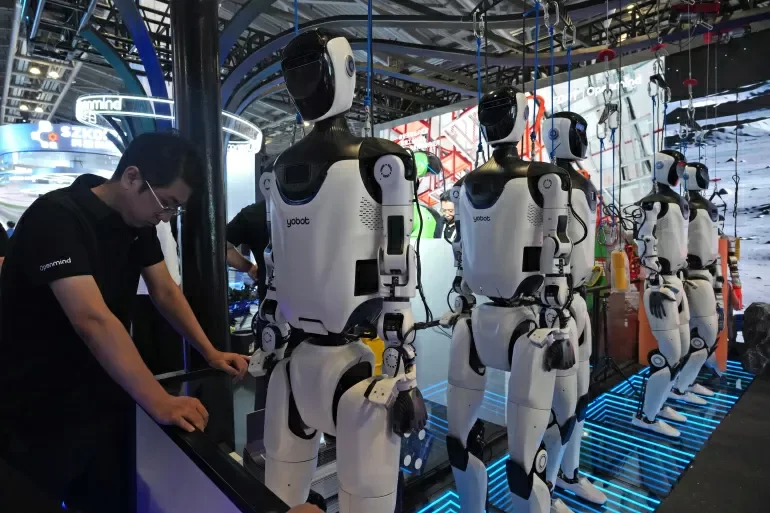
In a move that escalates technological rivalry between the world’s two largest economies, the United States has implemented an immediate import ban on new Chinese-made humanoid robots, quadrupedal robot dogs, and power converters, citing widespread cybersecurity and national security risks. The new restrictions, announced Tuesday by the U.S. Federal Communications Commission (FCC), only apply to devices that have not yet received approval for sale in the U.S. market, but leave open the possibility of revoking existing approvals for already cleared products in specific high-risk cases.
According to the FCC’s official announcement, the targeted Chinese devices pose unaddressed risks to U.S. supply chains, with regulators warning that foreign actors could gain unauthorized access to or control over the connected equipment. A successful breach, officials argue, could inflict severe damage on U.S. economic interests and critical national infrastructure, justifying the urgent regulatory action. The new measure forms part of a broader Washington strategy to cut dependence on Chinese technology across strategically vital sectors, including artificial intelligence, renewable energy infrastructure, and national data center networks.
Among the companies directly impacted by the robot restrictions is Unitree, a prominent Chinese robotics firm that maintains a partnership with U.S. chip giant Nvidia. The Pentagon added Unitree to a growing list of entities accused of having ties to the Chinese military just weeks ago, a claim the Chinese government has repeatedly and firmly denied. The restrictions also cover Chinese-made power converters, a critical component that connects solar panels and energy storage batteries to public electrical grids. Major Chinese suppliers including Huawei and Sungrow are the primary targets of this portion of the ban, given their large global market share in renewable energy infrastructure components.
The Chinese Embassy in Washington has issued a sharp condemnation of the new policy. In an official statement, embassy officials called on the U.S. to end what it described as “the smearing of legitimate Chinese companies” and abandon escalating threats of punitive trade restrictions. The statement also made clear that China will take all necessary countermeasures to defend the commercial and strategic interests of its domestic firms, should Washington continue its restrictive technology policy.
The ban aligns with the Biden administration’s broader goal of incentivizing advanced technology manufacturing within U.S. borders. Multiple U.S.-based and U.S.-headquartered firms are already ramping up development and assembly of humanoid robots for commercial and industrial use, including Tesla, Figure AI, Agility Robotics, and Boston Dynamics. Tesla has publicly announced plans to scale up production of its long-awaited Optimus humanoid robot in the coming months, a timeline that aligns with the new import restrictions on competing Chinese products.
Industry analysts warn the latest trade restriction will further escalate bilateral tensions between Washington and Beijing, which are already locked in a wide-ranging strategic standoff over advanced semiconductors, AI development rules, trade policy, and technological market access. U.S. government officials, for their part, maintain the ban is a narrow, necessary step to protect critical national infrastructure amid a period of intensifying great power technological competition.