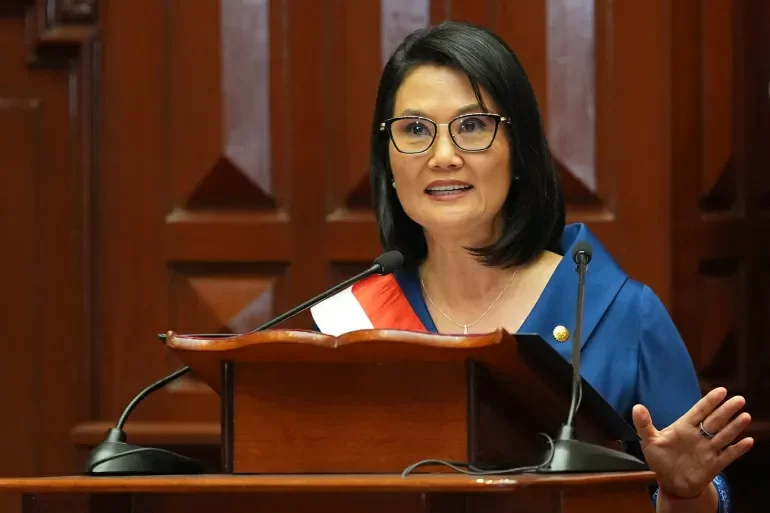
LIMA, PERU – In a pivotal moment for Peruvian politics, 51-year-old conservative leader Keiko Fujimori has been officially inaugurated as the country’s new president, closing out a tightly contested election season shaped overwhelmingly by public anxiety over soaring criminal violence. Fujimori secured a narrow victory over her left-wing rival Roberto Sanchez in June’s presidential runoff, winning by a margin of fewer than 50,000 votes. Her inauguration makes her the ninth president to lead Peru in just 10 years, a stretch defined by persistent political instability that has left the Andean nation hungry for consistent governance.
Speaking from Congress in Lima during Tuesday’s inauguration ceremony, Fujimori took her oath of office, promising to “faithfully carry out the duties of President of the Republic.” She immediately outlined an aggressive, hardline agenda to tackle the country’s spiraling security crisis, which has been fueled by widespread extortion, murder, and other violence perpetrated by domestic and transnational criminal gangs. In what she described as an “iron fist” response to the threat, she announced a series of sweeping policy proposals, including the construction of a large-scale maximum-security prison modeled after the facility system implemented in El Salvador, anonymous judges for high-risk criminal cases, mass expulsions of undocumented migrants, and a mandate requiring incarcerated people to work in exchange for food provisions.
Fujimori’s political party, Fuerza Popular, holds the largest single bloc in Peru’s Congress, and together with her center-right allies, she controls half of all seats in the newly formed Senate. This representation gives her coalition enough power to make impeachment efforts far more difficult to execute, though the bloc falls short of the absolute majority needed to pass her full policy agenda without opposition support.
Fujimori’s ascent to the presidency marks the return of one of Peru’s most polarizing political dynasties. She is the daughter of former president Alberto Fujimori, who ruled the country through the 1990s with aggressive authoritarian-leaning policies. While her father’s administration is credited with defeating the Maoist Shining Path insurgency and ending crippling hyperinflation, it also left a dark legacy: Alberto Fujimori was ultimately convicted of widespread corruption and systematic human rights violations, a divided history that continues to split Peruvian public opinion today.
Critics have raised urgent alarms that Keiko Fujimori’s tough-on-crime agenda will echo her father’s authoritarian tactics, warning that the crackdown on criminal activity will come at the cost of core civil liberties for Peruvians. On the eve of her inauguration, relatives of victims of state violence gathered in central Lima to protest her incoming administration and demand long-delayed justice for atrocities committed during her father’s time in office. Opposition groups are also pushing to roll back recent legislation they argue has weakened efforts to combat organized crime, and are demanding the reopening of investigations into the deaths of dozens of protesters during widespread anti-government demonstrations that took place in 2022 and 2023.
As Keiko Fujimori begins her presidential term, Peruvian society remains deeply divided. While many voters frustrated by rising crime supported her hardline platform, the country’s deep historical wounds and widespread concerns over potential authoritarian overreach have left the nation navigating a fragile balance between a hunger for political stability and vigilance against abuse of power.