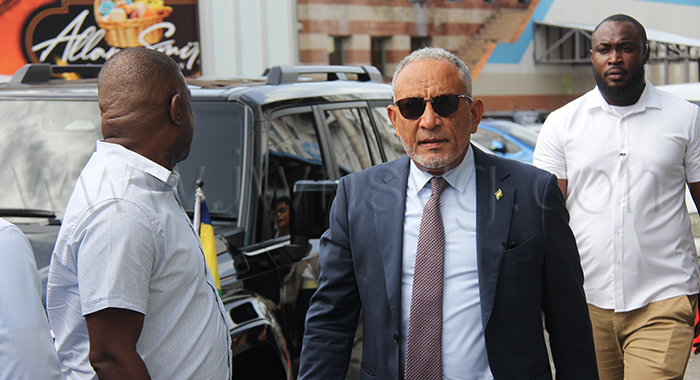
Three days of scheduled High Court hearings into two contested 2025 general election results in St. Vincent and the Grenadines moved into its second day on Wednesday, July 29, 2026, with an expert witness slated to testify before the court after a full first day of witness testimony and cross-examination on Tuesday. The two petitions, both filed by defeated opposition Unity Labour Party (ULP) candidates, challenge the eligibility of two sitting New Democratic Party (NDP) lawmakers on the grounds of dual citizenship with Canada, a foreign power under the nation’s constitution.
The first dispute centers on the East Kingstown constituency seat, where incumbent NDP candidate Dwight Fitzgeral Bramble — currently serving as Minister of Foreign Affairs, Foreign Trade, Foreign Investment, and Diaspora Affairs in the new NDP administration — secured a second five-year term in the November 2025 general election. Bramble earned 2,728 total votes, beating ULP challenger Luke Browne by a margin of 1,001 votes, with 19 ballots rejected. Browne, who has now lost four consecutive bids for the East Kingstown seat, argues Bramble is constitutionally ineligible to hold office because he holds voluntary Canadian citizenship alongside his birthright Vincentian citizenship, violating the nation’s eligibility requirements for parliamentary office.
The second petition targets NDP leader Godwin Friday, who now serves as Prime Minister of St. Vincent and the Grenadines, holding additional portfolios for finance, legal affairs and justice, economic planning, and private sector development. Friday secured his sixth consecutive five-year term as Member of Parliament for Northern Grenadines, winning 2,185 votes to ULP challenger Carlos Williams’ 339 — a margin so wide Williams lost his electoral deposit. Like Bramble, Friday holds voluntary Canadian citizenship, which the ULP’s petition argues disqualifies him from office.
Friday led the NDP to a historic landslide victory in the 2025 general election, winning 14 of the nation’s 15 parliamentary seats. This result marks the second most decisive election outcome in the country’s electoral history, bested only by the NDP’s 1989 clean sweep of all 15 seats.
Both Friday and Bramble appeared in person at the Kingstown High Court on Tuesday as witnesses testified and underwent cross-examination by legal teams. Speaking to reporters after the first day of hearings, Senior Counsel Anand Ramlogan, former Attorney General of Trinidad and Tobago and lead counsel for the government defending the election results, expressed confidence in the government’s position. Ramlogan noted that the petitions come against a backdrop of an overwhelming popular mandate for Friday and the NDP, calling the ongoing proceedings a rare intersection of democratic and judicial processes.
Ramlogan emphasized that Friday never concealed his dual citizenship status, arguing that Vincentian voters cast their ballots for him and the NDP with full knowledge of his citizenship and long record of public service. “Justice will prevail in the end, and the honourable prime minister will be vindicated,” he told reporters, adding that the scheduled Wednesday session would hear testimony from expert witnesses, with the three-day hearing moving forward incrementally. He also acknowledged the intensity of the judicial process, praising Friday for prioritizing the hearing by clearing his official schedule to attend, noting the public’s right to a timely resolution of the dispute in the interest of democratic governance.
For the petitioners, Senior Counsel Stuart Young, former Prime Minister of Trinidad and Tobago serving as lead legal counsel, stated the first day of hearings proceeded exactly as the legal team expected, saying only that the outcome of the three-day process would unfold in due course. The case is being heard by Acting High Court Justice Gertel Thom, a retired justice of appeal.
The challenge to the two NDP candidates’ eligibility began long before the petitions were filed, ahead of the November 2025 election. The ULP published public notices in local media urging voters in both constituencies not to support the NDP candidates, framing a vote for either as a “wasted vote” on an ineligible candidate. The notices cited Section 26(1) of the Constitution of St. Vincent and the Grenadines, which bars any person from election to parliament if they have voluntarily acknowledged allegiance to a foreign power.
The statutory declaration required of all electoral candidates mandates a statement confirming they have no such allegiance to a foreign state. The pre-election notices argued that Friday and Bramble each voluntarily applied for and obtained Canadian citizenship and passports, and have actively used those documents, putting them in direct violation of the constitutional eligibility requirement. Nomination objections were filed against both candidates on Nomination Day, November 10, 2025, with the petitioners maintaining that an invalid nomination automatically invalidates the election result.
The legal dispute has drawn divided commentary from domestic legal scholars even before the trial began. Linton Lewis, a former NDP senator and party chairman who has since split with the party, authored pre-election commentaries arguing the eligibility challenge against Friday and Bramble would ultimately succeed in court. Conversely, fellow legal scholar Jason Hayne argued that a correct reading of the SVG constitution explicitly allows Commonwealth citizens — of which Canada is a member — to contest national elections, meaning any dual citizenship-based challenge would fail.
A notable political irony accompanies the petitions: ULP leader and former Prime Minister Ralph Gonsalves, whose party brought the challenges, has repeatedly stated in past comments that elections are won at the polls on election day, not in courtrooms. Gonsalves was also present at the High Court for the first day of hearings on Tuesday, July 28.