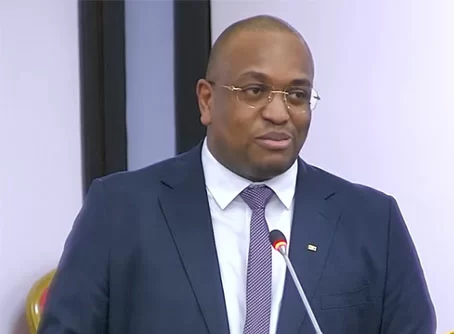
Suriname’s national government will join a traditional community gathering (krutu) this weekend with Granman Bono Velantie, leader of the Aucaner indigenous people, to discuss the long-awaited border treaty between Suriname and France. This commitment was announced Tuesday by Foreign Affairs, International Trade and Cooperation Minister Melvin Bouva during an address to the country’s National Assembly (De Nationale Assemblee, DNA).
The announcement comes after parliament voted to postpone its review and approval of the border treaty ratification bill, a decision made to give traditional governing authorities time to conduct internal consultations with their communities before moving forward with the formal legislative process.
Bouva emphasized that the Surinamese administration fully respects the request from traditional leadership for this internal discussion period. The national government will join the parliamentary delegation that has already been invited to participate in the krutu, and technical experts from the Ministry of Foreign Affairs are on standby to provide substantive support for the talks, answer community questions, and address any concerns raised by Aucaner residents.
The minister stressed that the decision to hold this extra round of consultations is not intended to signal that the border treaty itself is up for debate. Instead, Bouva explained, the extended process demonstrates that the national government acknowledges and prioritizes the concerns of affected communities, while working toward a deliberate, inclusive outcome that ultimately serves the best interests of both Suriname and its international partners.
Among the core non-negotiable principles to be reaffirmed during the community talks, Bouva highlighted that unimpeded navigation and free movement across the Marowijne River, which forms part of the disputed border region, must remain guaranteed. This longstanding principle, he said, will be clearly restated to all community members during discussions.
Bouva’s announcement of the government’s participation in the krutu received broad cross-party support from members of the National Assembly, though several opposition and ruling party leaders called for improved proactive communication with affected indigenous and tribal communities going forward.
Asis Gajadien, parliamentary faction leader of the ruling VHP party, noted that the government already has access to multiple communication tools to inform the public earlier and more clearly about major policy decisions like the border treaty. Gajadien argued that gaps in communication and insufficient public outreach have been a key contributing factor to recent public unrest surrounding the treaty, and urged the government not only to accept invitations from traditional leadership, but also to proactively use all available resources to keep all affected communities fully informed at every stage of the process.
Rabin Parmessar, faction leader of the main opposition NDP party, added that consultations with traditional indigenous authorities have been a topic of debate in Suriname for years. He reminded lawmakers that he took the position during the previous administration that the border treaty should not have been signed until all affected indigenous and tribal communities had been given an opportunity to share their perspectives.
Parmessar noted that the permanent parliamentary committee on the treaty has already made multiple visits to Granman Bono Velantie and held extensive discussions with the Ministry of Foreign Affairs. He also confirmed that official documents received by parliament show that multiple other indigenous granmans and tribal communities already publicly support the treaty.
The recent request from Granman Bono Velantie to hold a krutu with his community first, Parmessar said, is fully aligned with longstanding Aucaner traditional governance practices. “The granman must speak with his people first before taking a final position,” Parmessar told the assembly. For this reason, he called on both parliament and the national government to give traditional leadership the space it needs to complete this internal process carefully.
Parmessar emphasized that the current delay is not related to disputes over the technical content of the border treaty, but rather over the way the decision-making process has included affected community members. “These are our fellow citizens,” he told the assembly. “If communication has been insufficient, we have to fix that together.”
Following Tuesday’s debate, parliament reached broad consensus to wait for the completion of consultations with traditional leadership before resuming its formal review and approval process for the border treaty with France.