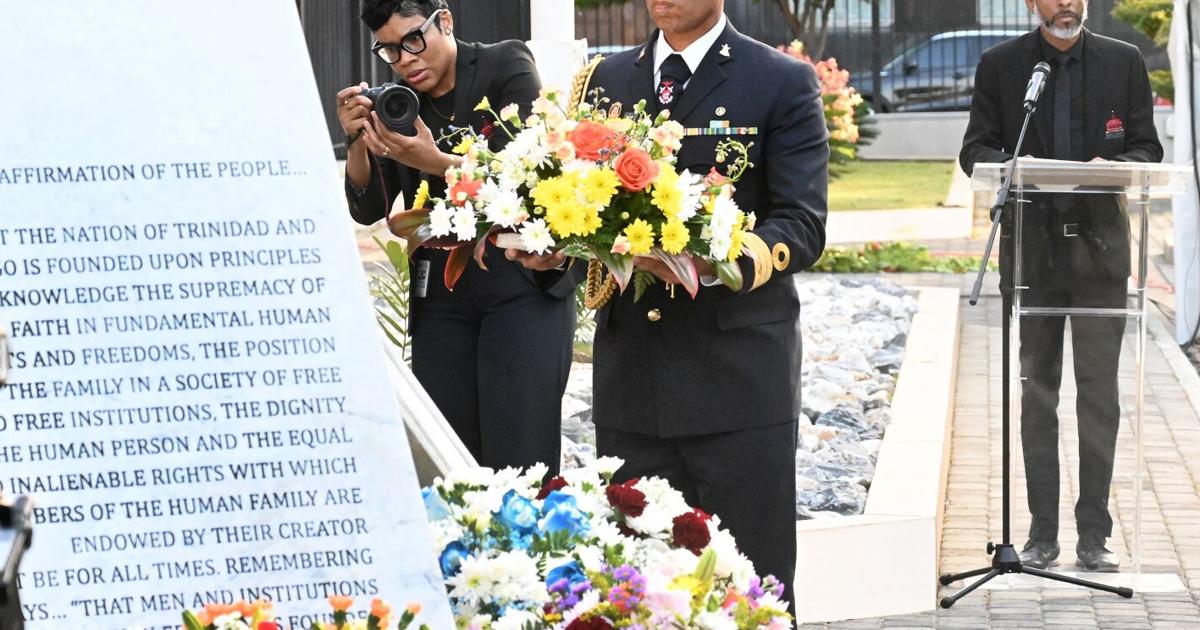
As Trinidad and Tobago paused this week to commemorate the 36th anniversary of the 1990 attempted coup, a fiery exchange has erupted over the current administration’s handling of critical national security infrastructure, with a former top security official accusing the sitting homeland security minister of misappropriating a landmark intelligence facility.
Gary Griffith, who previously led the Ministry of National Security, used a public Facebook post to anchor his criticism in the firsthand lessons he learned during the 1990 uprising. As one of the youngest active-duty soldiers deployed during the crisis, Griffith saw firsthand the systemic failures that allowed the coup attempt to catch state authorities off guard: within the first 48 hours of the insurgency, dozens of law enforcement officials abandoned their posts, leaving frontline personnel to defend critical state infrastructure without support or coordination.
In the aftermath of the failed coup, a government-appointed Commission of Enquiry was convened to unpack what went wrong. The commission ultimately identified deep structural flaws in national security operations and laid out 34 concrete recommendations designed to prevent a similar crisis from unfolding again. Griffith argues that for more than a decade after the commission released its findings, successive governments largely ignored the report entirely—a failure he says is only possible in a state with weak democratic accountability, what he calls a “banana republic.”
During his own tenure leading the national security ministry, Griffith prioritized implementing the commission’s recommendations, carrying out 13 of the 34 proposals before leaving office. The flagship recommendation from the commission was the creation of a dedicated National Operations Centre (NOC), a step directly prompted by the 1990 failure of separate intelligence agencies to share critical threat information with one another.
Griffith explained that this intelligence sharing gap left law enforcement completely unprepared for the 1990 insurgency: with no coordinated predictive intelligence, the state was forced into reactive damage control rather than launching a pre-emptive strike to stop the uprising before it began. Built at a cost of $500 million, the NOC Griffith established was designed as a cutting-edge, high-technology hub that would enable real-time intelligence gathering and cross-agency collaboration. Its core mandate was to bring all branches of the national intelligence community together to aggregate, analyze, and act on threat information, stopping national security risks before they escalated into crisis.
During Griffith’s time in office, the NOC delivered tangible results, he says: in 2014, Trinidad and Tobago recorded the largest single drop in serious crime in 31 years, a reduction achieved without implementing a disruptive national state of emergency.
Today, however, Griffith accuses the current administration and its Homeland Security Minister Roger Alexander of fundamentally altering the NOC’s core mandate, stripping it of its critical intelligence role and reducing it to a basic police dispatch center that duplicates the work already done by the existing E 999 emergency dispatch service. “Sadly, the present administration, through a Minister of Homeland Security whose knowledge is limited primarily to policing, has reduced this highly advanced system to a dispatch centre working alongside E 999, even though E 999 already has its own dispatch centre,” Griffith said. “The National Operations Centre was not built to duplicate E 999.”
Griffith’s final warning is stark: the failure to fully implement all 34 of the 1990 Commission of Enquiry’s recommendations, paired with the gutting of the NOC’s intelligence function, has left Trinidad and Tobago just as vulnerable to a major security crisis as it was three and a half decades ago. “Poor intelligence gathering was the principal weakness in 1990,” he noted. “The failure to implement the remaining recommendations of the Commission of Enquiry, combined with the failure to utilise the National Operations Centre as intended, has left this country exposed. Thirty-six years later, we are not one step closer to ensuring that what happened in 1990 will never happen again.”