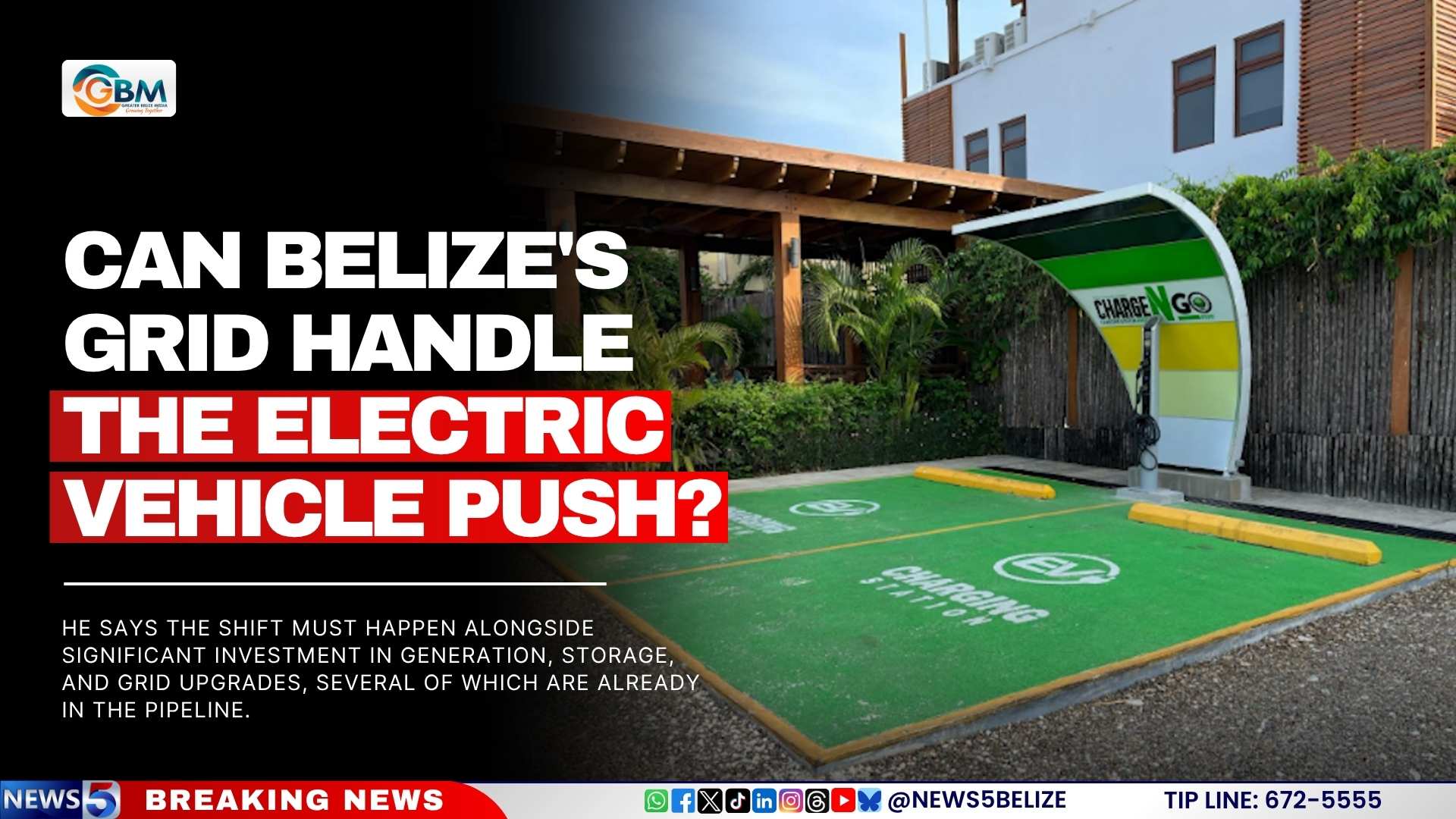
As Belize advances its ambitious push to accelerate a national transition from gasoline-powered vehicles to electric vehicles, a critical question about energy infrastructure has moved to the center of public debate: is the country’s existing electricity grid robust enough to handle the coming surge in power demand? With local residents already voicing persistent concerns about inconsistent power reliability and limited overall capacity, local outlet News Five sat down with Dr. Leroy Almendarez, Chief Executive Officer of Belize’s Ministry of Public Utilities and Energy, to discuss whether the nation has the necessary infrastructure to support widespread EV adoption.
Almendarez emphasized that a successful large-scale shift to electric vehicles cannot proceed without massive targeted investment in three core areas: expanded power generation, utility-scale energy storage, and comprehensive upgrades to the national grid. Notably, he added, many key upgrade projects are already in the planning and development pipeline. Almendarez explained that granular energy consumption data will guide utility provider Belize Electricity Limited (BEL) in calculating exactly how much additional capacity the nation will need, as widespread EV adoption will add new, consistent demand from public and private charging stations on top of existing residential power use.
Addressing common public assumptions that Belize’s abundant solar resources alone can meet the new demand without additional infrastructure, Almendarez noted: “I keep hearing people saying ‘the sun is shining,’ but you can’t just take the sun and put it in your vehicle. And I don’t mean to be cynical, but it simply means you must have infrastructure in place.”
Contrary to widespread public pessimism, Almendarez pointed out that Belize is much further along in preparing for increased energy demand than many residents assume. The nation is currently accepting proposals for a new 80-megawatt solar power facility, which is scheduled to enter operation in the first quarter of 2028. This new solar generation capacity will be paired with 40 megawatts of utility-scale battery storage, both zero-emission clean energy assets designed to stabilize national power supply as EV-driven demand grows.
For shorter-term demand needs, an additional 15 megawatts of generation capacity is expected to come online from the Belize Caribbean Biofuel Company Limited (BABCOL) by November 2026.
Even with expanded generation and storage capacity, however, Almendarez stressed that growing energy demand requires upgrades to the grid itself. Adding more power is only one piece of the broader infrastructure puzzle; the transmission and distribution network must be capable of delivering that extra energy to end users where and when it is needed.
“The grid must be able to dispatch that, to distribute that, to make sure that you can get access to that energy,” he said. “And you don’t want competing forces either. Otherwise, we’ll end up in a serious situation.”
New data shared during a recent public energy briefing also confirmed longstanding regional concerns: southern Belize currently faces the greatest strain on existing grid infrastructure, a challenge that will require targeted upgrades to avoid reliability issues as EV adoption expands.