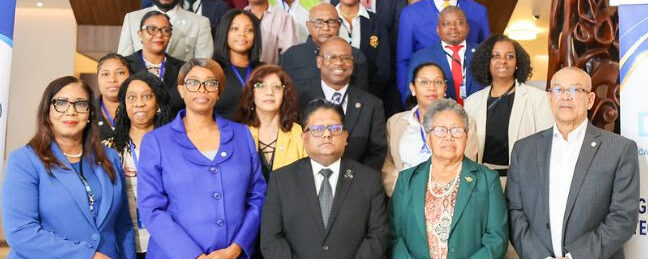
Against a backdrop of shrinking and volatile international development aid, the top official of the Caribbean Community (CARICOM) has called on regional tax administrations to step into a central role in building stronger, more economically resilient nations across the Caribbean.
CARICOM Secretary-General Dr. Carla Barnett delivered this call to action during the opening session of the Caribbean Organisation of Tax Administrators (COTA) 27th General Assembly and Technical Conference, which kicked off Monday in Georgetown, Guyana. The five-day gathering, which brings together tax policy leaders from across the region, centers on the official theme: “Future-Ready CARICOM Tax Administration: Smart, Data-Driven and AI-Enabled for Sustainable Revenue.”
Before turning to the conference agenda, Barnett opened her address by offering formal condolences to the government and people of Guyana in the wake of the M.V. Barima disaster, affirming that the entire CARICOM bloc stands in solidarity with all those impacted by the tragedy.
Barnett framed the conference as a pivotal gathering for the region, coming at a moment when CARICOM heads of government have advanced a sweeping slate of shared regional priorities. These priorities include the recent admission of Martinique and French Guiana as Associate Members, deepening integration through the CARICOM Single Market and Economy, expanding the free movement of people across borders, strengthening regional food and energy security, boosting climate disaster resilience, and continuing collective advocacy for comprehensive reform of the global international financial system.
Achieving these ambitious goals, Barnett stressed, hinges on governments having consistent, sufficient financial resources to invest in critical public goods: from transportation and digital infrastructure to healthcare systems, public education, climate adaptation measures, and a range of other essential community services.
“Particularly in this period when international development cooperation is increasingly uncertain, sustainable development, more than ever, depends on more reliable, resilient and home-grown sources of financing long-term growth and prosperity,” Barnett told delegates.
She went on to outline the unique structural pressures facing Caribbean nations that strain public budgets: small open economies that are disproportionately vulnerable to volatile global economic shocks, coupled with the rapidly growing costs of climate change impacts that force governments to divert funds from long-term development to emergency response and recovery.
Barnett also recognized COTA’s 50-plus year legacy of advancing cross-border cooperation, professional training, and knowledge sharing among regional tax agencies, work that has laid the groundwork for modernizing tax systems across the bloc. She emphasized that integrating digital tools, advanced data analytics, and artificial intelligence into tax administration can transform core operations: boosting total tax collection rates, improving customer service for individual and business taxpayers, and catching tax fraud far more efficiently than outdated manual systems. Even so, she acknowledged the growing risks that come with digital transformation, including rising cybersecurity threats and persistent digital divides that can leave smaller jurisdictions at a disadvantage.
In closing, Barnett encouraged conference delegates to use their five days of discussion and collaboration to develop concrete, actionable recommendations that will strengthen public financial governance, increase confidence among global and regional investors, and help build a more competitive, integrated, and sustainable Caribbean Community for future generations.