In the wake of the high-energy CARICOM summit held in Saint Lucia, and amid the raucous joy of local Carnival celebrations that dominated social media feeds, a quietly transformative development has gone largely under the public radar – one that demands deliberate attention and broader public discourse.
In the modern media landscape, staying meaningfully informed about events that shape our collective life grows more challenging by the day. Social media algorithms are designed to prioritize content that stokes division, outrage, and controversy, pushing aside moments that call for celebration or thoughtful reflection. As media observers have long noted, good news rarely drives clicks or advertising revenue, leaving underreported stories that carry profound long-term significance buried under sensationalized content.
Compounding this, the constant weight of persistent social, political, and economic struggles soaks up nearly all of our collective advocacy energy, leading many to overlook moments that deserve recognition and celebration. This is not to argue that we should divert focus from the urgent crises facing communities across the region – if anything, sustained attention to these issues is still insufficient. But it is possible to hold two truths at once: we can grapple with the devastating cost-of-living crisis while also celebrating tangible progress in the ongoing, unfinished work of decolonization and sovereign nation-building.
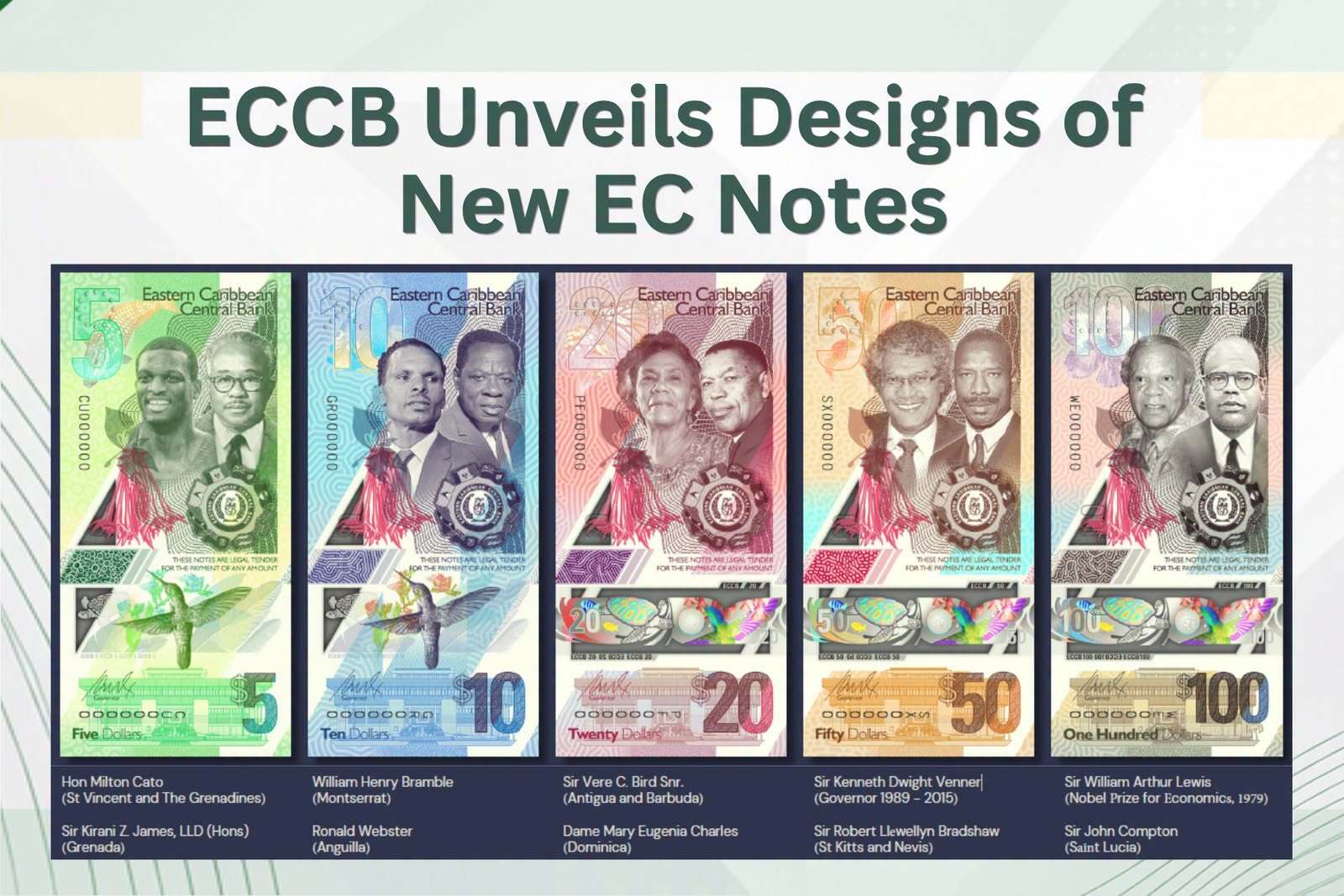
That tangible progress arrived recently when the Eastern Caribbean Central Bank (ECCB) unveiled its newly redesigned Eastern Caribbean (EC) banknote series. ECCB Governor Timothy N. J. Antoine framed the redesign as a direct response to public demand: for a regional currency that honors the Caribbean’s own heroes, nation-builders, and trailblazers whose lives and contributions have enriched member states and strengthened the entire Eastern Caribbean region. Reflecting the currency’s status as a public asset belonging to all members of the Eastern Caribbean Currency Union, the ECCB Monetary Council opened the redesign process to public input, inviting ordinary citizens to help shape this new chapter of shared regional history.
The final product is a new series of banknotes featuring portraits of distinguished Caribbean leaders and icons from across the region, replacing the portrait of the British monarch that has appeared on Eastern Caribbean currency for generations. This is far more than an aesthetic update: it marks a pivotal moment for decolonization, self-determination, and regional sovereignty.
Critics have pushed back against framing the change as a meaningful milestone, arguing that swapping portraits on currency does nothing to lower skyrocketing food prices, raise stagnant wages, or ease the widespread economic anxiety weighing on households across the region. Others dismiss the change as long overdue, arguing governments deserve no praise for taking an action that should have been completed decades ago.
But these critiques oversimplify a far more nuanced conversation, relying on a false binary that suggests societies must eliminate every material economic hardship before they can address the symbolic work of decolonizing the cultural and national symbols that shape collective identity. This is a false choice: nations can address pressing economic challenges while advancing work on sovereignty and identity, just as people can walk and chew gum at the same time. We have never been single-issue societies. The argument that only economic outcomes matter is rooted in narrow neoliberal thinking that frames fiscal management as the sole responsibility of the modern state, relegate questions of identity, collective memory, and national self-confidence to secondary status because their impact cannot be immediately quantified in dollars and cents.
In reality, nations are sustained by far more than balanced budgets. They are held together by shared stories, unifying symbols, and inclusive institutions that allow every citizen to see their own place in the society they help build. As Barbados’ founding father Errol Barrow famously asked decades ago during the island’s independence movement: “What is your mirror image?” That question remains just as urgent today.
This banknote redesign forces us to confront that question directly. The currency we use every day – to buy groceries, repay loans, save for retirement, or invest in our children’s futures – should tell our own regional story, not one written by our former colonial rulers. It should not carry the implicit message that our national legitimacy is only validated by the continued presence of the British Crown. Instead, it should center the people whose labor, sacrifice, and vision built the societies and monetary union that we benefit from today.
When a child growing up in Soufriere, Kingstown, Grand Anse, or Basseterre picks up an EC banknote, it should be more than just a tool for financial exchange. It should remind them that independent peoples have the confidence to honor their own heroes, celebrate their own achievements, and define the symbols that will shape how future generations understand their identity. It should teach them that we have the power to create our own icons, our own institutions, and our own narrative.
Featuring beloved regional figures including former Saint Lucia Prime Minister Sir John Compton, former Dominica Prime Minister Dame Eugenia Charles, and Olympic champion Kirani James, the redesign is far more than an artistic update. It is a deliberate affirmation that excellence born and raised in the Eastern Caribbean deserves public reverence. It invites young people to see themselves not as passive spectators in a history written by others, but as active contributors to their own story, as citizens of independent sovereign states rather than colonial subjects. As the legendary Saint Lucian poet Derek Walcott wrote, “At last, these islands are no longer being written about, they are writing themselves.”
Trinidadian novelist Earl Lovelace captured the enduring psychological weight of colonialism in his novel *The Dragon Can’t Dance*, asking: “How come everything we do we have to be appealing to somebody else… Is like we ain’t have no self. I mean we have a self but is for somebody else. We is people… for we own self.” That observation cuts to the heart of one of colonialism’s most persistent legacies: the deep-seated tendency to prioritize external validation over recognizing our own inherent worth.
Critics still dismiss this change as nothing more than empty symbolism, but symbols have always mattered. They shape how societies understand their own identity, the stories they pass down to future generations, and the confidence they bring to engagements with the wider world. To use a simple analogy: when a person’s name is repeatedly mispronounced or replaced with a different name, nothing material changes on paper, but something core to their identity is damaged, because names carry deep meaning and identity. Similarly, Caribbean people universally react with frustration when Saint Lucia is confused for another nation, or when the Eastern Caribbean is lumped together as culturally identical to the rest of the Caribbean. That reaction stems from the same truth: symbols matter. They communicate who we are, how we want to be seen, and what we believe is worth remembering.
Our currency serves exactly this identity-forming purpose. It tells a story about whose achievements deserve a permanent place in our collective memory. A society that neglects to lift up its own symbols cedes power to outsiders to define its history, its heroes, and ultimately its sense of self.
Even so, the ECCB’s work cannot end with the launch of the new banknotes. For this step to represent a true advance in decolonization, it must be paired with a sustained program of public education. Many of us know the basic titles: Sir John Compton is the Father of Saint Lucian Independence, Dame Eugenia Charles is the “Iron Lady of the Caribbean”, Sir Arthur Lewis is the region’s only Nobel Laureate in Economics. But how many of us truly understand the full scope of their lives, the struggles they overcame, the hard choices they made, and the lessons they leave for current and future generations? How much do we know about the remarkable figures from neighboring islands featured on the new notes?
This moment should inspire investment in public education initiatives: biographies, documentaries, updated school curricula, public lecture series, museum exhibitions, community dialogues, public murals, children’s books, and digital storytelling projects that bring these figures’ legacies to life. These banknotes should act as a gateway to deepening public understanding of the Eastern Caribbean’s shared history, rather than only serving as tools for commercial exchange. History has long taught us that societies that fail to understand their past are doomed to repeat its mistakes, so these new notes should educate as widely as they circulate.
Most importantly, this reform should act as a catalyst for a broader regional dialogue about completing the unfinished project of decolonization. We must continue to identify remaining colonial vestiges that no longer reflect who we are as independent nations, while preserving those artifacts carefully in museums, so future generations can engage critically with that history rather than simply erasing it. This dialogue will inevitably extend to constitutional reform, including the continued role of British monarchical representatives in many regional political systems. National Reparations Commissions, Constitutional Reform Commissions, and other public bodies must continue examining both the structural and symbolic legacies of colonialism, advancing a vision of indigenization that reflects the confidence, maturity, and aspirations of modern independent Caribbean societies. This conversation must not be limited to government meetings: it must take place in every public space, from town squares and courthouses to classrooms and playgrounds.
Errol Barrow once urged Caribbean nations to stop “loitering on colonial premises”, and the Eastern Caribbean Central Bank has taken a significant step forward along that path. This is neither the first nor the final step in the long journey to full decolonization, but it is a meaningful milestone that deserves recognition. For this achievement, the ECCB merits public commendation. Now, the responsibility falls to governments, educators, artists, historians, constitutional reformers, and ordinary citizens across the region to continue the work: ensuring that all the symbols of our societies reflect the confidence of the people we are becoming, rather than the outdated structures of our colonial past.
This commentary is by Rahym R. Augustin‑Joseph, the 2024 Rhodes Scholar for the Commonwealth Caribbean and a two-time valedictorian, who is currently pursuing a Master of Public Policy at the University of Oxford’s Blavatnik School of Government. Augustin‑Joseph holds two First Class Honours degrees in Political Science and Law from the UWI Cave Hill Campus, and is an award-winning debater, youth leader, and advocate focused on law, politics, and governance in the Caribbean.