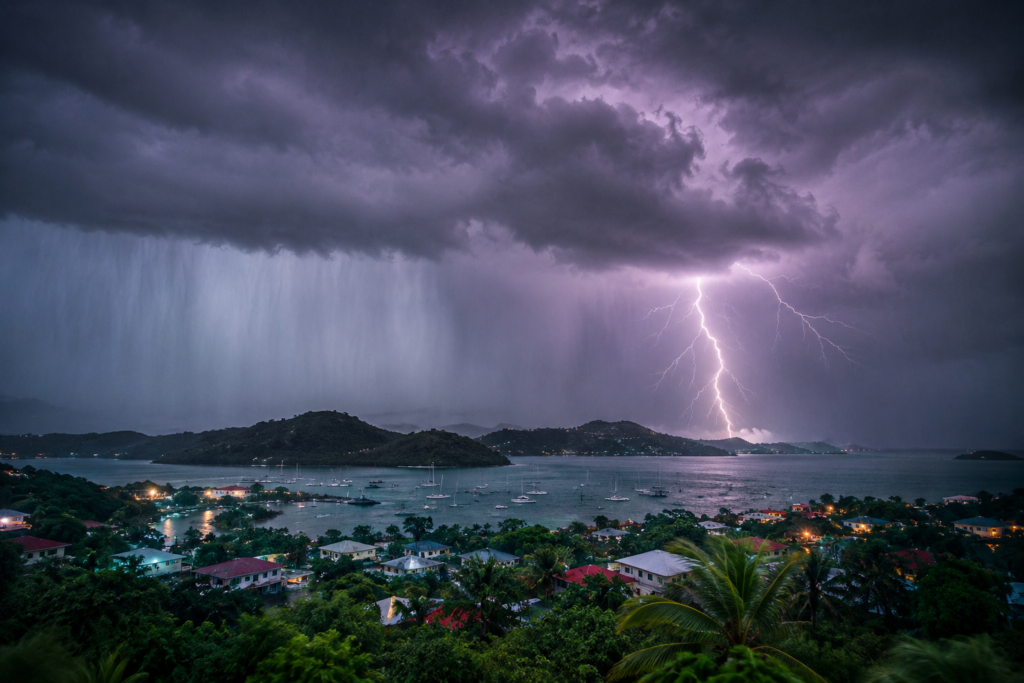
On Sunday, the twin-island nation of Antigua and Barbuda faced severe disruptive weather as a passing tropical wave brought hours of heavy rain, repeated lightning strikes, and intense thunderstorms across both islands. Local residents in multiple residential communities shared firsthand accounts of rapid, torrential downpours that swept through neighborhoods, paired with bright, frequent flashes of lightning that illuminated overcast skies.
Meteorologists attribute the volatile conditions to residual moisture and persistent atmospheric instability left in the tropical wave’s wake. These conditions have created a favorable environment for the development of scattered and isolated thunderstorms across the entire country, with unstable weather patterns projected to hold as the system continues its slow movement across the islands.
In response to the hazardous conditions, national safety officials have issued urgent public safety guidance aimed at reducing the risk of lightning-related injuries. Officials emphasize that lightning can travel as far as several miles from the core of a storm system, meaning strikes can occur even when no rain is falling at a location. For this reason, the public is strongly advised to move to safe shelter immediately whenever thunder is audible. The only recommended safe spaces are fully enclosed permanent buildings and vehicles with solid metal hard tops.
Until at least 30 minutes have passed since the last sound of thunder, officials warn the public to avoid a wide range of high-risk locations. These include open outdoor spaces, coastal beaches, natural bodies of water such as rivers and ponds, constructed swimming pools, tall isolated trees, utility poles, overhead power lines, and metal perimeter fences, all of which increase the risk of being struck by lightning.
As unstable weather conditions are set to continue in the coming period, local authorities are urging all residents to stay informed by regularly checking official meteorological updates. They also encourage community members to reach out to check on the well-being of vulnerable family members and neighbors, and maintain a heightened state of alert to respond to changing weather conditions.