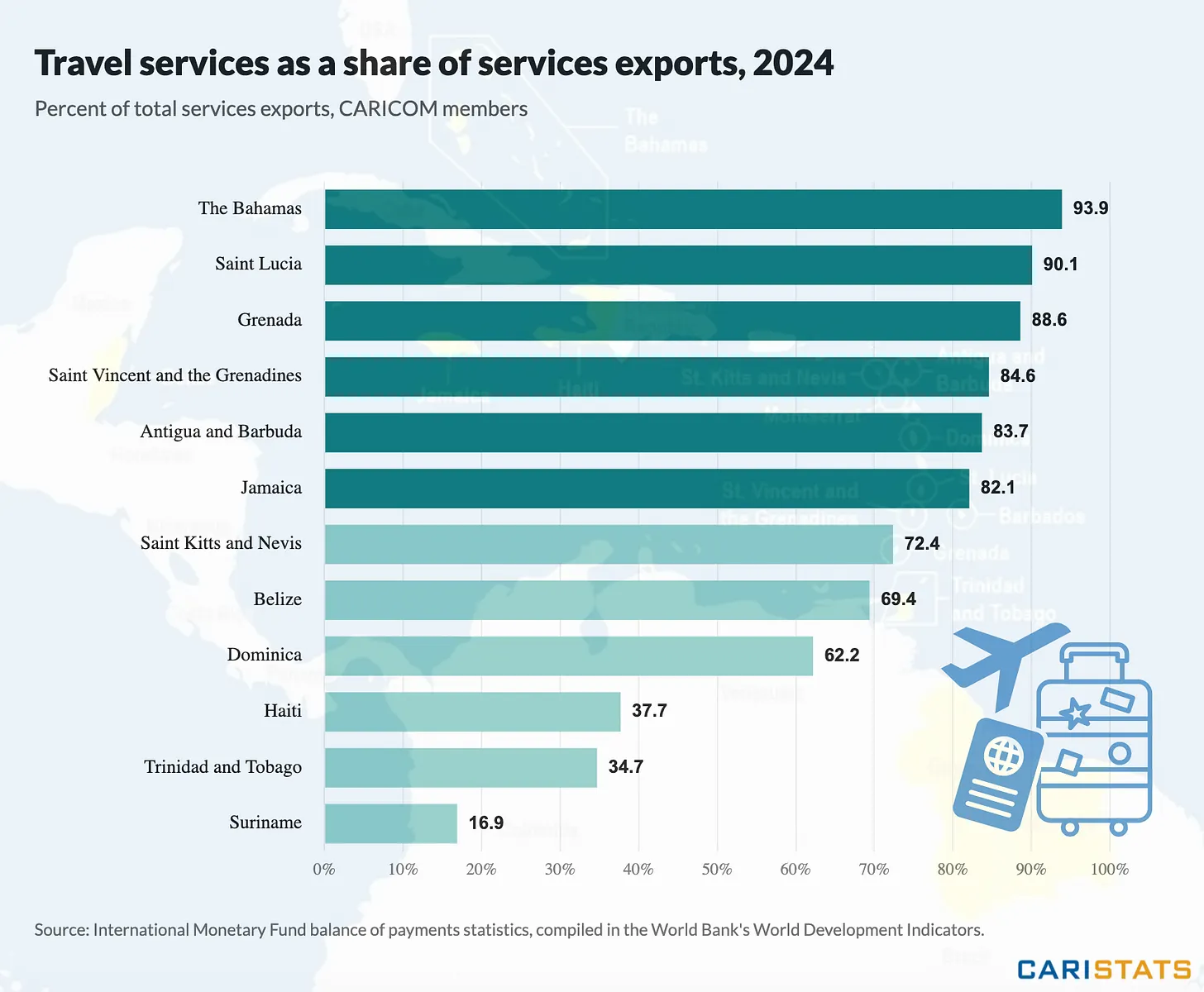
New 2024 balance of payments data from the International Monetary Fund, compiled in the World Bank’s World Development Indicators, has laid bare the extraordinary economic reliance that most Caribbean Community (CARICOM) member states place on travel service exports. Across 12 of the bloc’s 15 members that are included in the analysis, six economies see travel services — which measure all visitor spending within a nation’s borders — make up more than 80% of their total annual services exports. Topping the list is The Bahamas, where travel exports account for nearly 94% of all outbound services trade, followed closely by Saint Lucia at 90.1% and Grenada at 88.6%. Rounding out the group of highly dependent nations are Saint Vincent and the Grenadines, Antigua and Barbuda, and Jamaica, all of which crossed the 80% threshold in 2024. Behind the leaders, other CARICOM members still recorded far higher shares than most global comparators: Saint Kitts and Nevis came in at 72.4%, Belize at 69.4%, and Dominica at 62.2%. Only three of the 12 surveyed nations posted travel export shares below 40%. These outliers are Haiti at 37.7%, Trinidad and Tobago at 34.7%, and Suriname at just 16.9%. Both Trinidad and Tobago and Suriname are established resource exporters, and their economies have developed other high-value service sectors that outpace travel in export volume. Experts stress that these percentages reflect the composition of national export sectors, not the absolute scale of the travel industry. A high share of travel in total services exports simply signals that no other service categories — including finance, transportation, and business services — generate export revenue at a similar level to tourism and visitor spending. When placed in a global context, the CARICOM average is dramatically out of step with international benchmarks. The global average share of travel services in total services exports sat at 19.8% in 2024, while the broader Latin America and Caribbean regional average was 41.5%. Even among global small states, which often lean more heavily on tourism than large economies, the average travel share is just 30.9% — less than half the share recorded in six CARICOM members. The current dataset excludes three CARICOM members due to gaps in recent reporting: Barbados has not submitted updated data since 2017, Guyana’s most recent figures are from 2023, and Montserrat is not included in the current round of statistical compilation.
Tourism Accounts for Over 80% of Services Exports in 6 CARICOM Member States