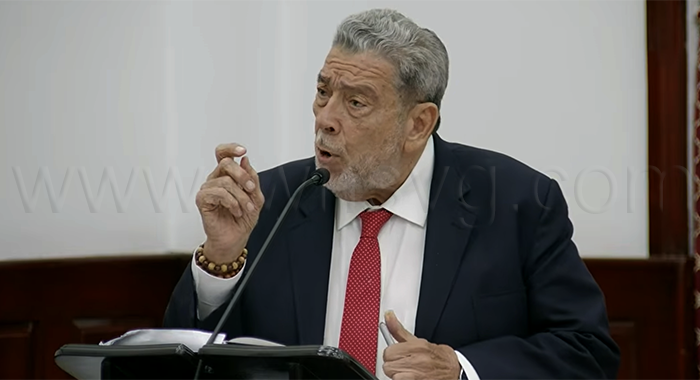
On a Tuesday parliamentary sitting, Opposition Leader Ralph Gonsalves delivered an extended, technically detailed analysis of the Daily Paid and Minor Salaried Officers (Compassionate Gratuity) Bill, 2026 — but declined to state a clear position on whether he supported or opposed the proposed legislation. Despite Parliament ultimately moving forward to pass the bill, Gonsalves warned that his unaddressed concerns over the policy would remain a persistent “running sore” for the country’s public sector.
The newly enacted law extends one-time compassionate gratuity payments to low-income, non-pensionable public sector workers when they retire or die while in active service. While government Members of Parliament and two sitting opposition senators, Carlos James and Keisal Peters, confirmed their public support for the bill, Gonsalves deliberately avoided committing to a clear yes or no stance, weaving equal parts praise and criticism through his hours-long parliamentary address without aligning with either side of the debate.
“Those who want to say whether I support or I oppose, you have heard me, and the people have heard me,” Gonsalves stated as he closed his remarks, noting that the legislation serves two core purposes: it codifies a longstanding informal practice stretching back more than 25 years, and makes targeted adjustments to that existing framework that he characterized as both positive and harmful.
Drawing on his decades of experience as a trained lawyer and former prime minister, Gonsalves framed the policy as a sui generis, one-off law crafted specifically for the underserved group of non-pensionable public workers, but emphasized that it cannot be interpreted or implemented separately from the country’s existing Protection of Employment Act and Pensions Act. He acknowledged that codifying the 25-year informal practice of granting compassionate gratuity is a positive step, and praised the legislation for removing the previous 26-year cap on reckonable service, extending the maximum eligible service period to 33 and one-third years — a change he called explicitly commendable.
“To the extent that this bill codifies existing practice … I am pleased, and to the extent that it improves in certain areas on existing practice, I’m pleased,” Gonsalves said. Still, he repeatedly pushed back on a number of provisions that he argued leave low-paid workers worse off than they should be.
One of Gonsalves’ core criticisms centers on the legislation’s payment formula. When the practice of granting compassionate gratuity first began, governments adopted the two weeks pay per year of service formula laid out in the original Protection of Employment Act. However, that legislation was updated in 2004 to introduce a more generous sliding-scale formula for severance pay: two weeks per year for workers with 2 to 10 years of service, three weeks per year for 11 to 25 years, and four weeks per year for any service exceeding 25 years. Gonsalves argued the new gratuity bill should have adopted this more worker-friendly formula as well, but instead retained a flat two weeks per year of service regardless of tenure.
Gonsalves conceded that it is fair to point out his own administration, which was voted out of office in November after 25 consecutive years leading the government, never made this adjustment during his time in office. Even so, he insisted that now that Parliament has chosen to formalize the longstanding practice in legislation, it has a responsibility to “do better” for the low-income workers the bill is designed to support.
The Opposition Leader also raised objections to the bill’s seven-year minimum service requirement for gratuity eligibility. He noted the threshold appears to be copied directly from the Pensions Act, which sets similar requirements for pensionable public workers, but argued the rule is poorly suited to non-pensionable employees, who lack the job security that pensionable workers enjoy and can be dismissed far more easily by supervisors.
Another major point of contention is Clause 9(2) of the bill, which grants the responsible minister discretionary power to reduce or fully withhold a worker’s gratuity if the minister finds the worker guilty of negligence, work irregularity, or misconduct. Gonsalves distinguished this problematic provision from Clause 9(1), which clarifies that the bill does not create an absolute legal right to gratuity and preserves existing powers to dismiss workers without compensation — language he called standard, aligned with Section 5 of the Pensions Act, and acceptable.
By contrast, he argued Clause 9(2) transplants a misconduct provision designed for pensionable workers into a completely different employment context where it serves no just purpose. Pensionable public workers have strong job protections, and dismissal requires lengthy, complex procedural steps, so reducing pensions as a disciplinary consequence makes sense in that framework. For non-pensionable workers, however, supervisors already have the authority to dismiss workers with basic notice or payment in lieu of notice, making the discretionary ministerial power “wholly unnecessary” that should be removed from the law entirely.
Gonsalves also expanded on concerns already raised by the two opposition senators who support the bill, backing their call for the legislation to outline a clear, low-cost administrative appeal process for workers who disagree with gratuity decisions, rather than forcing workers to pursue costly, time-consuming civil court claims. He additionally proposed that similar gratuity protections should be extended to non-pensionable workers employed by statutory bodies and public enterprises, a change that could be implemented by adding appropriate cross-reference language to the new law.
Toward the end of his address, Gonsalves connected the debate over the gratuity bill to broader conversations about public sector pension reform, warning that the long-term fiscal sustainability of the country’s overall public pension system is at risk. He noted that some currently eligible public workers can receive combined pension payments from the National Insurance Scheme and the state that add up to as much as 116% of their final working salary.