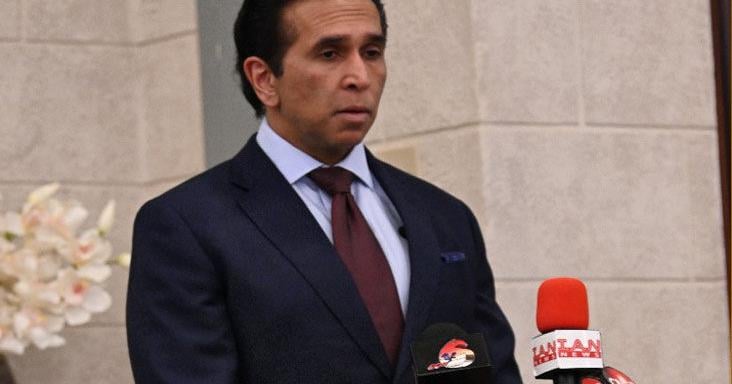
In a significant development in a high-profile national security case in Trinidad and Tobago, businessman Dominic Hadeed and his wife Genevieve have regained full, unrestricted liberty after Homeland Security Minister Roger Alexander revoked their Preventive Detention Orders (PDOs) earlier this week. Senior Counsel Faris Al-Rawi, the couple’s lead legal representative, confirmed the revocation to reporters at Port of Spain’s Altus Court Wednesday evening, clarifying that the order is fully void with no residual conditions attached.
Al-Rawi emphasized that the revocation erases the detention order from legal standing entirely. “The revocation of a preventive detention order is as good as it never existed,” he stated. “It is a complete return to liberty. There are no conditions attached to that. This is not home detention.” He added that a full revocation inherently invalidates the original grounds for detention, noting that the state would not have reversed the order if the justifications for detainment still held.
Minister Alexander announced the decision earlier in the day, explaining that he made the call after a comprehensive review of the legal, medical, and constitutional considerations tied to the couple’s detainment. Alexander concluded that continuing to hold the Hadeeds during the ongoing police investigation was no longer proportionate under the law.
The couple was first arrested by the Trinidad and Tobago Police Service on June 24, as part of a wide-ranging probe into an alleged plot to assassinate Prime Minister Kamla Persad-Bissessar and other senior members of her government. Three days later, on June 27, PDOs were issued against them under the 2026 Emergency Powers Regulations, enacted during the current national state of emergency. A third suspect, Star Sabga, who was detained alongside the couple, remains in custody, with a court hearing scheduled for Thursday to challenge her continued detention. Al-Rawi noted that Sabga, an elderly woman, has been separated from her family for an extended period and has felt the significant toll of her detainment, but declined to comment further on her case.
While the Hadeeds have now regained full freedom, Al-Rawi stressed that the broader criminal investigation into the alleged assassination plot remains active, and multiple ongoing legal proceedings tied to the case are still pending before national and international courts. The constitutional and judicial review challenges that the legal team filed on the couple’s behalf remain active. Additionally, the state has not withdrawn its appeal to the Privy Council, challenging a prior Court of Appeal ruling that granted the couple conditional release. That appeal is scheduled to be heard in October.
Al-Rawi framed the earlier Court of Appeal ruling as a landmark moment for judicial oversight of emergency measures. The court, led by Justice of Appeal Peter Rajkumar, established that courts retain supervisory jurisdiction over PDOs issued during a state of emergency — upending a long-held assumption that citizens could not challenge detainment through the courts once a state of emergency was declared. “The courts have recognised and we endorse the propriety that the State is subject to the supervisory jurisdiction of the court,” Al-Rawi said.
The upcoming appeal hearing before the Privy Council will address a core legal question: what constitutes sufficient objective grounds to issue a PDO. While these orders are often based on sensitive intelligence protected by public interest immunity, Al-Rawi argued that there must still be verifiable, objective evidence to justify depriving a citizen of their liberty. The ruling in this case will set a precedent that extends far beyond the Hadeeds, affecting any future individual subject to a preventive detention order in Trinidad and Tobago. Al-Rawi noted that even though the PDOs have now been revoked, the appeal remains relevant, as its outcome will clarify legal standards for future cases across the country.
Addressing recent reports surrounding Dominic Hadeed’s health during detention, Al-Rawi clarified that the claim Hadeed refused offered medical treatment is inaccurate. “Mr Hadeed never refused medical treatment offered by the State. Mr Hadeed received no medical treatment from the State,” he explained. The confusion arose when the government proposed that Hadeed’s neurological condition be assessed by a neurosurgeon, a recommendation the legal team declined after consultation with medical experts. “The person who was recommended by the State was not qualified to do the job,” Al-Rawi said, adding that he does not believe the recommendation was made with malicious intent, but simply represented a misjudgment of the required specialist qualifications. Al-Rawi declined to discuss Hadeed’s specific medical condition further, framing it as a private matter that was only brought before the court to uphold the state’s legal obligations to detainees, and declined to speculate on whether Hadeed’s health influenced Minister Alexander’s decision to revoke the PDOs.
When asked whether the couple plans to pursue damages or additional legal action against the state, Al-Rawi said no decisions have been made, and no conversations about seeking compensation have taken place at this stage. He confirmed that the existing judicial review proceedings remain active, but said the couple’s primary goal is clear: “They wish to clear their names, move on with their lives. They are not against any government in Trinidad and Tobago…and we will let the courts work this out.”