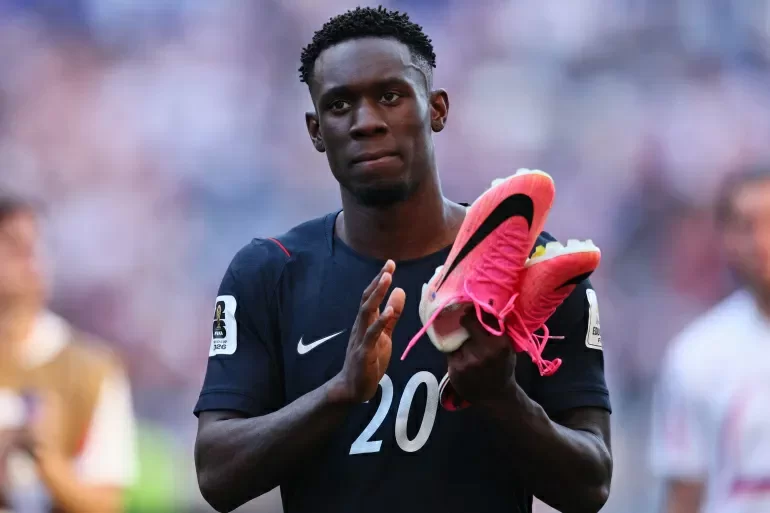
A growing controversy over political interference in World Cup rule enforcement is rocking global football, after the Norwegian Football Federation (NFF) confirmed plans to submit a formal ethics complaint to FIFA over the governing body’s decision to overturn a mandatory suspension for United States forward Folarin Balogun. NFF President Lise Klaveness says the unprecedented reversal, which came after direct lobbying from U.S. President Donald Trump, threatens the fundamental integrity of the sport and cannot be swept under the rug.
The dispute traces back to Balogun’s red card during the United States’ World Cup round-of-16 match against Bosnia and Herzegovina. Under standard FIFA competition rules, a straight red card carries an automatic one-match suspension, which would have forced Balogun to miss the U.S.’s subsequent quarter-final clash against Belgium. That suspension was scrapped entirely by FIFA following direct personal outreach from Trump to FIFA President Gianni Infantino, who pushed for the ruling to be revised because the U.S. leader claimed Balogun had not committed a foul deserving of ejection.
Klaveness, who secured the NFF presidency in 2022, argued that bending football’s core rules to accommodate the demands of a sitting head of state sets a dangerous precedent for the entire sport. “When you bend rules like this, you start down a slippery slope that puts the entire game at risk,” she told reporters, adding that the NFF’s governing board is fully behind the formal complaint to FIFA’s Ethics Committee. She also criticized the process behind the reversal: the decision was made by a single member of FIFA’s disciplinary committee without full consultation from the entire panel, at a time when an extremely powerful external voice was pressing for a specific outcome. Klaveness noted that avoiding this kind of concentrated, unvetted decision-making is critical when high-stakes controversy is already involved, calling the lack of collective input a fundamental error.
Norway is far from alone in its condemnation of FIFA’s action. European football governing body UEFA has labeled the reversal of Balogun’s suspension “unprecedented and incomprehensible,” warning that it directly undermines the integrity of the entire World Cup tournament. The Royal Belgian Football Association (KBVB) has already filed its own appeal against FIFA’s ruling, and has publicly expressed disappointment over the total lack of transparency in how the decision was reached.
Trump has publicly confirmed he reached out to Infantino to request a review of the red card, doubling down on his claim that the call against Balogun was incorrect. This is not the first time the NFF has clashed with FIFA over ties to Trump: the federation previously criticized FIFA’s decision to award its inaugural Peace Prize to the U.S. president, a move that drew widespread global pushback from the football community.
Klaveness emphasized that the issue cannot be dismissed out of hand, as coaches, players and fans around the world have already recognized that this kind of external interference strikes too close to the core of fair competition. “It is a threat to the game when fundamental rules of play are compromised,” she said. “Trying to sweep this under the rug will not work. We need open, honest communication and recognition that this ruling was shaped by external influence without following proper procedural process.”
Beyond the Balogun controversy, Klaveness also used the moment to criticize a recent proposal from South American football confederations to expand the World Cup from its current 48-team format to 64 teams. Norway, which returned to the World Cup for the first time in 28 years this edition and reached the quarter-finals before falling to England, has demonstrated that smaller federations can compete successfully under the 48-team structure, Klaveness said. Expanding to 64 teams so soon is neither reasonable nor in the best interest of global football, she argued, noting that opening debates about further expansion now, when pushed by powerful interests, will only create widespread distrust across the sport. Klaveness added that the World Cup should not place additional strain on domestic football leagues and continental confederations beyond the burden they already carry for the current tournament format.
Norway’s 2026 World Cup run is widely viewed as a successful comeback for the nation’s men’s national team, despite their quarter-final exit at the hands of England.