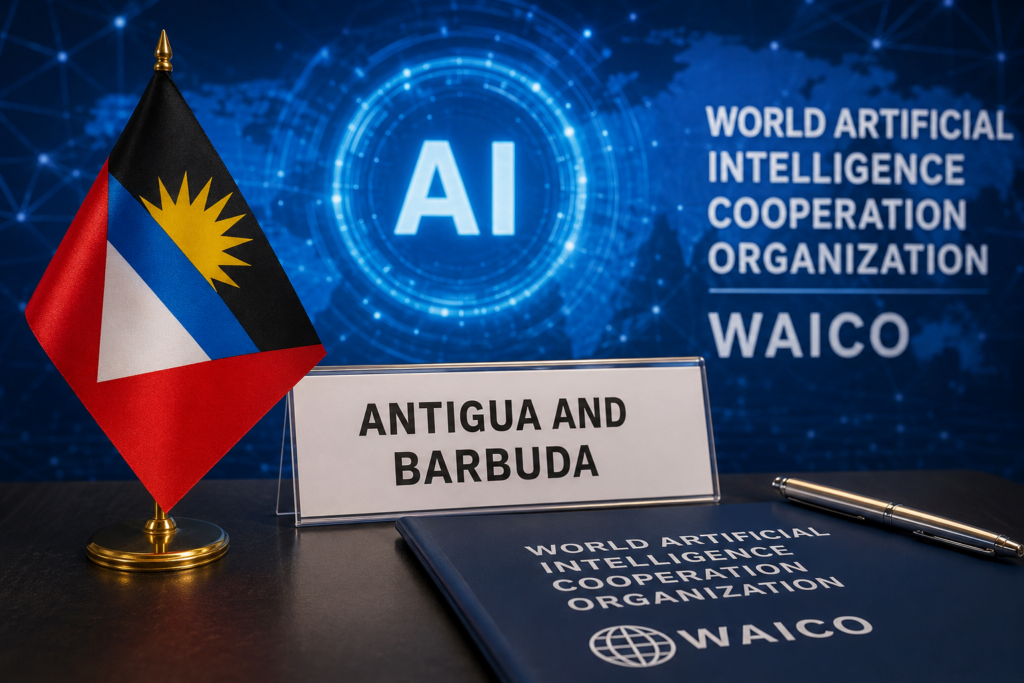
Against a backdrop of growing global debate over how to manage the rapid advancement of artificial intelligence, the small island developing nation of Antigua and Barbuda has publicly praised the signing of a historic international accord that establishes the World Artificial Intelligence Cooperation Organization (WAICO), framing the agreement as a critical leap forward in building a more unified, inclusive framework for global AI governance.
The landmark signing ceremony took place in Shanghai, China, alongside the 2026 World AI Conference and High-Level Meeting on Global AI Governance, a gathering that brought together senior government representatives, leading technology industry figures, and heads of major international organizations to align on strategies for cross-border collaboration on emerging AI technologies. Representing Antigua and Barbuda at the event was Andrea Jacobs, the country’s National AI Focal Point and Crown Counsel, who delivered the nation’s official stance on responsible AI development and global cooperation.
In her address, Jacobs outlined that Antigua and Barbuda stands firmly behind WAICO’s core structure, which is anchored to the United Nations Charter and prioritizes a human-centered approach to AI innovation and regulation. For developing economies like hers, open, collaborative multilateral platforms such as WAICO are not just advantageous—they are essential, she explained, to ensure small nations can play an active role in shaping the trajectory of AI, rather than being forced to adapt to systems designed without their input.
Jacobs shared that Antigua and Barbuda has already taken initial steps to build a foundation for responsible AI adoption at home, including completing UNESCO’s AI Readiness Assessment and launching collaborative research initiatives with the University of the West Indies. Even with these domestic efforts underway, she stressed that no single country, particularly a small developing state, can tackle the complex cross-border challenges posed by accelerating AI progress on its own. “We need meaningful international partnerships,” Jacobs stated, reaffirming Antigua and Barbuda’s backing for a UN-led global AI governance process and a multilateral, science-driven regulatory framework.
The nation also expressed support for the preliminary report released by the UN Independent International Scientific Panel on AI, noting that the panel’s evidence-based analysis gives member states a solid foundation to build effective national AI safeguards while contributing to the development of globally accepted standards.
Jacobs issued a stark warning about the risks of a fragmented global AI ecosystem: without a cohesive global governance system, smaller, more vulnerable nations face major threats including digital exclusion, systemic algorithmic bias, and unregulated access to AI technologies that they lack the institutional and technical capacity to manage safely. For small island developing states, she emphasized, effective AI governance is far more than a procedural bureaucratic task—it is a critical economic and strategic priority that shapes long-term national resilience.
AI carries transformative potential for Caribbean nations like Antigua and Barbuda, Jacobs explained, noting the technology can boost disaster preparedness, streamline public administration, expand equitable access to healthcare, and strengthen climate resilience—all priorities for a region on the front lines of climate change and rising sea levels. But these transformative benefits will remain out of reach for most developing countries if the global AI landscape continues to be divided along unequal lines, she cautioned.
The 2026 Shanghai conference marked a key milestone in global talks, uniting diverse stakeholders to chart a shared path forward for AI governance that accommodates the needs and priorities of all nations, from the largest economies to the smallest developing states.