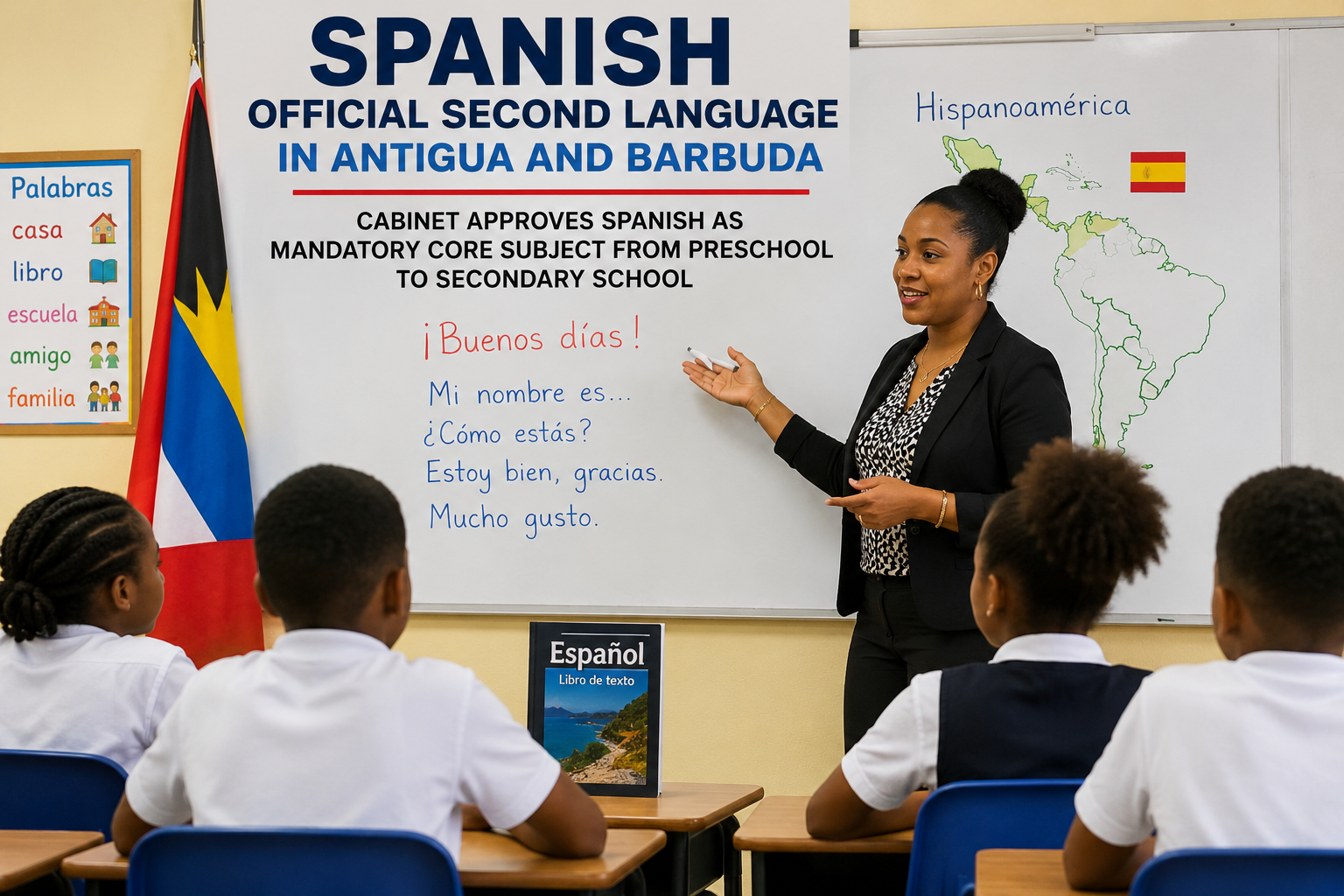
The Caribbean nation of Antigua and Barbuda is advancing a bold proposal to expand Spanish language education across all its primary and secondary schools, a plan that will require the recruitment of up to 20 additional qualified Spanish teachers over the coming years. The staffing requirement is a core component of the Education Sector Implementation Plan covering 2026 to 2030, a comprehensive policy document that Education Minister Daryll Matthew officially presented to the national Cabinet for review this Wednesday.
Speaking at a post-Cabinet media briefing the following day, Director General of Communications Maurice Merchant shared that preliminary demographic and program planning estimates point to a need for between 18 and 20 new teaching staff to fully launch and sustain the expanded initiative. To formalize this demand, the plan explicitly recommends the development of a targeted national staffing strategy that will outline recruitment pathways, qualification requirements, and employment terms for the incoming educators.
Unlike a new introduction of Spanish to national schools, the initiative aims to build on an existing foundation: Spanish is already included as part of Antigua and Barbuda’s standard K-12 curriculum. The policy overhaul seeks to strengthen inconsistent existing instruction, standardize learning outcomes across all institutions, and build what government officials describe as a cohesive, equitable, and sustainable national Spanish education framework. A key priority of the plan is aligning local Spanish learning benchmarks with globally recognized language proficiency standards, ensuring that students graduate with skills that are validated and recognized internationally.
The proposal addresses concerns about the status of other foreign language offerings, clarifying that French will retain its place as a core component of the country’s National Modern Language Programme. The plan’s explicit language reaffirms a commitment to expanding Spanish education while simultaneously preserving and protecting French language instruction for students who choose to study it.
To support successful implementation, the Ministry of Education is also planning to pursue targeted technical assistance from international partners including Spain, the Dominican Republic, and other global language education stakeholders. This planned collaboration will focus on three key areas: ongoing professional development for current and new Spanish teachers, refinement of the national curriculum to meet updated standards, and logistical support for rolling out the programme across all schools over the multi-year timeline.
The expansion is set to roll out gradually over a three-year period, with the speed of rollout adjusted to match individual schools’ readiness to adopt the new framework and the progression of student cohorts through the education system. As of Thursday, Cabinet has initiated its review of the policy brief but has not yet announced a final decision on approval.