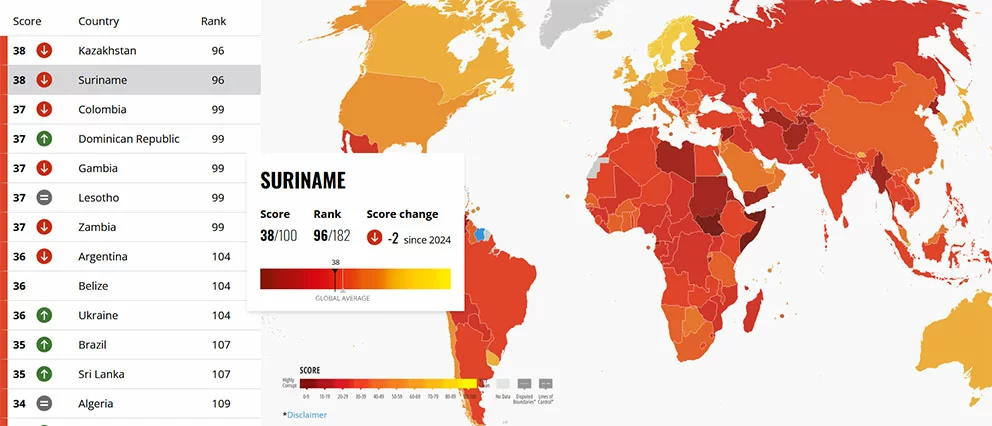
On Tuesday, during a national Anti-Corruption Congress held in Paramaribo, the president of Suriname’s High Court, Iwan Rasoelbaks, delivered a stark warning about the far-reaching damage systemic corruption inflicts on the South American nation, outlining sweeping changes needed to effectively combat the growing crisis.
Rasoelbaks emphasized that corruption is not merely a threat to Suriname’s rule of law—it erodes the country’s economic potential, fuels rising criminal activity, and destroys public and investor confidence in state institutions. In his opening address, the court president laid out the cascading harms of unchecked graft: it creates unfair, unequal distribution of national wealth, traps communities in long-term underdevelopment, pushes up rates of organized and street crime, and steadily erodes public trust in government. When a nation’s commitment to institutional integrity declines, he added, international investors and global development organizations also grow increasingly hesitant to commit capital or long-term partnerships to the country.
To contextualize Suriname’s current standing, Rasoelbaks pointed to leading global governance rankings, including Transparency International’s annual Corruption Perceptions Index and the World Justice Project’s Rule of Law Index. Both metrics, he noted, make clear that Suriname still must take substantial, meaningful action to strengthen its rule of law frameworks and mount more effective anti-corruption campaigns. As a model for successful reform, he pointed to Singapore, which has built its reputation as one of the world’s least corrupt nations through targeted investments in strong independent institutions, radical government transparency, and specialized anti-corruption enforcement frameworks.
A core pillar of Rasoelbaks’ argument centered on the need for a fundamentally new approach to corruption investigations, one that diverges sharply from the methods used in traditional criminal cases. Unlike standard criminal probes, which typically rely on witness testimony, forensic evidence, or in-the-act arrests, corruption investigations almost always begin with a different set of indicators: suspicious financial flows, anomalous banking transactions, complex offshore tax structures, and unexplained sudden growth in personal or corporate assets. This fundamental difference in how corruption occurs and is uncovered, he argued, requires an entirely new investigative mindset and operational framework.
That shift, Rasoelbaks explained, requires police, public prosecution services, and all other law enforcement agencies to update their technical skills and core working practices. Financial investigation, detailed analysis of corporate accounting records and financial reports, tracking of digital transaction trails, and untangling complex cross-border asset structures are now core, non-negotiable skills for anti-corruption work. “On each of these points, corruption investigations differ fundamentally from traditional criminal investigations,” Rasoelbaks told attendees at the congress.
In closing, the High Court president stressed that countries that have successfully curbed corruption do not rely solely on stricter anti-graft legislation. Instead, they prioritize building strong independent institutions, investing in specialized investigative training, embedding transparency across all levels of government, expanding international cooperation on cross-border graft cases, and entrenching principles of good governance. For Suriname to rebuild trust among its citizens, attract much-needed foreign investment, strengthen partnerships with global bodies, and unlock long-term sustainable economic development, Rasoelbaks said, the nation must follow this same path of reform.