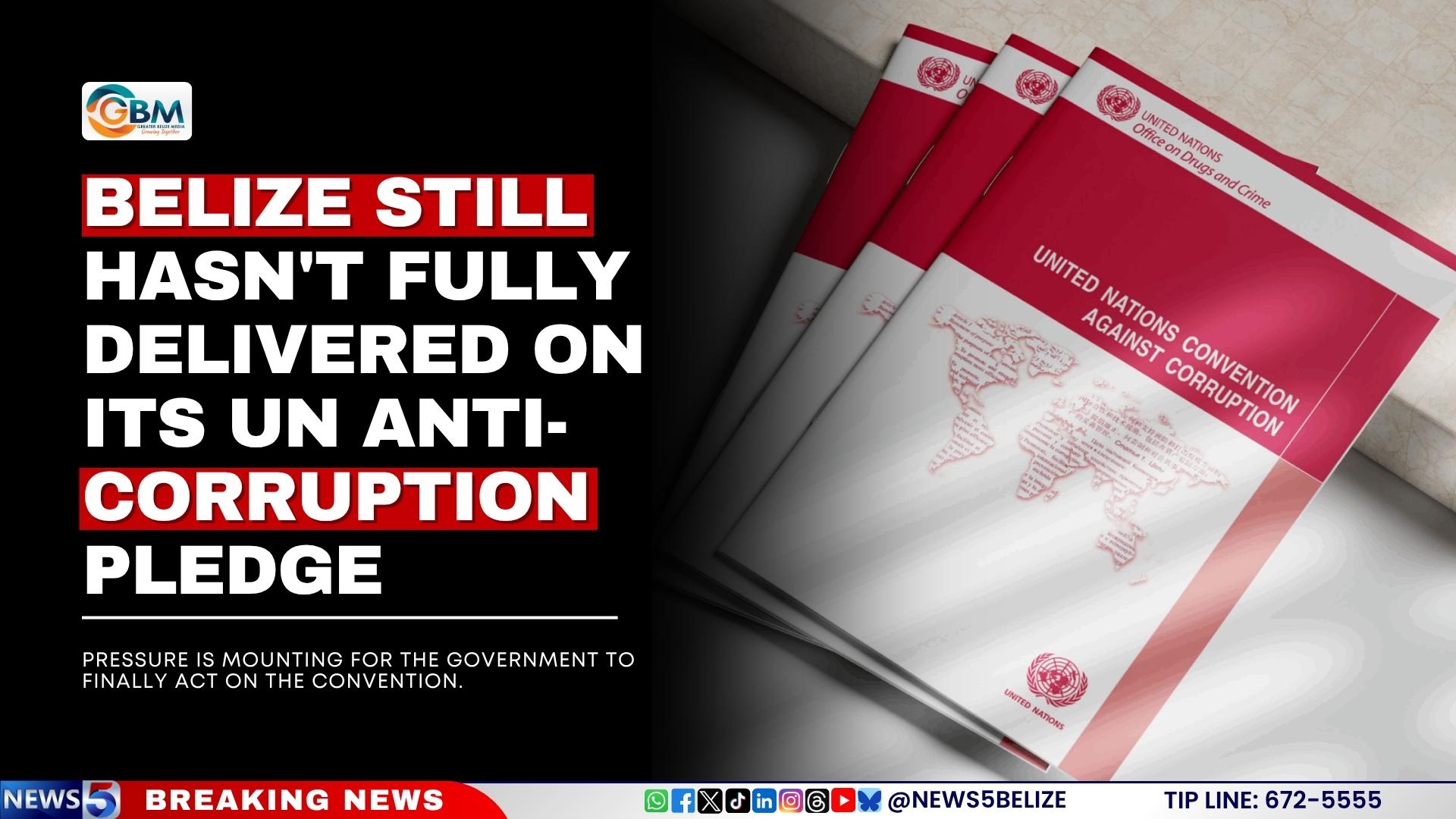
Nearly 10 years after Belize signed onto the United Nations Convention Against Corruption (UNCAC), the small Central American nation remains far from meeting its international anti-corruption pledge, as ongoing high-profile corruption scandals fuel public frustration and mounting pressure for urgent action.
Corruption has long been a persistent challenge for Belize’s public institutions, with no comprehensive, functional system in place to prevent graft, investigate violations, and hold wrongdoers accountable. Fresh public anger over two ongoing controversies – the Mira Millions scandal and unresolved questions about irregular procurement practices within the Ministry of Defence – has refocused national attention on the 2016 commitment Belize made to fully implement UNCAC, the world’s only legally binding global anti-corruption agreement.
UNCAC provides a universal, structured framework for nations to build transparent governance, enforce public accountability, and safeguard state resources from misappropriation. While Belize formally joined the pact a decade ago, translating its requirements into domestic practice has hit repeated barriers: gaps in national legislation, severely limited technical capacity among government agencies, and the significant financial costs associated with sweeping systemic reform.
The United Nations frames UNCAC as a complete “toolkit” for combating systemic corruption. UN Secretary-General António Guterres has repeatedly emphasized that corruption undermines the foundation of fair, functional societies: when public servants across all sectors – from frontline healthcare workers and police officers to senior elected politicians – prioritize personal gain over public duty, critical funding earmarked for schools, hospitals, and core infrastructure is siphoned away, worsening inequality and eroding public trust in government.
Cesar Ross, director of Belize’s Good Governance unit, the government body tasked with shepherding UNCAC implementation, confirmed that full adoption remains incomplete after 10 years. Ross identified two core obstacles blocking progress: limited government funding for reform efforts, and a chronic shortage of technical capacity across relevant agencies. Legislative drafters and Crown counsels, who are responsible for drafting the new laws required to align domestic policy with UNCAC standards, are already stretched thin by existing workloads, he explained. While bringing in external expert consultants would accelerate the drafting process, the associated costs remain a major sticking point for cash-strapped government leaders.
Despite these setbacks, Ross stressed that implementation work has not come to a standstill. Among the most advanced ongoing reforms is a draft whistleblower protection bill, inspired in part by the leaked Smart Stream invoices that exposed potential wrongdoing in recent public contracting. The proposed legislation would mandate that all corruption complaints receive formal review, and create a clear escalation process for reports that public agencies attempt to dismiss out of hand.
However, Ross made clear that passing new legislation is only the first step, not the end goal. True success, he argued, will only be achieved when these new laws are consistently enforced, and tangible results are delivered – including meaningful legal consequences for corrupt public officials. Ross has previously documented the massive scale of annual losses Belize suffers from corruption, noting that billions in public funds are lost to graft every year in public contracting and procurement alone.
Opposition figures have grown increasingly vocal in their criticism of the government’s slow progress. At a recent protest organized by the United Democratic Party (UDP), aspiring councillor Phillip Willoughby stated bluntly that full implementation of UNCAC is the only measure that can meaningfully curb systemic corruption in Belize, arguing that the nation cannot afford to delay action any longer.
While Ross acknowledged that full implementation of UNCAC could still be years away, he reaffirmed that the reform process is still advancing, with ongoing work to close the legislative and institutional gaps that have allowed corruption to flourish in Belize.