On July 16, 2026, Antigua and Barbuda’s National Parks Authority (NPA) hosted a landmark anniversary ceremony to mark a decade since the Antigua Naval Dockyard and Related Archaeological Sites earned a place on the United Nations Educational, Scientific and Cultural Organization (UNESCO) World Heritage List. The occasion, themed “A Decade Celebrating Centuries”, also capped a year of historic milestones for the NPA, following the authority’s 40th founding anniversary in December 2024 and ahead of the dockyard’s 300th founding anniversary in September 2025, weaving together 300 years of layered Caribbean history into a single moment of recognition.
First inscribed at the 40th session of the UNESCO World Heritage Committee held in Istanbul, Turkey on July 16, 2016, the site stands today as one of the most culturally significant landscapes across the Caribbean. Originally established by the British Royal Navy in 1725, the Antigua Naval Dockyard is a rare surviving example of Georgian naval infrastructure adapted to the Caribbean’s tropical climate. For nearly 200 years, it functioned as a key hub of British maritime power in the region, a legacy that cannot be separated from the labor, craftsmanship, and resilience of both free and enslaved African people who constructed the site. After the Royal Navy withdrew from the dockyard in 1899, local conservation efforts led by the Friends of English Harbour and the growth of the Caribbean yachting industry breathed new life into the historic space. In 1984, the Antiguan government formalized protection of the area, establishing Nelson’s Dockyard National Park under the newly created National Parks Authority. Today, the NPA safeguards more than 16 square miles of interconnected land and marine territory stretching from Mamora Bay to Carlisle Bay, where cultural heritage, recreational yachting, and local community life continue to thrive side by side.
Over the 42 years since its founding, the NPA has evolved into one of the Caribbean’s leading heritage conservation and management institutions. High-profile restoration projects at landmark sites including Clarence House and the Blockhouse Military Complex, completed by skilled local craftspeople, have demonstrated the authority’s core belief that heritage conservation acts as a powerful catalyst for inclusive socio-economic growth. Beyond restoration, the NPA has expanded its stewardship to address pressing modern challenges, integrating climate change adaptation, disaster risk reduction, and sustainable development planning into its core work. It also prioritizes community-centered programming, such as the 8th of March Project, which centers local voices in the site’s public historical narrative.
The anniversary ceremony opened with welcoming remarks from Senate President Alincia Williams-Grant, who framed the UNESCO inscription as the realization of a generations-long collective vision. She emphasized that the celebration was first and foremost a tribute to the people who have safeguarded the site through decades of restoration work, academic research, public education, volunteer service, and community stewardship, reminding attendees that cultural heritage is ultimately a story of national identity, collective memory, belonging, and intergenerational legacy.
Antigua and Barbuda’s Governor General, His Excellency Sir Rodney Williams, reflected on the dockyard’s historical significance as a hub of shipbuilding, naval strategy, and innovative engineering that was constructed in harmony with the region’s natural landscape. He urged attendees to confront the full, unvarnished truth of the site’s history, stressing that the dockyard was built through the labor, skill, and immeasurable sacrifice of countless free and enslaved African people, whose stories deserve to be honored with full dignity and respect.
E. P. Chet Greene, the cabinet minister with oversight of the National Parks Authority, reaffirmed the Antiguan and Barbudan government’s ongoing commitment to protecting the site’s unique cultural landscape through robust policy and legislative frameworks. Referring to the dockyard as “the people’s place”, Greene pledged the government would continue prioritizing the preservation of the nation’s rich African heritage, and work to ensure younger generations understand, embrace, and value the cultural legacy that shapes their country.
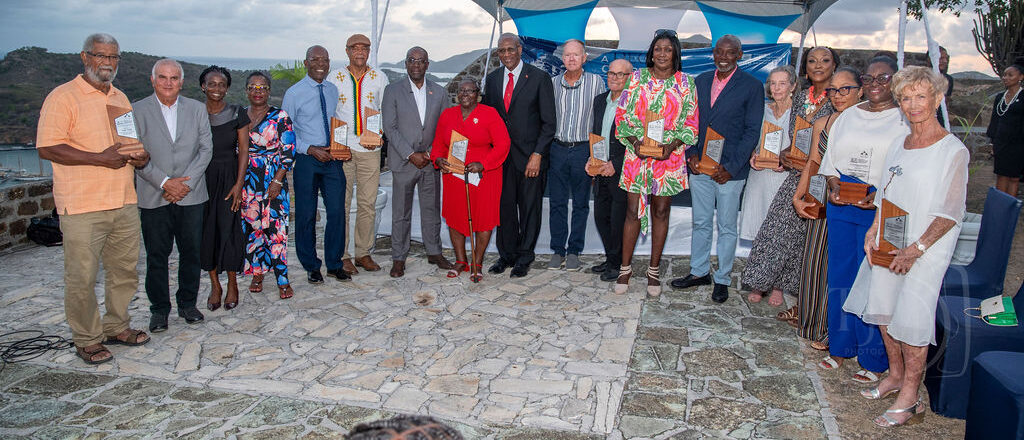
A centerpiece of the event came when NPA Chairman Senator Philip Shoul and Minister Greene jointly unveiled a new commemorative plaque, formally recognizing the site’s designation as a place of Outstanding Universal Value: an exceptional example of an 18th and 19th century British naval establishment and a uniquely living cultural landscape. Following the plaque unveiling, the NPA honored 12 long-time community stalwarts whose decades of dedicated service have been instrumental to the site’s ongoing success. The honorees included Franklyn Braithwaite MBE, GOH, OLY; Jean Weste; Paul Deeth; Elizabeth Jordan; Althea Joseph; Karl James MBE; Jennifer Byerley Bentley; Capewell William Greene II; Louise Edwards; Marinus Smith; Leslie Roberts; and the Shirley Heights Lookout community group.
NPA Parks Commissioner Ann Marie Martin noted that the national park has grown far beyond a static monument to the past. “It is a living heritage landscape where history, culture, nature, commerce, and community coexist,” Martin explained. “It remains an engine of sustainable tourism, a centre for research and education, and a source of national pride and identity.”
As the nation marked 10 years of global UNESCO recognition, the milestone serves dual purpose: it celebrates decades of collective achievement, and renews the NPA’s commitment to stewarding the site for future generations. The Antigua Naval Dockyard and Related Archaeological Sites belong first to the people of Antigua and Barbuda, and through its World Heritage inscription, to the entire world. The National Parks Authority remains steadfast in its mission to protect, preserve, and promote this extraordinary legacy for all generations to come.