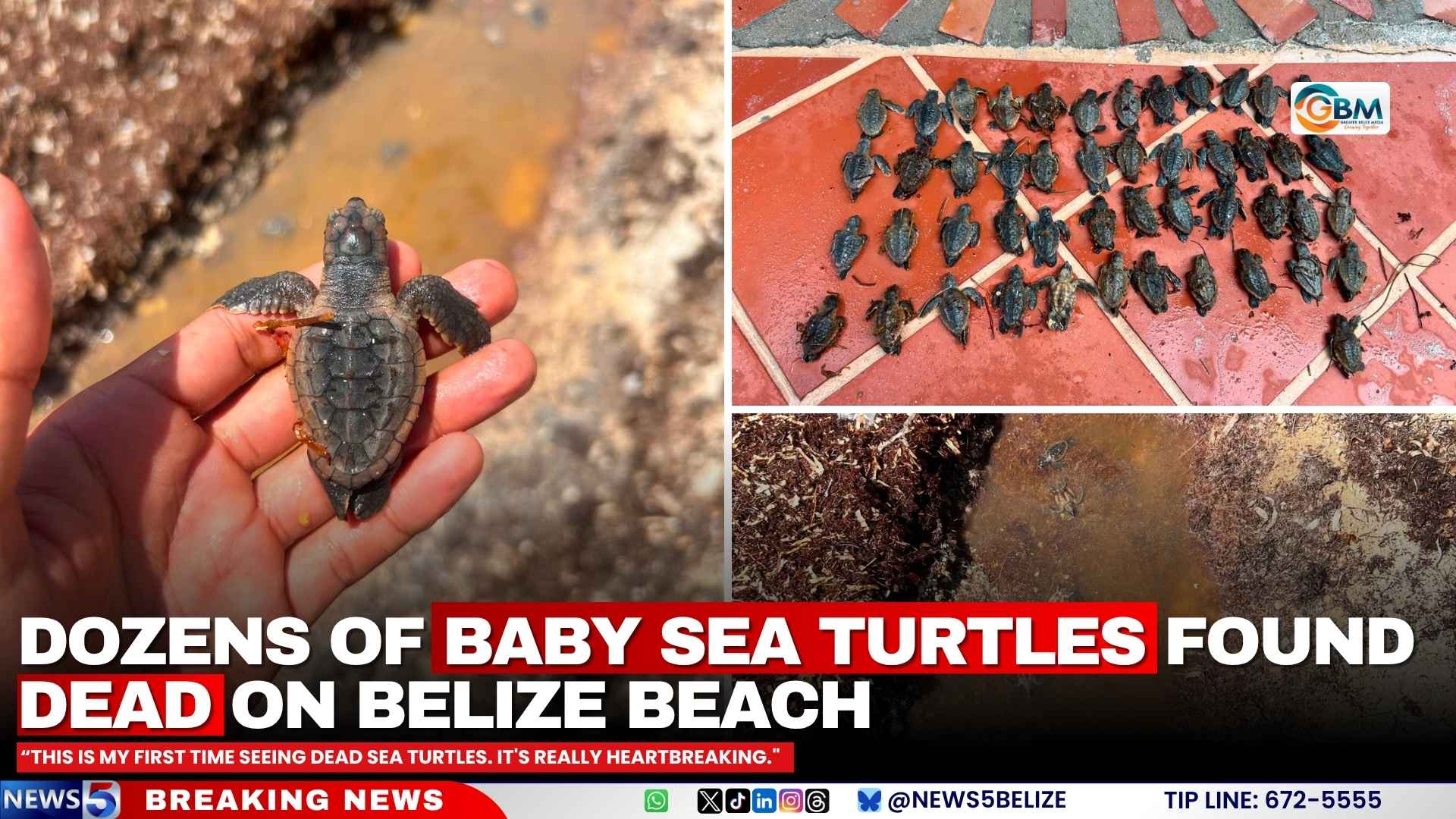
On a quiet private stretch of shoreline on Belize’s Ambergris Caye, a devastating discovery earlier this month has thrown a harsh spotlight on the escalating sargassum seaweed crisis threatening Caribbean coastal ecosystems. At least 52 dead loggerhead sea turtle hatchlings, all from what appears to be a single complete nest that never reached the ocean, were found trapped in thick mats of rotting seaweed, triggering urgent calls for government intervention to address the growing environmental disaster.
The grim find was made early one morning by Joshua Seguro, a part-time property worker who has been spending summers on this stretch of coast for more than 15 years. As he made his routine walk along the shore, he immediately recognized the small creatures as loggerheads – a globally threatened species of sea turtle – and realized none were still alive. Following protocol, he first notified the property’s owners before reaching out to the Belize Fisheries Department, which coordinated next steps with the Belize Sea Turtle Network.
Fisheries officer Alicia Eck guided the local team remotely, instructing them not to disturb the protected wildlife and to conduct a full count to establish the scale of the die-off. By the time the count was completed, the group had documented 52 dead hatchlings, confirming the entire nest had perished before reaching open water. For local observers, the cause of death is unambiguous: the overwhelming blanket of decomposing sargassum that has choked Belize’s shorelines in recent years.
Property co-owner Maria Sussman recalled that her family initially thought the hatchlings were alive when Seguro first brought the news. Excited to share the experience with their 5-year-old daughter, the whole group rushed to the beach, only to find more and more small bodies tangled in the thick seaweed as they walked along the pier. The team searched for the original nest in the hope of rescuing any remaining unhatched turtles, but could not locate it – it is believed to be buried deep beneath the pier, trapped under layers of accumulated sargassum.
Seguro, who remembers watching healthy turtle hatchlings make their way to the ocean as a child, says this mass die-off is the starkest marker yet of how dramatically the coastal ecosystem has declined. He notes that successful turtle hatchings have become extremely rare in the area, with his last live sighting of a hatchling roughly a decade ago – that individual was also trapped in sargassum, but was rescued and released successfully. “We’ve never seen anything like this. Especially dead. This is my first time seeing dead sea turtles. It’s really heartbreaking,” he said.
Crucially, this mass mortality event is not an isolated incident. Seguro says a similar discovery of dead hatchlings was made just 300 feet along the same coastline, raising alarming questions about the true scale of turtle deaths across Belize’s entire 200-plus miles of coast. “Now imagine the entire coastline of Belize. How many turtles are dying every single day?” he asked.
Property co-owner Scott Sussman has called the deaths an unacknowledged tragedy, warning that uncounted thousands of turtles could be dying every month during hatching season without any formal documentation. He is pushing the Belizean government to take immediate, large-scale action to manage the sargassum crisis, pointing to successful mitigation efforts in neighboring Mexico as a model. Sussman noted that the government recently received $25 million in earmarked funds to address the sargassum problem, arguing that targeted investment in clearing and management would not only protect vulnerable marine species but also preserve Belize’s critical tourism industry.
Today, Sussman says the sargassum accumulation on his beach is so thick that the shore cannot be traversed without hiring labor to clear a path, and the problem grows worse with every passing month. Beyond turtles, the sargassum bloom is damaging the entire coastal ecosystem: during a recent boat trip just five miles north of the property, Sussman encountered water thick with discoloration and reeking of decomposition, with hundreds of seabirds feeding on dead fish. Long-time residents report that once-common species including porpoises and abundant lobster populations have vanished from the area, replaced by 150 feet of murky brown water choked with rotting seaweed.
Roberta Schulte, Sussman’s mother-in-law, added that the mass die-off of loggerhead hatchlings raises broader concerns about species preservation and economic risk. “You’re talking about the preservation of a species, and you don’t know what other species are being impacted,” she said. “People come to Belize for the sea, and to see what is being allowed to happen is really disappointing and possibly a deterrent for tourism.” Without urgent government intervention, locals warn, the damage to Belize’s marine ecosystems could become irreversible.