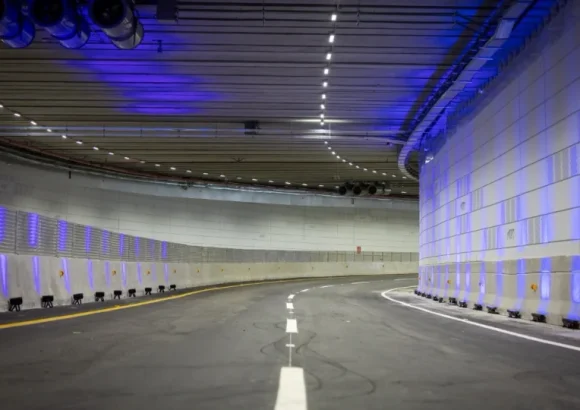
On a Sunday ceremony in Santo Domingo, Dominican Republic President Luis Abinader officially opened a transformative infrastructure project: the newly constructed Plaza de la Bandera tunnel and the fully revitalized surrounding public space. Developed to cut through persistent traffic gridlock across Greater Santo Domingo and strengthen transportation links between the capital and the nation’s southern region, the initiative marks a key milestone in the administration’s public works agenda.
Stretching 1.2 kilometers with four travel lanes, the tunnel runs beneath the iconic Plaza de la Bandera, extending the existing Gregorio Luperón Avenue and eliminating one of the capital’s most crippling traffic chokepoints. Funded entirely through proceeds from the renegotiated Aerodom concession contract, the RD$3.3 billion project is projected to slash travel times for commuters, upgrade overall road safety standards, and deliver tangible benefits to roughly 300,000 local residents and frequent travelers.
During his inauguration address, President Abinader framed the completed tunnel as a tangible demonstration of his government’s pledge to elevate the quality of life for Dominican citizens by building infrastructure that directly addresses daily transportation struggles. He also underlined that the surrounding public space renovation carefully preserved the deep historical and national symbolic value of Plaza de la Bandera, while bringing the area’s outdated road network into line with 21st-century mobility needs.
Abinader further noted that the new tunnel is just one component of a far-reaching national strategy to improve connectivity between the capital and southern Dominican provinces. Complementary initiatives already underway or completed include the Pintura overpass, the new bypass roads around Baní and Azua, the expansion of the Santo Domingo cable car system toward Haina, and comprehensive upgrades to major highways connecting the provinces of San Cristóbal, Peravia, Azua, Barahona, and Pedernales.
Minister of Public Works Eduardo Estrella shared that construction on the tunnel kicked off in February 2025 and was delivered ahead of schedule in approximately 18 months. Engineered to handle up to 2,500 vehicles per hour, the infrastructure includes a full suite of modern safety and operational features: advanced ventilation and gas extraction systems, cutting-edge fire suppression technology, backup power generators, real-time surveillance integrated directly with the national 911 emergency response system, and a dedicated on-site operations control center to monitor conditions around the clock.