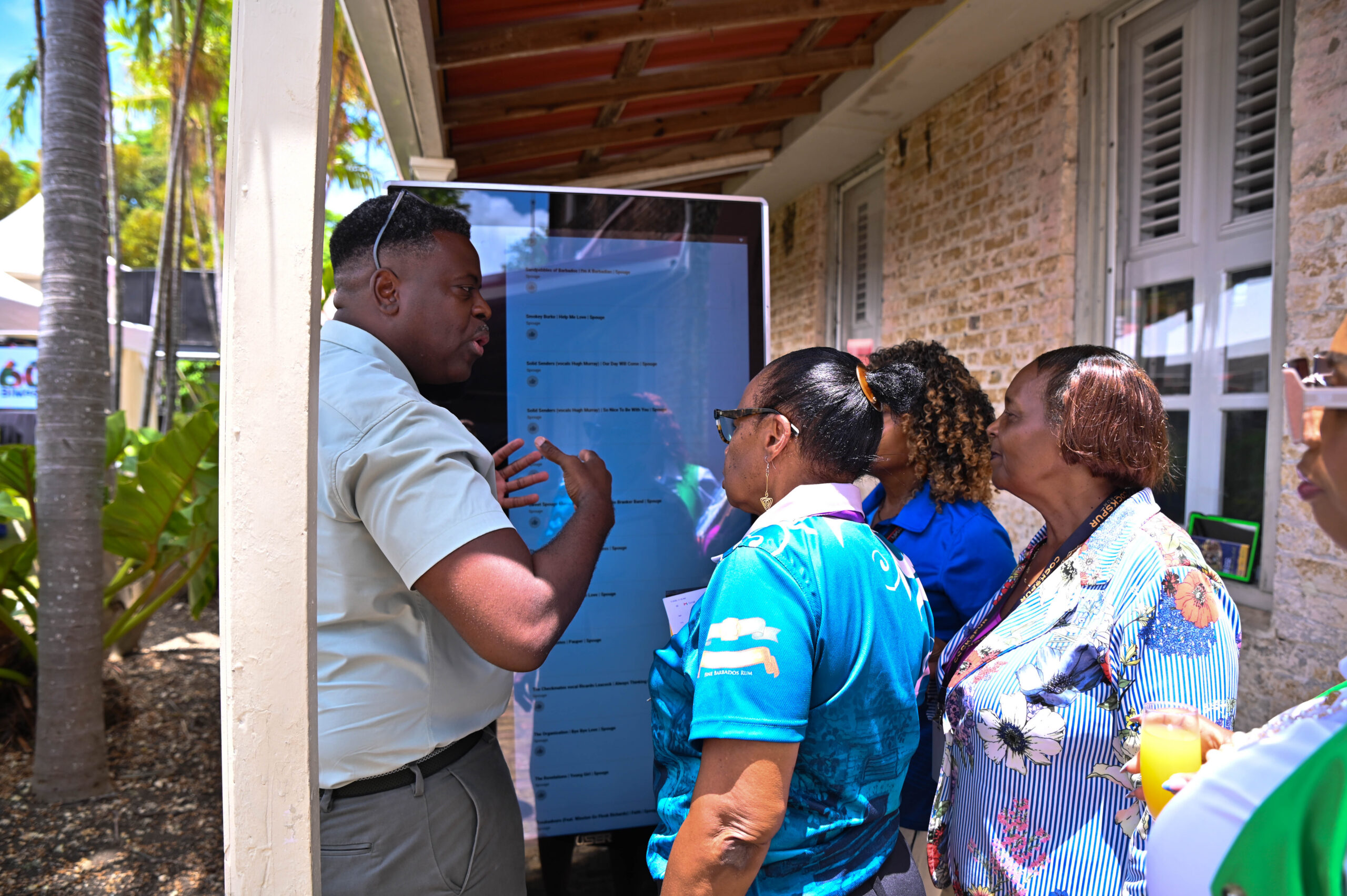
As Barbados marks 60 years of independence and five years as a republic, a groundbreaking public initiative is inviting Barbadians at home and across the global diaspora to help codify the nation’s cultural history through song. Launched Wednesday at the Barbados Museum & Historical Society, the BIM@60 campaign is a collaborative project between the museum and the National Cultural Foundation (NCF), designed to crowdsource the 60 tracks that best capture the country’s six decades of independent nationhood.
From a pre-vetted shortlist of more than 200 songs that have shaped Barbadian cultural identity since 1966, members of the public can cast their votes online via the campaign’s digital platforms or at in-person interactive kiosks installed across the island. The initiative is far more than a public vote, however: when voting closes, the final selection will form the foundation of a lasting public legacy, including a permanent publicly accessible digital archive, themed curated playlists, a full-length documentary exploring the stories behind the selected tracks, new museum exhibitions, and educational resources for schools across the country and diaspora communities.
Alissandra Cummins, director of the Barbados Museum & Historical Society, framed the project as a key step in the institution’s ongoing evolution ahead of its 2033 centenary, aligned with a broader vision to make heritage more accessible and community-centered. “Heritage cannot be confined to buildings or display cases,” Cummins said at the launch event. “Heritage lives in people. It lives in communities, traditions, creativity, language, memory, and shared experiences.”
She explained that the museum is reimagining its role to become more open, connected and relevant to all segments of Barbadian society, merging traditional collection preservation with public dialogue and community participation. “Our stories, our museum,” she emphasized. “They remind us that the museum does not belong to a single generation, a single profession, or a single community. It belongs equally to the child visiting for the first time, the researcher exploring our archives, the artist finding inspiration, the family tracing its history, the Barbadians living overseas, and the visitor discovering our island for the very first time.”
Cummins also used the launch to announce that the museum will launch a major capital fundraising campaign in August, which she described as “an investment in the stories we preserve, the knowledge we share, and the legacy we leave for future generations.”
Kevin Farmer, deputy director of the Barbados Museum & Historical Society, noted that music has long functioned as a living historical record for Barbados, and remains one of the most potent expressions of national identity. “It reminds us that music is more than entertainment. It is evidence and testimony. It is history. It tells the story of a nation. It tells the story of people,” he said.
Farmer extended an open invitation to all Barbadians worldwide, regardless of genre preference, to participate by selecting the tracks that have left a permanent mark on their personal and collective memory. “Whether they are gospel, soca, calypso, jazz, R&B, rock or hip-hop, that is the heart of BIM at 60,” he said. “We’re simply asking for you to share with us how the last 60 years are in a way inscribed on and in your memory.”
He highlighted the deep historical roots of Barbadian musical heritage, noting that a traditional Barbadian slave song – one of the oldest documented enslaved musical works in the Caribbean region – has already been inscribed on UNESCO’s Memory of the World Register through cross-border collaboration. Addressing questions about why a historical museum would lead a music-focused project, Farmer argued that preserving living heritage is just as critical as conserving traditional artefacts and documents.
“When you think of us, it is not simply about objects and pages, but it is about music. It’s about that which keeps us alive,” he said. “We’re trying in a very small way to capture it and immortalize it within 60 years of independence and the fifth anniversary as a republic.” He also called on the public to contribute informal musical memorabilia – such as handwritten lyric scribbles on napkins, brochures or beach scraps – noting that these ephemeral items hold as much historical value as the finished songs themselves.
Carol Roberts, chief executive of the NCF, said the campaign offers an unprecedented opportunity for Barbadians to collectively define the nation’s musical identity. “BIM@60 is a project that asks a deceptively simple question: ‘What does Barbados sound like?’” Roberts said. “Our music is the most complete record we have of who we are – our humor, our struggles, our faith, our resilience, our passion, our hope, and our joy.”
Roberts stressed that while the museum’s expert panel has already curated the shortlist of more than 200 culturally significant tracks, the public will have full control over the final 60-song selection. “This will not be an archive built behind closed doors,” she said. “From that curated list, it is you, me, the people of Barbados at home and across the diaspora, who will vote to choose the final top 60. Sixty songs for 60 years.”
Outlining the campaign’s long-term legacy, Roberts added that the resulting resources will make Barbadian musical history accessible to future generations across the globe. “This will allow a child in a classroom in St Lucy or St Philip, Toronto… to trace the journey of their Barbadian music and understand that it belongs to them,” she said. The NCF will support the initiative by providing publicly accessible recordings, coordinating with artists and rights holders, and promoting the campaign across its national marketing and programming platforms. Roberts emphasized that the project is ultimately a tribute to Barbadian creative workers: “To our artists, composers, arrangers and producers, this project is, above all, for you. It says that your work is not in vain. It is heritage. It is history.”
Trevor Prescod, Minister in the Prime Minister’s Office with responsibility for Pan-African Affairs and Heritage, noted that the campaign aligns with a critical moment in Barbados’ national history. Quoting Frantz Fanon, he said: “Each generation must discover its historic mission. You either honor it or betray it. I think staff of the museum, the NCF, and the Ministry… have all discovered our historic mission.”
Prescod added that music has long documented the Barbadian experience, and should be leveraged to strengthen national identity while guiding future generations. “Over the years, the story of Barbados has been told in the lyrics of our fathers,” he said. “For generations, Barbadian artists, musicians, composers and cultural practitioners have given voice to our experiences, our aspirations, our struggles and our triumphs.” He also called for increased investment in Barbados’ cultural industries, arguing that music should be recognized both as a core cultural asset and a high-potential economic sector capable of generating wealth for local creators. Prescod urged continued support for local musicians and called for expanded international promotion of Barbadian creative talent.
The launch event concluded with live performances from local artists Dale and Blood, who showcased a selection of new tracks alongside their most beloved earlier hits. Now that voting is open, organizers expect the final 60-song list to stand as a permanent, community-defined record of the music that has shaped Barbadian national life since independence, preserving these stories for generations to come.