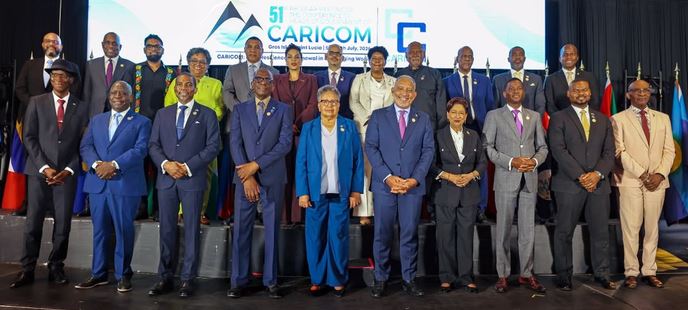
Leaders of the Caribbean Community (CARICOM) have closed ranks behind Guyana’s nominee Ambassador Carolyn Rodrigues-Birkett for the 10th United Nations Secretary-General position, but internal divisions within the regional bloc have cast uncertainty over a unified regional front for the high-profile global role, as small Caribbean nations brace for outsized geopolitical impacts from the race’s outcome.
The endorsement came at CARICOM’s 51st regular heads of government summit, where regional leaders formally backed Rodrigues-Birkett’s candidacy in an official communiqué. Nominated by Guyana on June 15, 2026, her selection as the bloc’s consensus candidate marks a major diplomatic win for the South American Caribbean nation.
Rodrigues-Birkett’s three-part policy vision, which she laid out to attending leaders at the summit, won widespread support across the bloc. Her agenda is anchored in upholding the core principles laid out in the UN Charter, reforming the body’s institutional structures to boost agility, accountability and effectiveness amid a rapidly shifting global order, and uniting member states around renewed multilateral collaboration to deliver more consistent progress across the UN’s three core pillars: peace and security, human rights, and sustainable development.
Despite the formal bloc-wide endorsement, the path to a unified CARICOM position is not fully resolved. Another CARICOM member state, Antigua and Barbuda, has already nominated its own candidate for the role: H.E. María Fernanda Espinosa Garcés, an Ecuadorian former diplomat who entered the race on May 11, 2026.
Shortly after the summit concluded, Antigua and Barbuda Prime Minister Gaston Browne reaffirmed his government’s continued support for Espinosa Garcés, noting that CARICOM now has two highly qualified candidates in the running for the top UN job. This stance directly contradicts the formal summit communiqué’s call for unified regional backing, exposing lingering splits within the 14-member bloc over the selection process. The divide comes even though CARICOM’s founding Revised Treaty of Chaguaramas requires member states to coordinate their foreign policy positions on global issues.
As the race for the UN’s top role enters its final phase with multiple candidates competing, the stakes could not be higher for CARICOM’s small island and coastal states. The current Secretary-General António Guterres’ second and final five-year term will expire in December 2026, with his successor set to take office in January 2027. The incoming leader will inherit a UN mid-way through comprehensive reform, operating amid unprecedented geopolitical tension that has strained the post-WWII international order.
Guterres has recently warned that the existing 80-year-old rules-based global system is being displaced by a ‘law of the jungle’, a shift that small states like CARICOM’s members are uniquely vulnerable to. Caribbean nations are disproportionately exposed to risks stemming from the erosion of multilateralism and international law, leaving their sovereign influence and future stability uncertain in the current geopolitical climate.
Against this backdrop, CARICOM member states universally recognize that the outcome of the Secretary-General race will shape nearly every core priority of their foreign policy, as the next UN chief will play a defining role in efforts to reset and strengthen the global body. This analysis, written by Nand C. Bardouille, Ph.D., manager of The Diplomatic Academy of the Caribbean at The University of the West Indies St. Augustine Campus in Trinidad and Tobago, reflects solely the author’s own views.