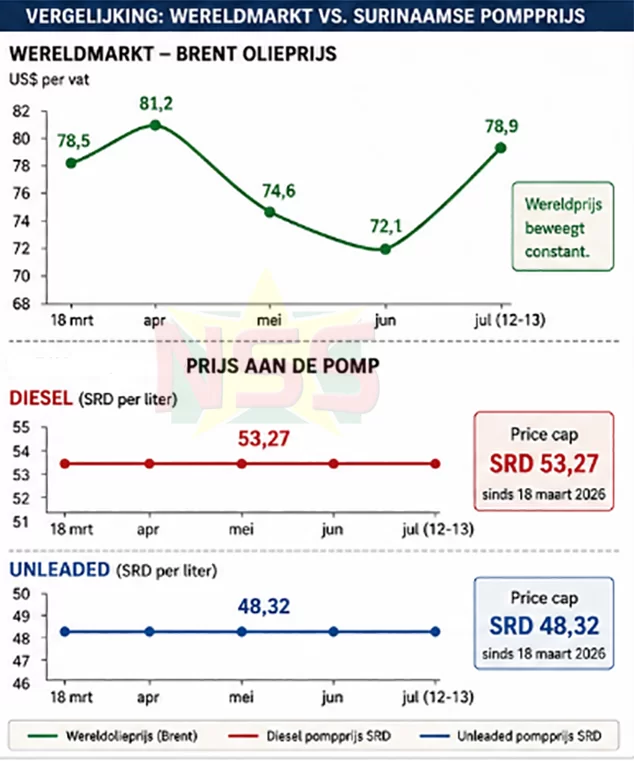
There is an old adage that holds true across many policy contexts: no measure is more permanent than a temporary policy that never gets scheduled for review. This principle is now playing out in Suriname, where a temporary fuel price cap implemented amid the outbreak of conflict in the Middle East continues to operate without the public transparency and scheduled evaluation that good governance demands.
When regional hostilities sent international oil prices skyrocketing in early 2025, threatening to accelerate already strained inflation levels, the Surinamese government faced a critical policy choice. To protect household purchasing power and avoid adding additional pressure to already strained manufacturing and transportation sectors, authorities introduced a fuel price cap on March 18. The policy set maximum retail prices of 53.27 Surinamese dollars (SRD) per liter for diesel and 48.32 SRD per liter for unleaded gasoline. At the time of its introduction, the emergency measure was widely viewed as a justifiable decision to counter volatile market conditions.
But every temporary intervention raises an unavoidable question over time: when and how will policymakers assess whether the policy is still needed? Since March, the global oil market has been anything but stable, with prices swinging sharply between steep increases and sudden drops before climbing again amid continued Middle Eastern geopolitical tensions. This volatility underscores just how challenging it is to implement and sustain fuel price policy in an unpredictable global economy – and that reality makes transparency all the more critical for public accountability.
During recent parliamentary budget deliberations, Minister of Finance and Planning Adelien Wijnerman confirmed that the government would review the future of the fuel subsidy program in the near term. She also noted that a gradual phase-out of the cap would likely be more prudent than an abrupt end to the policy. Wijnerman added that without the current price cap, retail prices would rise to roughly 64 SRD per liter for diesel and 62 SRD per liter for unleaded gasoline.
President Jennifer Simons has also shed light on the significant fiscal cost of the policy, revealing that the government foregoes approximately 300 million SRD in monthly revenue to keep fuel prices artificially low, through a reduction in state levies on fuel. This represents a major fiscal commitment: public funds can only be spent once, and every month that the state treasury forgoes hundreds of millions of Surinamese dollars means less budget available for critical investments in healthcare, education, public safety, infrastructure, and other core public services.
This fiscal trade-off does not automatically mean the fuel subsidy must be eliminated entirely. But it does mean that Surinamese society has a right to know how policymakers are weighing these competing priorities. The core debate around this policy is not ultimately whether fuel prices should rise or fall – it is a question of responsible governance and an open, accountable government.
Multiple critical questions remain unanswered for the public: How is the current price cap calculated on a monthly basis? Exactly how much revenue is the state actually foregoing? What is the current size of the effective subsidy, given that global oil prices have shifted dramatically multiple times since the cap was introduced? When will policymakers assess whether market conditions have changed enough to require policy adjustments? And when will these trade-off decisions be shared openly with the public?
Beyond fiscal impacts, the price cap also reshapes competitive dynamics among private oil companies. Before the policy was introduced, companies competed on retail pump prices to attract customers; today, motorists pay nearly identical prices at every filling station across the country. This market intervention has spawned new questions: How does healthy competition still function in this regulated market? Is the subsidy calculated uniformly for every operating oil company? How will policymakers prevent unequal outcomes that stem from differing cost structures and price-building processes among companies? Precisely because the government has chosen to intervene directly in the fuel market, the full workings of this system deserve complete public transparency.
Price stability for consumers is a legitimate policy goal, and no government is required to adjust retail fuel prices on a weekly basis to match shifts in global commodity markets. But stability does not justify silence on policy trade-offs. Precisely because the government made the deliberate choice in March to implement a sweeping market intervention, the public has a reasonable expectation that authorities will periodically explain how the system works, what trade-offs guide decision-making, and when the policy will next be evaluated. This approach also aligns with the original process the president used to develop the policy, which included open consultations with business groups, trade unions, independent economists, political parties, and other civil society organizations.
Remarkably, almost no public information is currently available about how fuel prices under the cap are calculated. This information vacuum pushes public debate toward speculation rather than fact-based discussion – an outcome that serves no one, neither the government, operating oil companies, nor the Surinamese public.
At its core, the debate over the temporary fuel price cap is not about the cost of a liter of gasoline. It is about how much transparency and open accountability good governance is worth. Temporary emergency measures can remain in place for extended periods when conditions justify it. But secrecy around those measures never can.