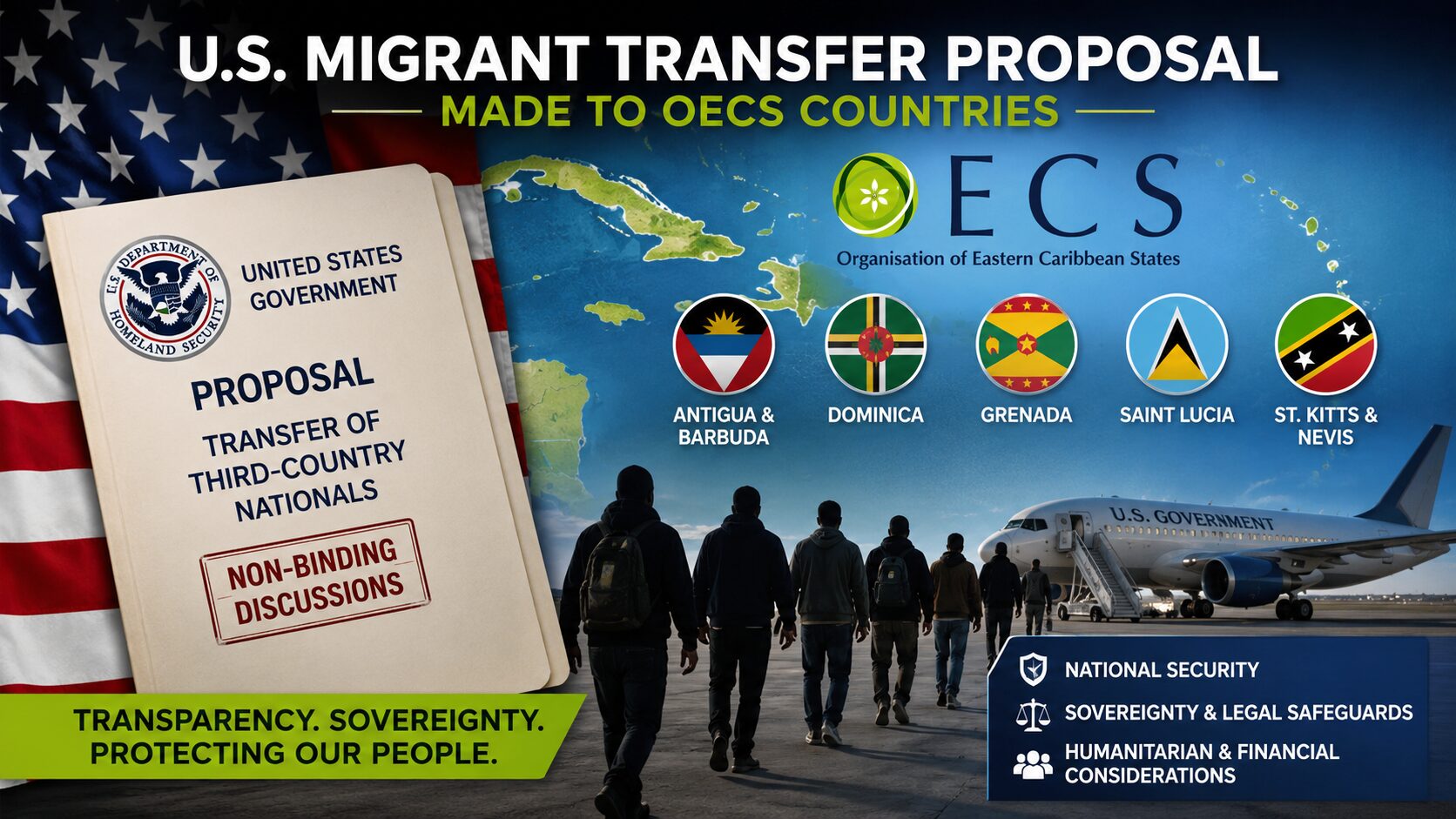
In a landmark move for governmental transparency, the Government of Antigua and Barbuda is set to present a landmark resolution to its House of Representatives on Wednesday, laying out binding guiding principles for any future negotiations surrounding the potential transfer of third-country nationals deported from the United States. This policy framework is crafted to balance ongoing diplomatic dialogue with the protection of the island nation’s core interests: its sovereign authority, domestic national security, standing legal obligations, limited administrative capacity, and critical national financial resources.
In what administration officials frame as an unprecedented break from standard closed-door diplomatic negotiations, the government will also make public both the full original proposal submitted by the United States and Antigua and Barbuda’s formal official response to the plan. Government spokespersons confirmed to local outlet Antigua.news that this move makes Antigua and Barbuda the first nation involved in these regional discussions to release the full, unredacted documents to the public. Officials also used the announcement to clarify a key point: no binding bilateral agreement has been signed, and no final arrangement for transfers has been reached between the two governments.
Prime Minister Gaston Browne emphasized that issues carrying such weighty legal, humanitarian, financial, and national security implications demand open debate and formal oversight from the nation’s elected parliament. “This Government believes that matters of such legal, humanitarian, financial and security importance must be handled openly and with respect for Parliament,” Browne stated in his official remarks. “By bringing the full proposal from the United States, and our response, before the House of Representatives, Antigua and Barbuda is demonstrating transparency and accountability, while maintaining our longstanding friendship and cooperation with the Government and people of the United States.”
The resolution itself is structured to lay out clear, non-negotiable safeguards that will govern any future discussions, while preserving the executive branch’s authority to approve or reject any individual transfer request on a case-by-case basis. Key guiding principles outlined in the draft include a ban on automatic or open-ended transfer programs, no predetermined quota of individuals to be accepted, and a requirement for explicit prior government approval for every single proposed transfer.
The proposed framework also adds that all comprehensive legal, operational, financial, and administrative arrangements must be finalized and agreed in formal writing before any transfer can move forward. The government has outlined a list of mandatory pre-transfer provisions that must be satisfied, including reliable identity verification, valid travel documentation, guaranteed accommodation, full funding for all related costs, clear defined legal status for individuals, rigorous security screenings, access to required support services, and formal agreements covering responsibility for any onward movement or return of individuals if needed.
The negotiation process is not limited to Antigua and Barbuda, and has emerged as a coordinated regional issue for members of the Organisation of Eastern Caribbean States (OECS). During a OECS Heads of Government meeting held in January, regional leaders confirmed that the United States had approached five member states — Antigua and Barbuda, Dominica, Grenada, Saint Lucia and St. Kitts and Nevis — with a proposal to accept third-country nationals removed from U.S. territory. Leaders also noted that a small number of countries had already signed non-legally binding memoranda of understanding to enable further exploratory talks with U.S. officials.
Rather than pursuing separate, individual negotiations with Washington, the OECS member states agreed to form a unified, broad-based high-level negotiating team made up of representatives from all participating member states to conduct technical discussions with the U.S. side. The regional bloc noted that this collective approach ensures all participating nations can implement consistent common standards and protective safeguards, while collectively addressing shared legal, security, financial, and humanitarian concerns across the region.
Other participating nations have already begun outlining their own national safeguards for any potential arrangement. Earlier this year, the government of Dominica released a public statement clarifying that any existing understanding with Washington is non-binding, and reserves full discretion for the Dominica government to accept or reject any individual transfer proposal. Dominica’s framework also requires extensive screening for every proposed individual, and mandates that the United States retain full responsibility for all funding, transportation, documentation, and other operational requirements before any transfer can proceed. Like Dominica, Antigua and Barbuda has previously emphasized that its own non-binding preliminary understanding with the U.S. has not been put into effect, and no arrangements have been finalized to receive third-country nationals. Antiguan officials have repeatedly stressed that any future transfers would require rigorous vetting, and the nation will not accept any individual with a criminal background.
Discussions around the proposal have also advanced to the broader Caribbean Community (CARICOM) level. During a recent CARICOM Heads of Government meeting held in Saint Lucia just last week, regional leaders acknowledged shared concerns over the limited administrative and infrastructural capacity of small island developing states to manage the transit of third-country nationals. Leaders stressed that any future arrangements must not compromise the national security of participating states, nor divert scarce public resources away from domestic programs that serve local citizens. They also clarified a key point of context: the proposed memoranda are intended to facilitate the transit of eligible individuals onward to their home countries, rather than enabling permanent resettlement of these individuals in Caribbean participating states.
While the Browne administration has repeatedly reaffirmed Antigua and Barbuda’s long-standing close friendship and diplomatic cooperation with the United States, it has consistently maintained that the government holds a constitutional duty to prioritize and protect the interests of its own citizens. Administration officials noted that Wednesday’s parliamentary debate and resolution are designed to embed democratic oversight, full transparency, and formal parliamentary approval into all future policy decisions on this issue, while protecting the nation’s institutions, limited public resources, and domestic social stability.