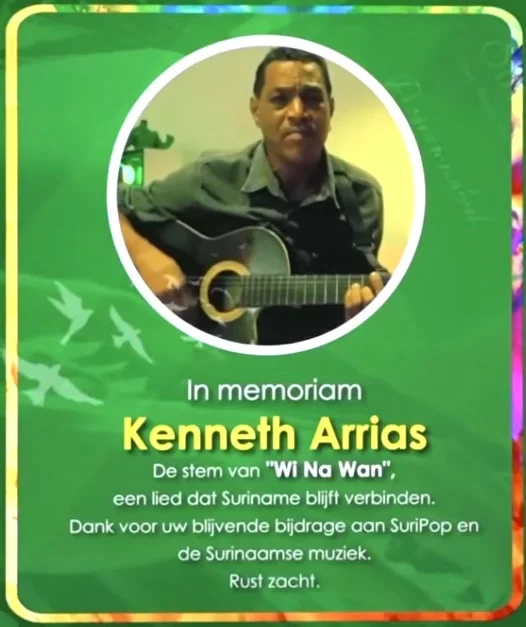
When the classic Surinamese film *Wan Pipel* is announced, every Surinamer’s emotions are stirred. This epic, iconic cultural work evokes a deep sense of national connection that makes audiences drop everything to experience it, bound together by its core message of unity: one people, one nation, one heart, one home. No other Surinamese cultural production has ever matched or surpassed its impact on the national consciousness. That same profound, unignorable feeling washed over veteran journalist Stuart Rahan when he first heard the song *Wi Na Wan* – a work that carries a spiritual calling no Surinamer can refuse, that demands something greater than the sum of its lyrics and melody. Now, following the recent passing of the song’s legendary performer Kenneth Arias, that feeling has returned in full force. The track’s lyrics were crafted by the visionary Julius ‘Ouwe’ Vreden, and its story is woven into the modern history of a deeply divided nation.
To understand the impact of *Wi Na Wan*, we must travel back to 1990, when the song was entered into Suriname’s iconic Suripop song competition. At the launch event for the Suripop LP VI, held for local media at Buiten-Sociëteit Het Park, the songwriting team was introduced and short snippets of all competing tracks were played. Rahan, who was working at Radio Boskopu at the time, recalls that the song’s sweeping, evocative flute introduction grabbed hold of listeners instantly. The track pleads with Suriname and its multi-ethnic, diverse society to embrace unity as one people, opening with a tribute to the nation’s first Indigenous inhabitants, woven with the sambura rhythm and opening chant. Its lyrics incorporate three of Suriname’s most widely spoken languages: Sranantongo, Dutch, and Sarnami, reflecting the nation’s multicultural identity.
Right after the first playthrough, Rahan told event host Henk van Vliet: ‘Henk, this song will win the Suripop festival.’ The track’s impact was so immediate and unshakable that it was clear this was far more than a simple pop song. It carried an unprecedented power in both its lyrics and its arrangement, forming a cohesive, overwhelming whole that demanded national attention. Arias was selected as the performer for his singular, distinctive vocal tone, a pairing that proved perfect: the combination of melody, lyrics, and voice stirs the heart and soul of every Surinamer to this day.
For the first time, Suriname had a song that cut across all its cultural divides, something the nation had long yearned for. Surinamese people had long lacked a cultural work that could fully express their shared connection to their homeland; with *Wi Na Wan*, the popular national folk anthem *Opo Kondreman* had finally found its equal. What political leaders had failed to achieve for generations, this simple competition entry had accomplished: it brought a divided nation together. In 1990, Suriname was in the depths of its devastating Civil War, deeply split along political and ideological lines, with Surinamese fighting one another to the death. The song’s core message – that no matter where you come from, we are all one Surinamese people – struck a national chord. Thanks in large part to Radio Boskopu’s listeners, the track received constant airplay, numbers that would generate massive streaming revenue for modern platforms.
Van Vliet, as an organizer committed to giving all competitors equal attention, did not share Rahan’s immediate enthusiasm, and asked that the other nine entries be given the same shot at airplay. They received that opportunity, but none could match the overwhelming power and resonance of *Wi Na Wan*, even with full respect to the other artists involved. To this day, the track’s impact has not faded for those who experienced its arrival.
The night of the Suripop final, held at the NIS venue, was an experience no one who attended has ever forgotten. Chaotic in the way only a Surinamese large event can be, the evening did not go according to plan. *Wi Na Wan* was scheduled to perform fourth, and van Vliet ended up calling, nearly begging, for Arias to come to the stage, even asking the audience to help locate him. Arias was nowhere to be found – in fact, he wasn’t even inside the NIS building. He was just behind the venue, in the makeshift Maroon village of Pokigron, where Civil War refugees had been temporarily housed, calmly smoking his dyonko tobacco. Those who knew Arias well confirm that he was an avid smoker, and that night was no exception. It was only when he felt he had properly centered himself to bring the Surinamese national story to life that he made his way into the venue. As a penalty for his delay, organizers made him perform last – a turn of events that proved anything but a punishment. It was the perfect spot, written in the stars for the song that would close the historic night in unforgettable fashion.
That performance turned out to be the best of the entire night. Arias sang while Vreden accompanied him on the birimbao, a unique one-stringed instrument built around a halved hollowed calabash. The crowd went wild; it stopped being a competition and became a once-in-a-lifetime cultural apotheosis that the Suripop organizers never could have planned for. Everything fell perfectly into place. The spiritual energy that filled the NIS that night exceeded every expectation. *Wi Na Wan* outshone every other song ever written to celebrate Surinamese national pride, and it did so as an entry in a popular song competition. Arias, with his unorthodox voice and uncompromising character, was the undisputed king of the night, while Vreden stood as the master composer behind the work.
Arias may be gone, but his iconic performance and the unifying message of *Wi Na Wan* will live on forever in the dignity and shared identity of the Surinamese people.