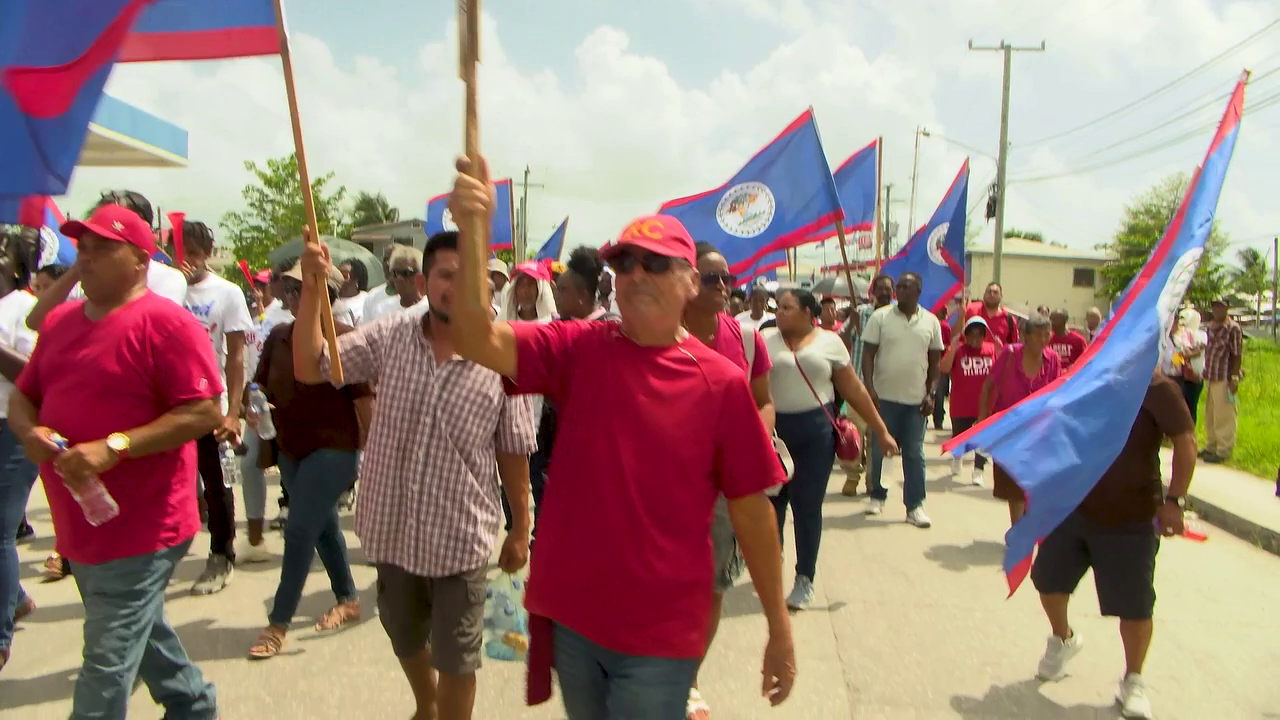
On July 10, 2026, a protest march organized by the United Democratic Party (UDP) in Belize began as a targeted demonstration over newly surfaced corruption allegations at the nation’s Ministry of Defense, but rapidly expanded into a collective demonstration of widespread national discontent that cut across every segment of Belizean society. Activists, labor union representatives, aspiring political candidates, and everyday citizens from all regions of the country gathered to air a wide range of grievances extending far beyond the initial defense ministry scandal, uniting behind shared demands for greater accountability, transparent governance, and improved living conditions for all Belizeans.
Cyril “Uruwei” Garcia, one of the leading activists at the demonstration, emphasized that corruption is not an isolated issue limited to a single government department, but a systemic problem plaguing the entire public sector. He called for the immediate activation of the United Nations Convention Against Corruption (UNCAC), a framework designed to enable criminal prosecution of corrupt officials. Garcia argued that currently, no minister or area representative found guilty of corrupt activity has faced jail time, even for severe abuses of power, pointing to high-profile unresolved cases including the Budna and Mira scandals. For Garcia, full implementation of UNCAC is the only path to deliver the transparency and meaningful accountability the public demands.
Dorla Staine, a representative of Belize Energy Workers For Justice, explained why her labor group chose to join the demonstration. She noted that while government officials report massive streams of public revenue flowing into state coffers, excessive and unexplained public spending raises red flags for ordinary workers. Staine pointed out that if public funds were being managed honestly, members of the military would not have reason to complain about inadequate compensation, just as energy workers have long protested being paid far less than they are rightfully owed for their labor.
German Tillett, a local bus owner, added his voice to calls for sweeping audits of multiple government agencies, naming the transport department – where the National Bus Company (NBC) manages large public budgets – as a high priority for investigation, citing multiple unexplained and irregular activities within the ministry. He also called for a full audit of the Ministry of Agriculture, arguing that the department’s marketing board has been operated as a personal asset for political leaders connected to the ministry, a practice that is incompatible with ethical public governance.
Windell Lemoth, a UDP candidate for city council, highlighted the tourism sector as another area in need of independent oversight, noting that massive public spending in the industry has not been matched by transparent accounting. He called for an independent audit to restore public trust in government institutions, and went so far as to describe the corrupt activities uncovered at the Ministry of Defense as equivalent to an act of treason against the Belizean people.
Even ordinary residents from far-flung regions of the country shared their frustrations. A resident of Stann Creek West summed up the sentiment of many attendees, saying that all current ministers are self-serving and focused only on siphoning public funds for personal gain. The resident explained that working-class Belizeans are struggling to access even small, affordable plots of land to build homes, a basic need that remains out of reach for many amid systemic graft.
This report is adapted from a transcript of an evening television newscast, with Kriol-language remarks preserved according to standard spelling conventions.