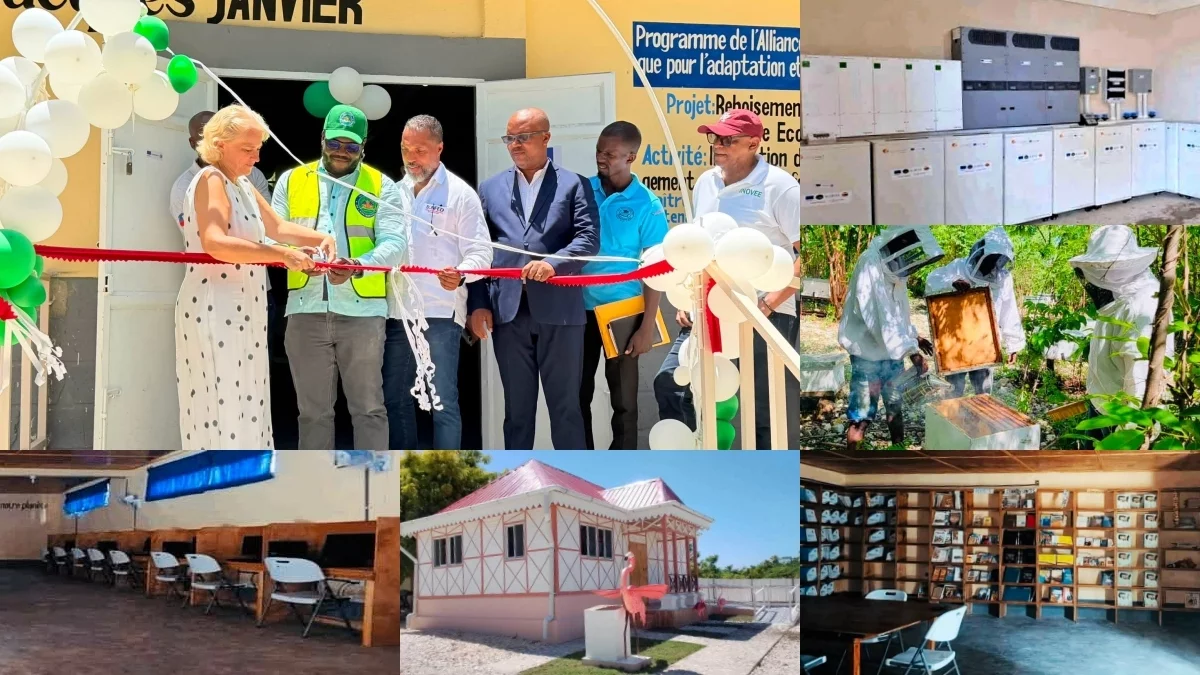
Between July 7 and 9, 2026, Haiti’s Minister of Environment Valéry Fils-Aimé led an official inspection and inauguration tour across the South-East department, stopping in the key coastal municipalities of Jacmel and Belle-Anse. The visit marked the completion of several community-focused climate adaptation projects developed under the Global Alliance against Climate Change Plus (GCCA+) initiative, a program designed to boost local resilience to worsening climate impacts across vulnerable nations.
Accompanying Minister Fils-Aimé on the tour were high-level stakeholders including Hélène Roos, Ambassador of the European Union to Haiti, and Charles Jean-Jacques, National Authorizing Officer for the European Development Fund (EDF) in Haiti, which provides core financing for the initiative.
The completed projects deliver long-term benefits across environmental protection, education and economic development. First, the delegation inaugurated a new Governance Office and Herbarium at the Lagon des Huîtres National Natural Park, one of Haiti’s most ecologically significant protected areas. These new facilities will strengthen park management capacity, support conservation research and better safeguard the region’s unique biodiversity.
In a nod to connecting environmental action to community education, the tour also marked the reopening of the renovated library at Calixte Numa Rabel High School, alongside a new fully solar-powered computer lab equipped with 17 internet-connected devices. The off-grid solar system solves longstanding unreliable electricity access issues, giving students consistent access to digital learning tools that were previously out of reach for most in the region.
The final major infrastructure inauguration was the fully rehabilitated Communal Maritime Fishing Center in Belle-Anse, outfitted with a new solar-powered cold storage room. The facility will revolutionize local fishing operations by extending the shelf life of caught seafood, cutting post-harvest waste that has long eaten into fishermen’s profits, boosting local household incomes and laying the groundwork for sustainable growth of Haiti’s blue economy.
Beyond physical infrastructure, the GCCA+ program has already delivered transformative social and environmental results by supporting livelihood transitions for local workers. Twenty-one charcoal producers, who previously relied on deforestation for their income, have been retrained and reorganized into three independent beekeeper groups. Three dedicated beekeeping stations have been established to produce organic honey, creating a steady alternative income stream while reducing pressure on Haiti’s threatened forest ecosystems. This dual-focus approach advances both biodiversity conservation and improved living standards for communities in Belle-Anse.
During opening remarks, Minister Fils-Aimé highlighted the success of the cross-sector partnership, emphasizing that all completed projects are first and foremost investments in the well-being of Haitian communities. Closing out the visit to Belle-Anse, Ambassador Roos reiterated the core vision guiding the collaboration: that meaningful climate resilience can only be built through shared effort between local communities, national government authorities, and strong international partnerships.