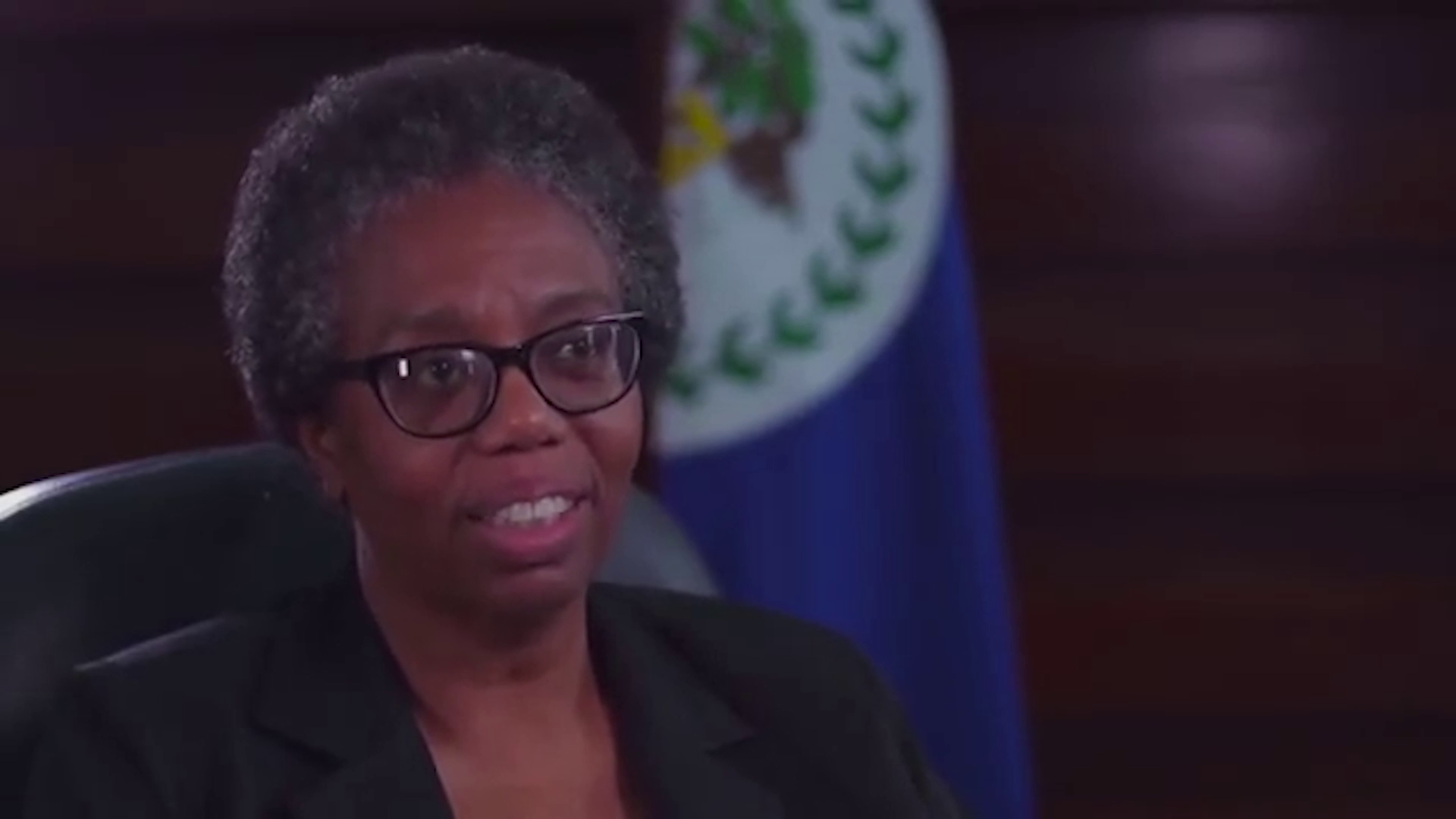
Twelve years ago, what started as a six-month emergency appointment to clear a case backlog at Belize’s Supreme Court is drawing to a close: Justice Antoinette Moore, one of the nation’s most influential legal figures, will step down from the High Court at the end of August 2026, leaving an indelible mark on Belize’s pursuit of equal justice.
Moore’s long career in law began long before she took the bench. A legal scholar trained at two of the world’s most prestigious institutions — Loyola University Chicago and the University of Oxford — she first built her reputation as a fierce human rights attorney working in private practice. Throughout these early years, she dedicated much of her work to upholding constitutional protections and amplifying the voices of marginalized, vulnerable communities across Belize. Her most landmark contribution from this era came in her decades-long advocacy for Maya customary land rights, a battle that wound through domestic Belizean courts, regional human rights bodies, and ultimately reached the nation’s highest judicial forum. “That is what you have been struggling for and that certainly… That has gone for the last ten years through the courts, through the regional human rights bodies, through the courts of Belize and until now it reached the last, the highest, that mountaintop in terms of the courts, the highest court,” Moore said of the land rights campaign in a 2015 interview.
Beyond her human rights work, Moore also stepped into a critical role as lead prosecutor for Belize’s Financial Intelligence Unit, where she took on the complex, high-stakes work of combating financial crime. She led the prosecution of what was then the largest money laundering case in Belize’s history, which involved more than $1.5 million in illegally laundered funds. Her work secured guilty convictions against all five accused, including defendants Michael and Melonie Coye. “We are very pleased that the jury saw the evidence and resulted in guilty verdicts for all five of the accused, which of course includes the corporate accused and the four natural persons,” Moore stated after the 2012 verdict.
In 2014, Moore was tapped for a temporary six-month assignment to the Supreme Court’s criminal division, tasked solely with clearing a backlog of more than 70 pending criminal cases. What was meant to be a short-term gap-filling role extended far beyond its original timeline: 12 years later, Moore leaves the bench as one of Belize’s most respected and trusted criminal judges, having presided over nearly all of the nation’s most high-profile, consequential criminal trials in over a decade.
Among her most notable rulings was the life sentence handed down to William “Danny” Mason and four accomplices for the brutal kidnapping, murder, and beheading of Pastor Llewellyn Lucas, a case that shocked the nation and became one of the most sensational criminal events in Belize’s modern history. She also delivered life sentences for a string of high-profile murders, including Enrique DePaz for the killing of Harrison Bowers, Shane Bennett for the murder of Anthony Parks, Wilmer Escobar for the double murder of sisters Cresencia and Josephine Oh, Nicholas Swazo for the murder of Gerald “Shiny” Tillett, and Christopher Bradley for the death of Martha Gonzales. In 2023, Moore drew national attention for her sentencing of former police corporal Kareem Martinez to 18 years in prison for the manslaughter of 14-year-old Laddie Gillett, a ruling that sparked renewed national conversation and scrutiny over excessive use of force by law enforcement.
Across more than three decades in Belize’s legal system, Moore has served in nearly every critical role: from human rights advocate, to financial crime prosecutor, to judicial educator, to High Court Justice. As she prepares to retire, her legacy extends far beyond the walls of the courtroom, shaping how Belize approaches justice, equity, and accountability for all.
This report is from Shane Williams, for News Five.