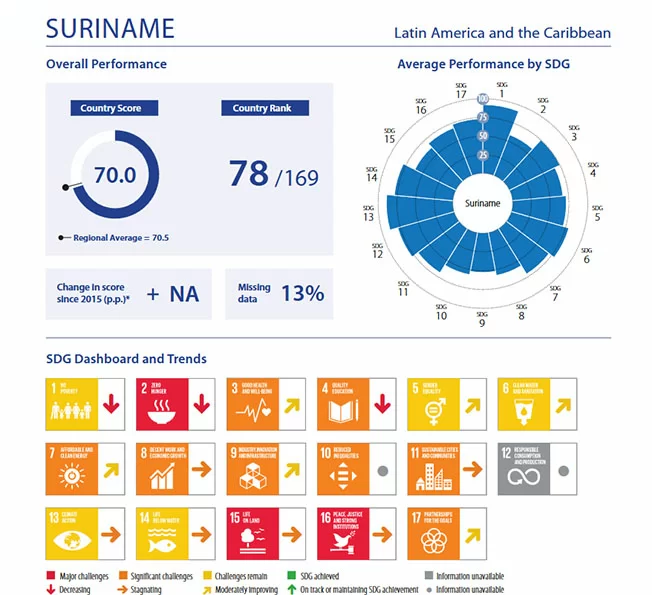
Five years ahead of the 2030 deadline for the United Nations’ Sustainable Development Goals (SDGs), the newly released 2026 Sustainable Development Report (SDR 2026) delivers a stark warning: none of the 17 global SDGs are currently on course to be achieved by the target year. The report’s data paints a sobering picture of global progress, noting that only 16.5% of all SDG targets are tracking on schedule globally, 67% are showing only minimal incremental progress, and a full 16% are actually moving backwards. Against this concerning global backdrop, the report also includes a detailed assessment of Suriname’s performance, where the South American nation ranks 78th globally with an SDG score of 70.0, nearly matching the 70.5 average for the Latin America and Caribbean region.
A key innovation included in this year’s SDR is the addition of retrospectively calculated SDG rankings, a new feature that allows for reliable, cross-country comparisons of national performance across multiple years, filling a longstanding gap in global SDG progress tracking.
Breaking down Suriname’s results, the report identifies critical persistent challenges alongside notable areas of progress. The country’s largest setbacks are recorded on SDG 2 (Zero Hunger) and SDG 15 (Life on Land), both of which show negative development trajectories. For SDG 2, Suriname grapples with a relatively high national obesity rate of 29%, while SDG 15 progress is undermined by growing pressure on the nation’s biodiversity and terrestrial ecosystems. Suriname also lags behind on SDG 16 (Peace, Justice, and Strong Institutions), with its low score dragged down by poor performance on global corruption perception indices, reflecting ongoing concerns over the quality of governance and public institutional capacity in the country.
Despite these challenges, the report highlights clear positive gains for Suriname in several key areas. The nation has made consistent progress on SDG 3 (Good Health and Well-being), with life expectancy rising to 73.9 years and child mortality rates continuing to decline. Suriname also scores highly on access to basic infrastructure and services: 99.6% of the population has access to electricity, and 98% has reliable access to clean drinking water. The country has also maintained steady, positive results for gender equality in the labor market.
Ten years after the SDGs were first formally adopted, the 2026 SDR is calling for a dramatic acceleration of global and national action to get the 2030 agenda back on track. The report outlines eight core priority areas to close the current progress gap, including advancing peace and effective governance, scaling up investment in sustainable development, deepening regional cooperation, developing innovative financing mechanisms for global public goods, and establishing clear international frameworks for emerging technologies such as artificial intelligence and biotechnology. Report authors also argue that the United Nations needs a stronger coordinating role in advancing the global sustainable development agenda.
For Suriname specifically, the report emphasizes that targeted extra efforts will be required over the coming years in environmental protection, climate adaptation, and public institutional strengthening. It calls for collaborative action across the national government, private sector, and civil society organizations to reverse declines in underperforming SDGs and get closer to the 2030 targets.
In conclusion, the report underscores that the global sustainable development agenda is at a critical juncture. Without sweeping policy changes and a rapid acceleration of implementation efforts, the globally agreed 2030 SDGs will remain out of reach when the deadline arrives in 2030.