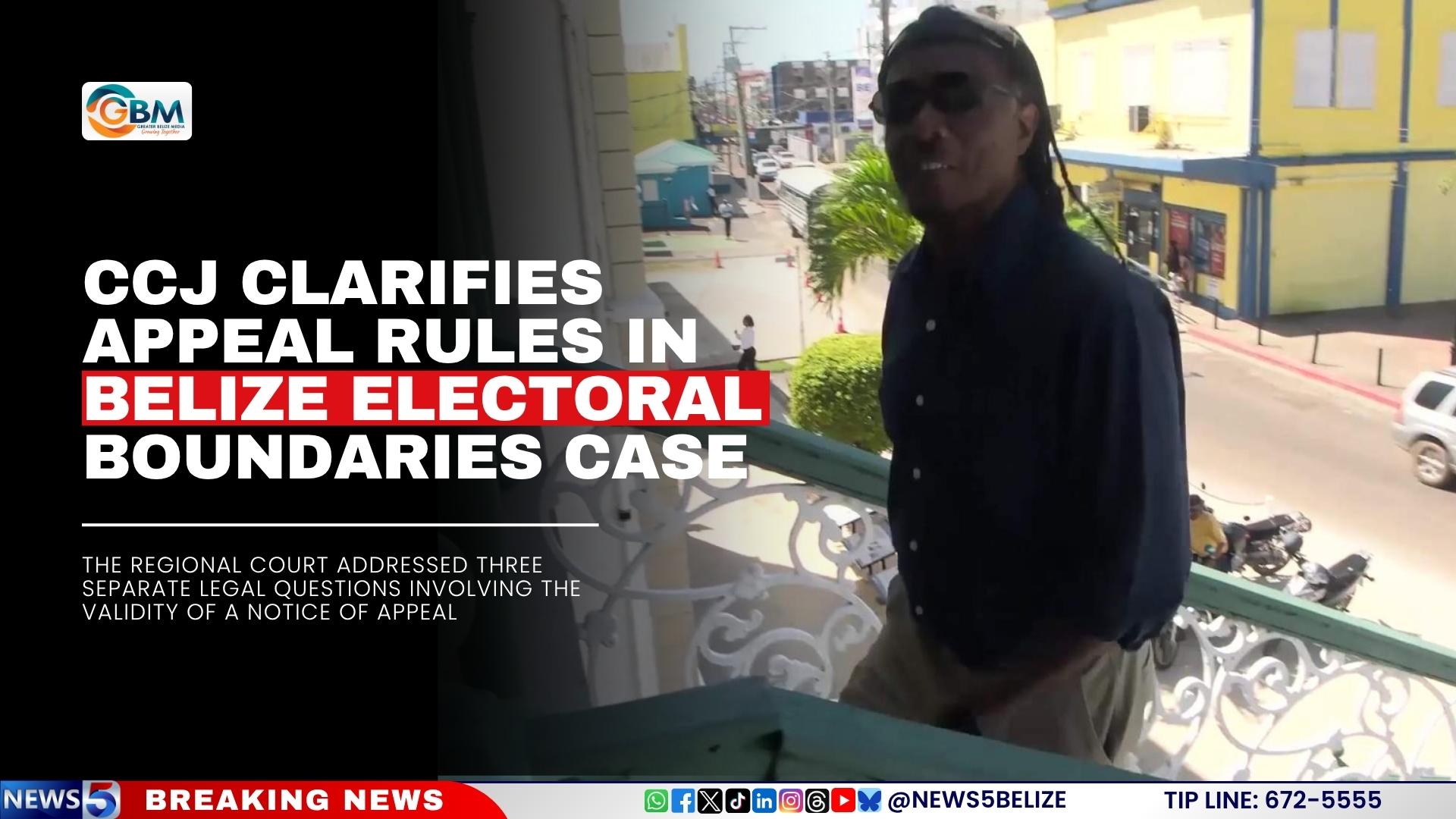
On July 10, 2026, the Caribbean Court of Justice (CCJ) published its full reasoned decision for a March ruling that clarifies critical appeal procedures in Belize’s long-running electoral boundaries dispute, siding with claimant Jeremy Enriquez and his legal counsel, Senior Counsel Anand Ramlogan, on two out of three linked legal applications.
The core of the underlying dispute dates back to Enriquez’s formal legal challenge against the Government of Belize, which accuses the national government of failing to revise the country’s electoral district boundaries as required by recommendations put forward by the official Elections and Boundaries Commission. The three applications brought before the CCJ addressed distinct procedural questions arising from earlier lower court proceedings: the legal validity of a filed notice of appeal, a personal wasted costs order issued against Ramlogan, and an ex parte order granted by the High Court trial judge.
In its first key holding, the CCJ overturned a decision by Belize’s Court of Appeal that had struck out Enriquez’s notice of appeal as legally invalid. The regional court clarified that under Belize’s Senior Courts Act, the window to file an appeal opens as soon as a lower court order is signed, entered, or formally perfected, and completion of any one of these steps meets the requirement to activate the appeal timeline. The CCJ further confirmed that the notice of appeal in question was fully valid, noting that even if it had been filed prematurely, the Court of Appeal already held the authority to correct the procedural error rather than dismissing the appeal entirely.
Second, the CCJ vacated the personal wasted costs order that required Ramlogan to cover 50% of the Attorney General’s legal fees connected to an interim relief application. The court emphasized that a wasted costs order against a legal practitioner is not merely a standard adjustment of litigation costs, but a disciplinary action targeting a lawyer’s professional conduct. For this reason, the CCJ ruled that no extra permission to appeal the order was required. The judgment also highlighted that the High Court judge violated multiple procedural requirements when issuing the order: the judge acted on their own initiative without clearly stating the legal grounds for the penalty, failed to give Ramlogan an opportunity to defend his conduct at a required show-cause hearing, and did not provide the mandatory seven-day advance notice outlined in Belize’s Civil Procedure Rules.
On the third application, which challenged the High Court’s ex parte order that restricted publication of certain case details and mandated Ramlogan to turn over additional information, the CCJ ruled against Enriquez. The court found that the claimant had skipped a required procedural step: under Belize’s legal framework, parties must first ask the High Court itself to vary or cancel an ex parte order before filing an appeal. The CCJ concluded that the proposed appeal had no reasonable prospect of succeeding, and therefore dismissed the application.
As a final outcome, the CCJ granted special leave to appeal and upheld the first two successful appeals, ordering that Enriquez and Ramlogan receive compensation for their legal costs in both the CCJ proceedings and the earlier Belize Court of Appeal hearing. For the dismissed third application, costs were awarded to the Attorney General and the Elections and Boundaries Commission.