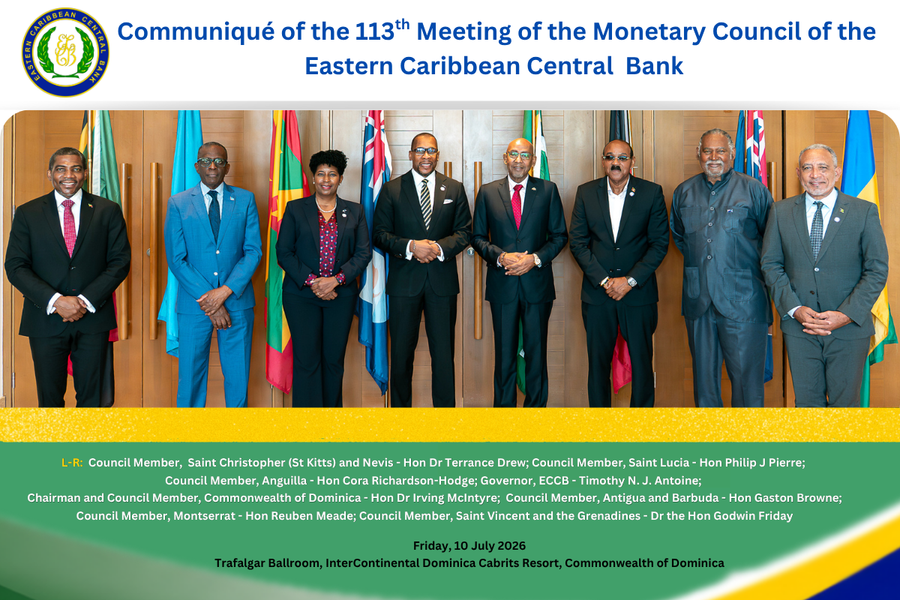
On July 10, 2026, the Monetary Council of the Eastern Caribbean Central Bank (ECCB) gathered for its 113th regular meeting at the InterContinental Dominica Cabrits Resort, chaired by Dominica’s Finance Minister, the Honourable Dr Irving McIntyre. Against a global economic landscape marked by rising volatility, inflationary pressures driven by energy supply disruptions, and slowing international growth, the council reaffirmed its longstanding commitment to protecting the Eastern Caribbean (EC) dollar while advancing policy priorities to build resilience, boost competitiveness, and deliver shared prosperity across the eight-member Eastern Caribbean Currency Union (ECCU).
This year’s meeting carries special historic weight: it coincides with the 50th anniversary of the EC dollar’s fixed exchange rate peg of EC$2.70 to US$1.00, a policy framework that has stood as one of the world’s longest-running and most successful fixed exchange rate arrangements. Council members paid tribute to decades of collective stewardship from successive leaderships, member governments, and regional populations, whose commitment to prudent monetary and fiscal policy has sustained five decades of unbroken monetary stability and confidence in the regional currency.
Against this milestone, the council reaffirmed that maintaining the EC dollar’s peg to the U.S. dollar remains the cornerstone of the ECCB’s monetary policy. This framework, members noted, underpins broader monetary stability and creates the conditions for sustainable long-term growth and rising living standards across the region. Current data reinforces the strength of the peg: the EC dollar holds a 97.6% reserve backing ratio, with total foreign reserves reaching EC$5.9 billion. This figure far exceeds the statutory requirement of a 60% minimum reserve backing, further strengthening market and public confidence in the currency arrangement. Alongside confirming the stability of the peg, the council voted to keep key interest rates unchanged, holding the Minimum Savings Rate at 2.0% and retaining the Discount Rate at 3.0% for short-term lending and 4.5% for long-term lending.
While celebrating the historic stability of the currency union, the council did not downplay significant downside risks to the regional economic outlook. Volatility in global energy prices, ongoing trade tensions, and simmering geopolitical conflicts continue to create headwinds, with the potential to weaken tourism demand — a core driver of ECCU economic activity — and slow overall growth. To address these challenges, the council emphasized the urgent need to accelerate collective action under the ECCB’s 2026-2031 strategic plan, *The Big Push: Collective Action for Shared Prosperity in the ECCU*.
A top policy priority highlighted at the meeting is strengthening energy resilience, which leaders framed as critical to driving sustainable economic expansion. The council called for immediate progress on operationalizing the Caribbean Resilient Renewable Energy Infrastructure Investment Facility (RREIIF) hosted by the Eastern Caribbean Partial Credit Guarantee Corporation (ECPCGC), noting that further delays would undermine the region’s goals of achieving energy security, lowering electricity costs, and improving long-term competitiveness. In a second key initiative to boost strategic resilience, the council approved an additional EC$25 million grant to support member governments’ work on food and nutrition security, building on an earlier EC$25 million grant approved in February 2025. The new funding will support efforts to reduce import dependence and strengthen the currency union’s overall resilience to external shocks.
On financial stability, the council reported that the ECCU banking sector continues to demonstrate robust resilience, supported by strong liquidity positions, higher capital adequacy ratios, and declining non-performing loan volumes. Updates were provided on two key regulatory initiatives: the ECCU Credit Bureau, which has already onboarded 83% of licensed financial institutions and 27% of credit unions across the region, and the upcoming Office of Financial Conduct (OFC), which remains on track to launch operations in September 2026 following ongoing stakeholder consultations. Council members stressed that full participation by all financial institutions is essential to the credit bureau’s ability to deliver comprehensive, reliable credit data that supports lending and financial system stability.
Progress was also highlighted on payment modernization and financial inclusion, core priorities under *The Big Push*. The ECCU First Step Savings Account, designed to expand access to low-cost basic banking services for first-time account holders, is now offered by at least 17 licensed financial institutions across the region. Updates were provided on two flagship regional payment initiatives: the CARICOM Payments and Settlement System (CAPSS) pilot and the regional Fast Payment System. CAPSS will enable instant cross-border payments in local currencies, reducing transaction costs and reliance on third-party correspondent banking, while the Fast Payment System will offer 24/7 real-time electronic payments across the ECCU. Together, the initiatives are expected to deepen regional financial integration, improve payment efficiency, and expand access to financial services for underserved populations. The council also reaffirmed its support for retail bond issuances as a tool to advance financial inclusion and wealth creation across the region.
In governance updates, the council confirmed that the new Eastern Caribbean Citizenship by Investment Regulatory Authority (ECCIRA) remains on schedule to launch in September 2026. The new authority will strengthen governance, transparency, and regulatory oversight of regional citizenship by investment programs, and leaders emphasized the importance of maintaining alignment with international standards to preserve strong economic and diplomatic ties with global partners.
On fiscal policy, the council acknowledged member governments’ efforts to implement targeted measures to cushion households and businesses from rising living costs, but emphasized that such support must be fiscally sustainable, targeted to vulnerable groups, and include clear sunset clauses to ensure they remain temporary and subject to regular review. Leaders also called on member governments to continue strengthening sustainable domestic revenue mobilization while managing expenditure growth responsibly to maintain long-term fiscal and debt sustainability.
Despite broader global headwinds, the tourism sector — the ECCU’s largest economic driver — delivered strong performance in the first quarter of 2026. Total visitor arrivals rose 9% year-on-year from 2.3 million to 2.5 million, while visitor spending increased 4% from EC$2.7 billion to EC$2.8 billion, reflecting sustained global demand for the region as a travel destination. Still, leaders noted that high transportation costs and suboptimal air connectivity continue to constrain intraregional travel and trade, and welcomed ongoing progress on plans to launch a new regional carrier, OECS Air, which will address connectivity gaps to support growth in tourism, trade, and labor mobility across the currency union.
Looking ahead, the council reaffirmed that sustained inclusive prosperity will require deeper regional integration, improved productivity, more affordable energy, increased private sector investment, and continued coordinated policy action across member states. The 114th meeting of the Monetary Council is scheduled to be held via videoconference from ECCB Headquarters in St. Kitts and Nevis on October 30, 2026.
Closing the meeting, the council emphasized that five decades of proven monetary stability provides a strong foundation for the ECCU to pursue faster, more inclusive, and more resilient growth through collective regional action. Leaders expressed confidence that with sound policy frameworks, strong regional institutions, and closer collaboration, the currency union is well positioned to navigate ongoing global uncertainty and deliver shared prosperity for all people across the Eastern Caribbean.