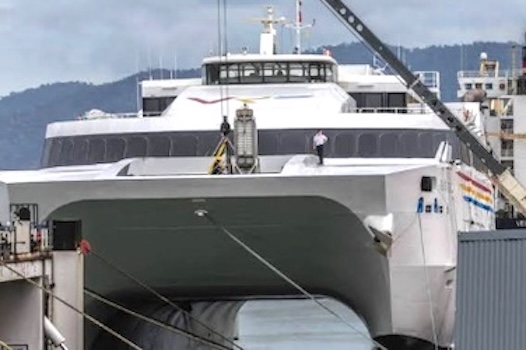
Against a backdrop of growing regional efforts to cut trade costs and deepen economic integration, the 15-nation Caribbean Community (Caricom) has secured a temporary solution to advance its long-planned affordable intra-regional ferry service, with Trinidad and Tobago agreeing to deploy one of its existing vessels for cargo transport across member states. The agreement emerged from the 51st Caricom summit, a four-day gathering that wrapped up this week where regional leaders prioritized boosting connectivity, strengthening food security, and advancing the goals of the Caricom Single Market and Economy (CSME), the bloc’s framework for free movement of goods, labor, skills and services across the region.
St. Lucia Prime Minister Phillip J Pierre, who currently holds the Caricom grouping’s chairmanship, outlined key takeaways from the summit at a post-meeting press conference Wednesday. He confirmed that leaders had agreed to accelerate work on the permanent ferry initiative, noting that a reliable, low-cost intra-regional ferry connection would not only ease cross-border travel for residents but also streamline trade flows and shore up regional food security by making it easier to move agricultural and essential goods between islands. Pierre added that the summit also delivered further progress on expanding the free movement of Caricom nationals across the bloc, with more member states moving toward full participation in the policy.
Barbados Prime Minister Mia Mottley, who leads CSME coordination in Caricom’s quasi-cabinet structure, explained that the temporary ferry arrangement comes as the region grapples with volatile global oil prices driven largely by ongoing Middle East conflicts, a key factor pushing up regional cost of living. Lower-cost intra-regional transport is seen as a critical lever to bring down prices of essential goods across Caribbean island nations. Mottley shared that Trinidad and Tobago Prime Minister Kamla Persad-Bissessar has offered one of the country’s five active ferries for the temporary pilot, which will run while the regional private sector works to acquire a permanent purpose-built vessel, a process expected to take roughly 12 months.
The pilot program, which will serve as a proof of concept for the full permanent service, will initially focus on ports across the southern and eastern Caribbean. Mottley noted that the program first requires assessments of existing port infrastructure, including whether existing ramps can accommodate the ferry or if upgrades are needed. In the coming weeks, Mottley plans to hold tripartite talks with Persad-Bissessar and St. Vincent and the Grenadines Prime Minister Dr. Godwin Friday to work out logistics for utilizing the Trinidadian ferry during the pilot phase.
Beyond vessel logistics, Mottley is leading work to put in place the required regulatory framework for cross-border cargo movement. She is coordinating with fellow regional leaders to draft cross-border agreements for mutual recognition of vehicle operating licenses and insurance coverage, which will allow cargo trucks to travel seamlessly off the ferry and into destination member states. Mottley has set an ambitious target to finalize and put these regulations into effect within three months.
Private sector stakeholders have been deeply involved in advancing the initiative, and expressed confidence that the project will deliver tangible results in the near term. Dr. Patrick Antoine, chief executive and technical director of the Caricom Private Sector Organisation (CPSO) Secretariat, told Caribbean Media Corporation (CMC) earlier this week that Mottley and Friday have already held two working sessions with private sector partners on the ferry plan in the past two weeks. Antoine pushed back against any suggestion that the project is an unrealistic proposal, emphasizing that the work is already well underway.
Antoine explained that the initiative has hit delays in past years in part due to shifting election cycles across member states that disrupted planned ministerial-led working meetings, but he noted that momentum has now firmly shifted toward implementation. Three private firms have already completed preparatory work for the permanent service, he added, with two of the companies already securing preliminary financing contingent on the completion of the required cross-border regulatory protocols. Over the next three months, Antoine said, Barbados and Jamaica will take leading roles in advancing the operational details of the initiative, with the CPSO providing data, analysis and coordination between the regional government and the three private sector entities that will ultimately operate the full service.
The temporary ferry pilot marks a key milestone for Caricom’s decades-long push toward deeper economic integration, with leaders and private sector stakeholders aligned on the need to deliver a functional low-cost service that addresses longstanding barriers to intra-regional trade and movement.