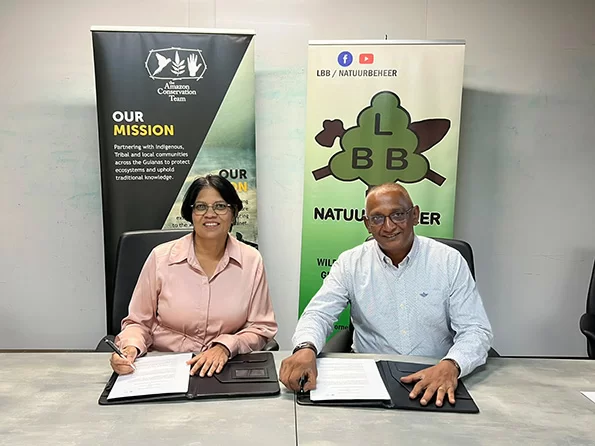
Two leading environmental organizations in Suriname have formalized a new collaborative agreement to ramp up conservation efforts for vulnerable sea turtles and fragile coastal habitats across the country. The Suriname Forest Service (Dienst ‘s Lands Bosbeheer, LBB) and the Amazon Conservation Team Guianas (ACT Guianas) signed the cooperation protocol on July 8, marking the start of targeted on-the-ground conservation work that will launch immediately.
Acting head of LBB Romeo Lala emphasized that the new partnership creates a structured framework to expand existing sea turtle protection work by uniting the resources, expertise, and local connections of both organizations alongside community stakeholders. Minu Parahoe, regional director of ACT Guianas, described the signing as the foundation for deeper long-term collaboration, noting that the initiative will build on proven conservation strategies ACT has successfully deployed in other Guiana Shield countries.
The first concrete milestones of the partnership are already on track to be realized in the coming days at Braamspunt, one of Suriname’s most critical sea turtle nesting sites. A permanent field outpost will be opened there to serve as the central hub for all monitoring, coordination, and protection activities throughout the 2026 sea turtle nesting season. In addition to the field post, teams will complete the setup of a dedicated hatchery designed to protect at-risk nests that are threatened by ongoing coastal erosion, seasonal flooding, and human disturbance.
This specialized hatchery will prioritize nests of the critically endangered aitkanti (olive ridley) sea turtle, a species whose Braamspunt nesting habitat is under extreme pressure from constant shifting of the local coastline, driven by natural geomorphological processes. Several weeks ago, the first batch of collected aitkanti eggs was already transferred to a temporary controlled incubation facility managed by Suriname’s Nature Management department. After roughly 60 days of development under regulated conditions, the newly hatched baby sea turtles will be released onto the sands of Braamspunt to begin their journey to the Atlantic Ocean.
ACT Guianas’ involvement in this project is part of its broader regional conservation initiative called *Ancestral Tides*, which operates across coastal areas of the Guiana Shield and other regions where the organization works. The program integrates rigorous scientific monitoring, meaningful engagement of Indigenous and local coastal communities, and hands-on protection measures to reverse population declines of threatened sea turtle species. Both organizations report that this combined approach has already delivered measurable results in other regions, including higher nest survival rates and increased odds of juvenile sea turtles reaching maturity. The model will be adapted to the unique ecological conditions of Suriname’s coast for local implementation.
The entire Guiana Shield coastline, stretching from Guyana’s Shell Beach through Suriname to French Guiana, is recognized as one of the most geodynamically active coastal systems on Earth. Constant tidal action and sediment carried downstream from the Amazon Basin create continuous change: mudflats, mangrove forests, and sandy nesting beaches shift constantly, eroding in some areas and accumulating new land in others. While this dynamic process is natural, it has put Braamspunt, a primary aitkanti nesting ground in Suriname, at heightened risk, with large sections of nesting beach eroding away in recent years.
LBB and ACT Guianas acknowledge there is no simple fix for these natural geomorphological changes. For as long as Braamspunt remains a key nesting site for threatened sea turtle populations, the two organizations will continue their coordinated efforts to safeguard nests, boost juvenile survival rates, and protect the broader coastal ecosystem that supports these iconic marine species.