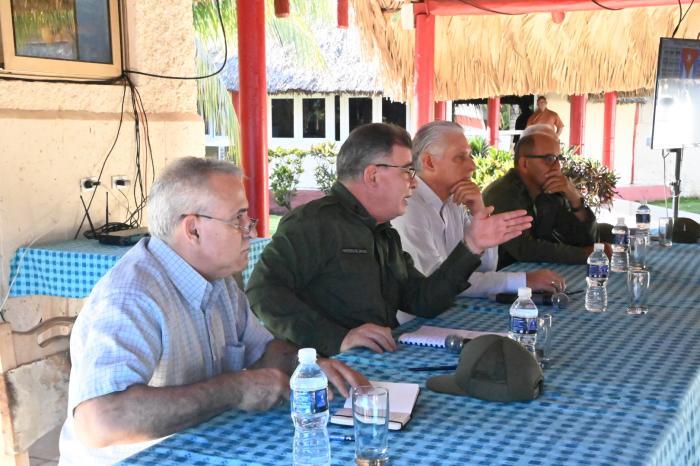
Rooted in a long-held national principle that consistent peacetime preparation is the most reliable deterrent to conflict, Cuba’s national defense framework continues to refine its local organizational structures to better address both community needs and exceptional scenarios. On a Saturday morning in July 2026, Miguel Díaz-Canel Bermúdez, President of Cuba’s National Defense Council, First Secretary of the Central Committee of the Communist Party of Cuba, and President of the Republic, carried out an inspection visit to the Wajay Defense Zone, one of seven such operational zones located in Havana’s Boyeros municipality.
During the visit, Díaz-Canel held in-depth discussions with local defense personnel and stakeholders, receiving on-the-ground accounts of daily operations and collaborating to map out strategies for unlocking the full structural and organizational potential of local defense zones. The visit came as Cuban defense officials continue to strengthen the integration of Internal Order Groups into the broader work of local Defense Zones, a structural adjustment designed to enhance cross-stakeholder collaboration, streamline operational frameworks, and speed up the flow of critical information to serve both community welfare and emergency preparedness.
Unlike traditional defense structures that focus exclusively on wartime scenarios, Cuba’s Defense Zone model is integrated with local People’s Council governance, tying national defense preparedness directly to the daily quality of life for neighborhood residents. Officers on the ground emphasized during discussions that the full integration of Internal Order Groups into the Defense Zone structure enables more accurate problem identification, more effective utilization of on-the-ground data, more robust strategic analysis, and ultimately faster, more targeted implementation of solutions to challenges ranging from routine community issues to large-scale exceptional events.
During closing remarks, Díaz-Canel highlighted the unique contributions that Internal Order Groups have made to refining the organizational methodologies of local defense zones, working alongside existing established structures. He described the integrated model as a coherent, detail-oriented, flexible, and resolute approach to national defense and community organization that aligns with Cuba’s specific national context. The Cuban leader also praised the model for its ability to strengthen social cohesion by bringing together formal defense forces and local community members, improving operational outcomes at the individual district level across the municipality.
Díaz-Canel closed his remarks by thanking attendees for their detailed analysis and actionable input, reinforcing his conviction that deeper integration of working groups within Defense Zones will directly translate to better overall operational performance. He noted that Cuba already maintains abundant organizational resources for local defense, and that tailored, context-specific solutions can always be developed to match the unique characteristics of any given locality.
The visit was also attended by three senior members of Cuba’s Political Bureau: Army Corps General Lázaro Alberto Álvarez Casas, Minister of the Interior; Army Corps General Roberto Legrá Sotolongo, First Deputy Minister of the Revolutionary Armed Forces and Chief of the General Staff; and Major General José Amado Ricardo Guerra, Secretary of the Council of Ministers.