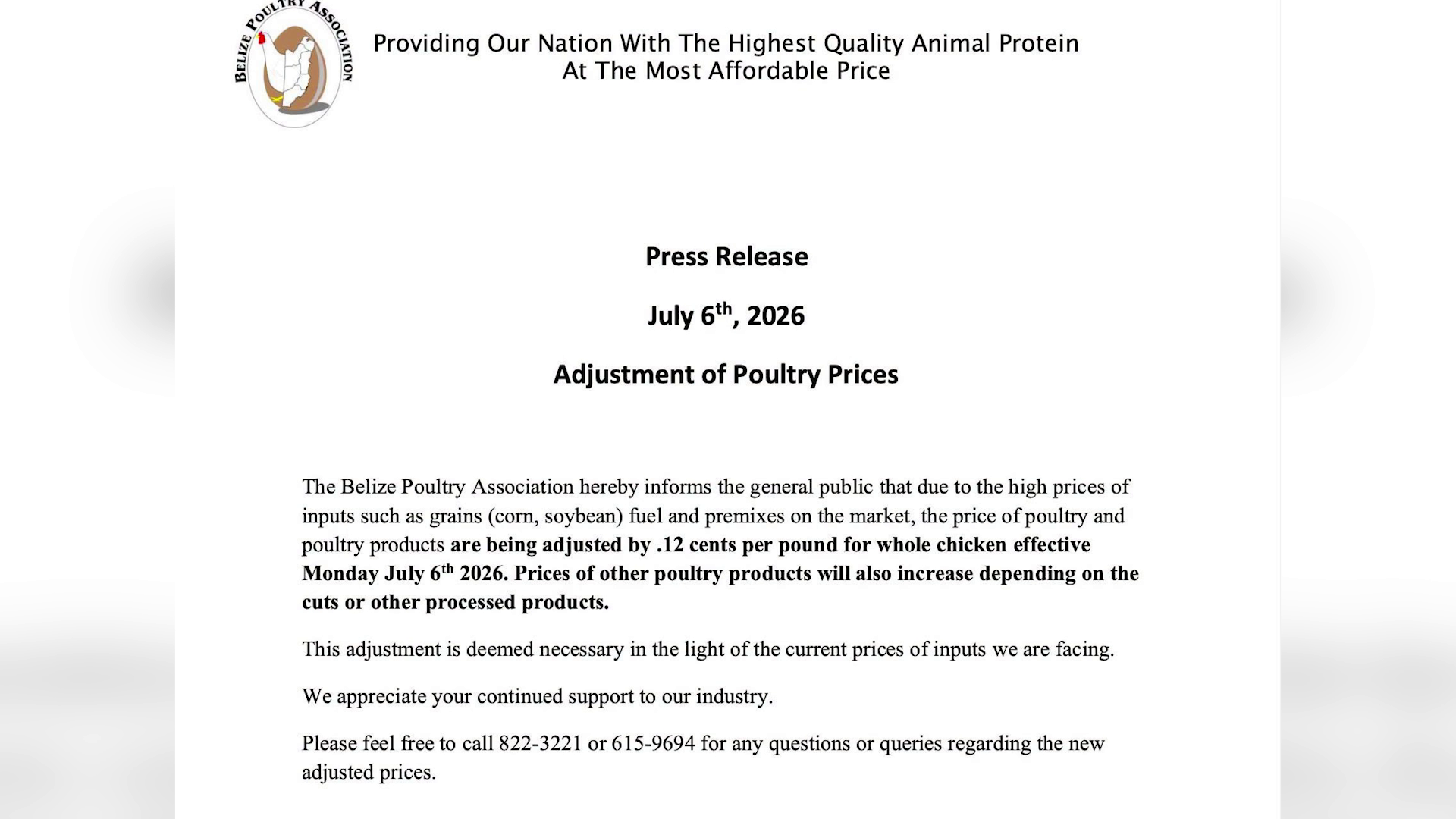
For Belizean households, chicken has long been an affordable dietary staple that anchors weekly meal plans. Starting in mid-2026, however, families across the country are facing higher grocery bills as the nation’s poultry producers announce a new round of price increases, driven by cascading global cost pressures that producers can no longer absorb internally.
The Belize Poultry Association (BPA), which represents the nation’s primary poultry producers, confirmed the price hike in an announcement July 6, noting that multiple interconnected cost increases across the supply chain have left the industry with no other option but to pass expenses on to end consumers. According to BPA manager Armando Cowo, the most dramatic strain on production costs comes from a steep jump in the price of imported feed premix, a critical additive sourced from Europe that is required to produce domestic chicken feed.
Cowo explained that the price of the association’s upcoming shipment of premix, which is imported from the Netherlands, has risen far beyond previous projections. This increase, paired with steady upward movement in global grain prices over the past several months, has pushed feed costs sharply higher. Both corn and soy, the core base ingredients for poultry feed, have seen consistent price gains since earlier this year, adding another layer of expense to feed production that local producers cannot offset.
Feed costs are not the only driver of the price hike, Cowo emphasized. Rising global fuel prices have inflated costs across every stage of the poultry supply chain, making the entire energy-intensive industry far more expensive to operate. From the initial planting and harvesting of grain by local agricultural producers, to the import of hatching eggs via air transport, to on-farm operations, feed delivery, processing, and final distribution of finished poultry products, every step relies on fuel. As energy costs climb, all suppliers along the chain adjust their prices to recover higher expenses, and those increases accumulate to raise the final cost of chicken for consumers.
This is the second poultry price adjustment for Belize in 2026. The BPA previously raised prices by six cents per unit in March, a move attributed entirely to rising labor costs across the industry. This latest increase stems from imported inflation, Cowo said, a global economic pressure that ripples through small domestic markets like Belize despite no local policy or production changes driving the trend.
For working-class Belizean households that rely on chicken as an affordable primary protein source, the new price increase will put additional strain on monthly food budgets, at a time when multiple consumer goods have already seen upward price adjustments amid broader global economic volatility.