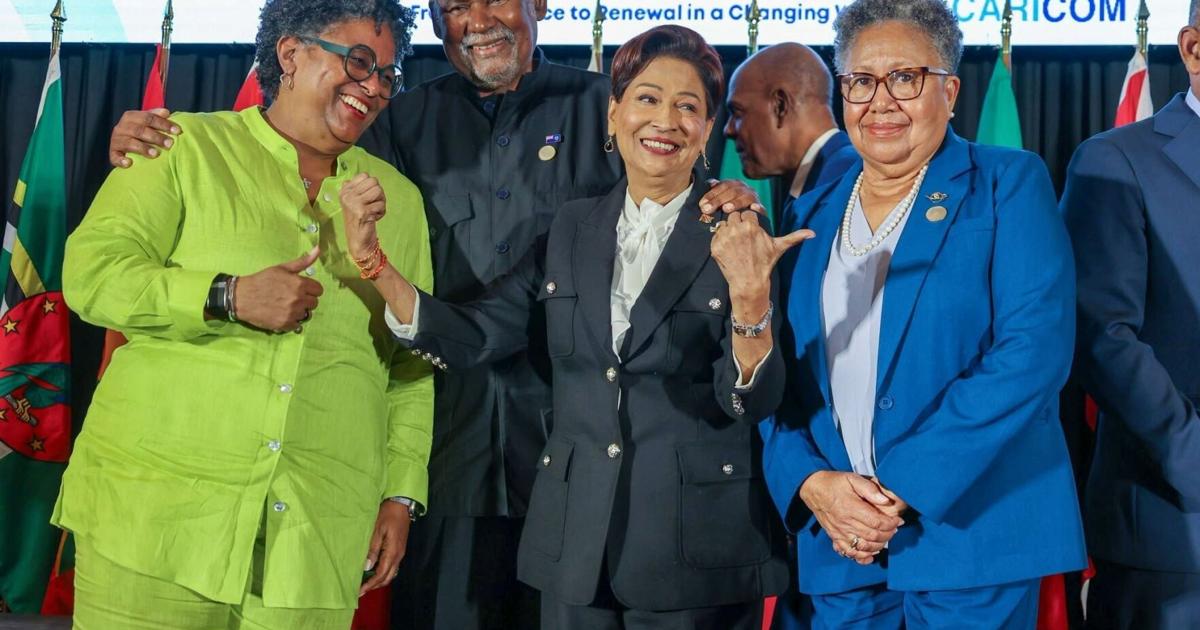
As diplomatic cordialities played out on the sidelines of the 51st Caricom Heads of Government Conference in St. Lucia, a significant constitutional dispute has moved to the center of regional discussions, with Trinidad and Tobago Prime Minister Kamla Persad-Bissessar refusing to back down from her demand that Carla Barnett’s reappointment as Caricom Secretary-General be reviewed by the Caribbean Court of Justice (CCJ).
Persad-Bissessar touched down in St. Lucia on Sunday to join the gathering of regional leaders, though logistical complications kept her from attending Barnett’s opening address to the conference. Footage from the event confirmed she participated in the official group photograph and held informal, polite discussions with both Barnett and fellow heads of government, including Mia Mottley, Prime Minister of Barbados. According to reporting from the Express, Persad-Bissessar planned to formally table her constitutional concerns during the closed-door leaders’ retreat held the following day.
Weeks ahead of the summit, the Trinidad and Tobago Prime Minister circulated a 22-page formal letter dated July 3 to Caricom Chairman and St. Lucia Prime Minister Philip J Pierre, as well as every sitting head of government and head of state across the bloc. In the document, she laid out detailed claims of severe procedural and constitutional violations surrounding the process that led to Barnett’s purported second term, and put forward a slate of interim measures to govern the bloc while the CCJ evaluates the dispute.
Central to Persad-Bissessar’s argument is that her objection is not a personal attack on Barnett, but a defense of foundational principles: the rule of law, constitutional governance, and the institutional integrity of the 15-member regional integration body. She reaffirmed Trinidad and Tobago’s unwavering commitment to Caricom and the broader project of regional unity, but stressed that unity cannot be built on “expediency and irregular practices masquerading as precedent.” Instead, she argued, all Caricom business must be rooted in strict adherence to the Revised Treaty of Chaguaramas, the bloc’s founding legal document.
As a result of the procedural failures, Persad-Bissessar confirmed that Trinidad and Tobago does not recognize the legality of the process that led to Barnett’s reappointment, and cannot accept the validity of her second term. “This matter is advanced not in a spirit of disagreement, but in a spirit of constitutional responsibility,” she wrote in the letter, repeating that the dispute centers on process, not Barnett’s personal suitability for the role.
Persad-Bissessar’s core proposal is that Caricom activate Article 212 of the Revised Treaty to formally request an authoritative advisory opinion from the CCJ. She argued that the regional supreme court is the only body with the mandate to deliver a binding, legitimate interpretation of the treaty clauses that govern the appointment and reappointment of the Secretary-General. She called on the Conference of Heads of Government to fast-track the referral to the CCJ, request an expedited hearing, and commit in advance to abiding by whatever ruling the court issues.
Seeking judicial intervention, she added, is not an act of confrontation, but a demonstration of trust in Caricom’s own established legal institutions. “The framers of the Revised Treaty wisely recognised that disagreements concerning the interpretation of our constitutional instruments should be resolved by law, rather than by competing political interpretations,” the letter read.
The letter also laid out a full chronological breakdown of the process that led to Barnett’s reappointment at a February 2026 retreat in Nevis, highlighting multiple alleged violations. Persad-Bissessar noted that the reappointment was never listed as an official agenda item in any provisional agenda, work program, or working paper circulated to member states ahead of the conference. She also claimed that three member states – Trinidad and Tobago, Antigua and Barbuda, and The Bahamas – were blocked from exercising their treaty-guaranteed right to participate through their properly designated representatives. Most notably, she argued that the Heads’ Retreat itself lacks any constitutional authority to appoint or reappoint a Secretary-General, a power reserved for the full plenary conference.
Per Persad-Bissessar’s accounting, only 10 of Caricom’s 15 member states were able to participate in the vote: the three blocked states were shut out, while Haiti and Montserrat were absent from the gathering. She stated that this participation level falls far short of the minimum voting threshold required by the founding treaty. Even if preliminary discussions were held during the retreat, she added, no formal confirmation vote was held during the conference’s plenary session, and without plenary approval, the decision can never gain legal force.
Persad-Bissessar also raised a conflict of interest concern, noting that Barnett, as the sitting Secretary-General, took part in administrative arrangements for her own reappointment process. While she acknowledged Barnett was not in the room during the actual deliberations on her term, she pointed out that Barnett issued the decision restricting attendance at the retreat to only sitting heads of government – the policy that blocked the designated representatives of three member states from participating. This, Persad-Bissessar argued, creates at minimum the appearance of improper conflict of interest, as Barnett was directly involved in setting the terms of a process that determined her own continued tenure.
Pending a final ruling from the CCJ, Persad-Bissessar has called for both Barnett and Caricom’s General Counsel to recuse themselves from all aspects of the advisory opinion proceedings. She also proposed that independent officials appointed directly by the Conference of Heads of Government manage all logistics related to the CCJ referral. Additional temporary measures have been put forward to ensure administrative continuity within the Caricom Secretariat while protecting the legal standing of all parties involved in the dispute.
The challenge has gained at least partial support from another major regional leader: Jamaica Prime Minister Andrew Holness submitted his own letter to the Caricom Chairman, noting that while Jamaica is not seeking to overturn the regional leaders’ decision to reappoint Barnett, it shares concerns that the current process has failed to resolve the dispute or uphold the core principles and goals of the Revised Treaty of Chaguaramas. “It has become clear that we were not all on the same page. Therefore, it is important that any concerns be addressed in a meaningful manner to restore cohesion, if not unity, which is indispensable to the effective functioning of Caricom,” Holness wrote.
As of reporting, the leaders’ retreat continued late into the evening, with discussions on the constitutional dispute expected to dominate closed-door talks among regional heads.