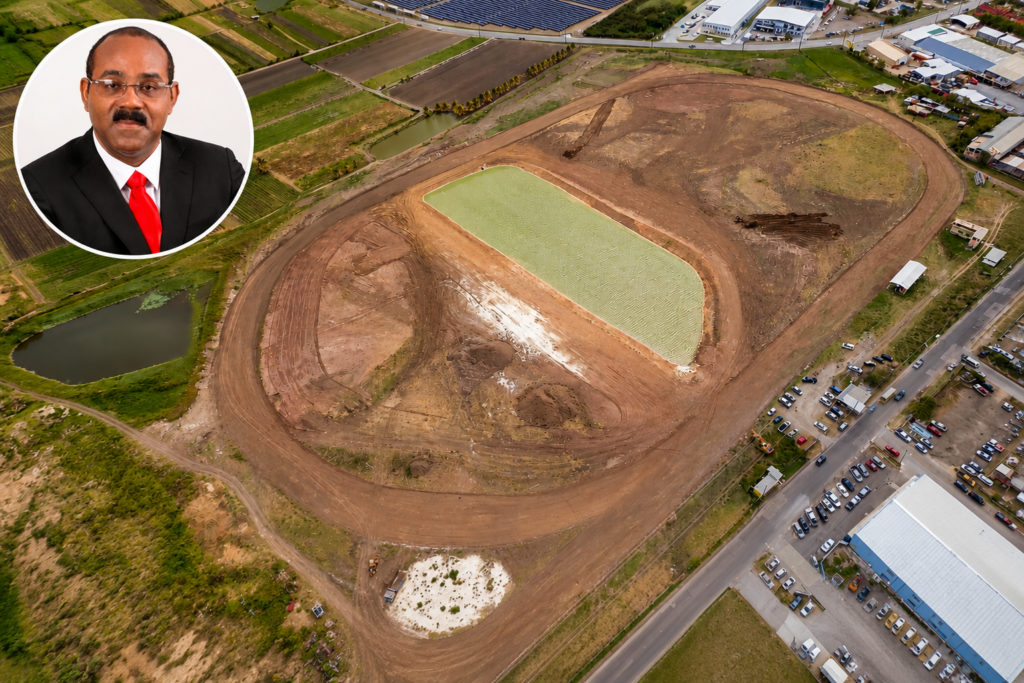
A public dispute over the fate of the EC$30 million Cassada Gardens Racetrack redevelopment project has prompted Antigua and Barbuda Prime Minister Gaston Browne to set the record straight on the government’s position, emphasizing that the administration has not blocked the project itself – only a controversial request to exempt the foreign investor from a mandatory industry levy.
The controversy erupted after the Antigua Turf Club issued a public statement claiming that negotiations over the revitalization initiative had collapsed, citing an unresolved impasse between the government and the unnamed foreign investor over a key concession demand. In response, Browne published a detailed official statement on Tuesday, breaking down the package of incentives the government has already approved to demonstrate its ongoing support for upgrading the public racetrack facility.
Per Browne’s account, the administration has already delivered substantial financial breaks to the investor, including a full decade-long corporate tax holiday and the approval of a casino license, alongside other tailored concessions. The sole sticking point, the prime minister explained, is the investor’s last-minute demand to waive the statutory 8% gaming fee that all licensed gaming and racetrack operators in the country are legally required to remit to the government.
Browne argued that approving the requested exemption would fundamentally undermine fair competition across Antigua and Barbuda’s growing gaming sector, creating an unfair advantage for the foreign backer that would put existing local and compliant operators at a disadvantage. “To waive it would give them an unfair advantage and we declined their offer,” Browne noted, pushing back against widespread narratives that the government had outright rejected the redevelopment project. He questioned the logic of framing the refusal of one specific concession as a total withdrawal of support, asking, “How does that translate into the government not supporting the project?”
The prime minister also outlined a clear alternative path forward for the initiative, noting that if the project can only move forward with the unfair tax exemption, the government is prepared to redirect the full package of concessions to a local operator instead. “If the foreign investor is depending on that tax waiver to develop the facility, we rather give the concession to a local operator, including the Turf Club itself,” Browne said.
Closing his statement, Browne reaffirmed the government’s red line on fiscal responsibility, stressing that the administration will not approve concessions that erode public tax revenue beyond what is considered reasonable and fair for the Antiguan public. “No plundering and bartering of government’s tax revenue will be entertained,” he wrote.
For its part, the Antigua Turf Club has defended the requested concession, arguing that the exemption is a core component of the project’s financial model, which is structured to reinvest all available funds back into upgrading the publicly owned racetrack rather than allowing capital to flow out of the initiative. The club has not walked away from negotiations, confirming that it is preparing an updated proposal to submit to the government and expressing hope that constructive discussions can resume in the near future.