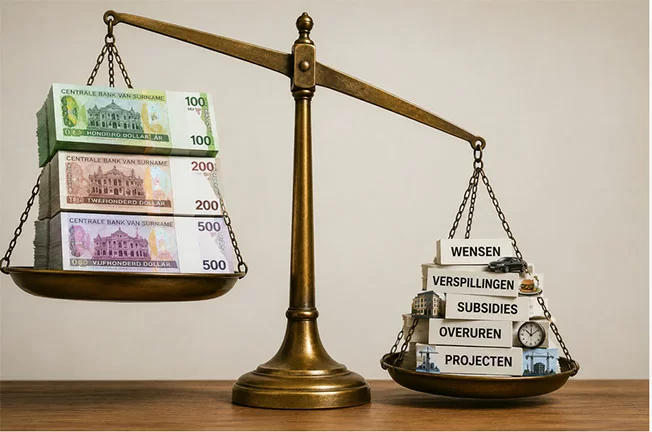
As the parliamentary debate on Suriname’s 2026 national budget drew to a close, President Jennifer Simons delivered what may prove to be the most consequential message of the entire legislative session: there will be no expansion of the national budget, as the country simply does not have the funds to spare. This hard announcement comes as Suriname’s budget deficit has swollen to more than 5% of gross domestic product, with an additional 13 billion Surinamese dollars required to cover existing funding gaps. Beyond the raw numbers, Simons’ statement confronts a reality the South American nation has pushed off for years: Suriname has long been living beyond its financial means.
The president warned that the next three years will bring significant economic hardship for the country, with new fiscal space only opening up once projected oil and gas revenues begin to actually flow into state coffers. Until that turning point, Simons emphasized, national leaders will be forced to make deliberate choices, prioritize core public needs, and accept the hard limits of the government’s implementation capacity. Not every policy initiative can move forward at once, she made clear.
But the core question that remains unanswered is whether the country as a whole is willing to accept the consequences of this necessary fiscal reset. Across Suriname, austerity has become an almost taboo topic. As soon as cuts to public spending are mentioned, the public immediately assumes outcomes such as higher consumer prices, eroded purchasing power, reduced social services, and increased tax burdens. Most residents assume austerity will only force ordinary citizens to make further sacrifices – but that does not have to be the case, the commentary argues. In fact, the most logical place to begin reducing unnecessary spending is within the government itself.
Long-running systemic waste in Suriname’s public sector is well-documented, from unproductive subsidies to groups and industries that do not actually need public support, to persistent public funding for state-linked institutions and parastatal enterprises that contribute little to national development while remaining permanently dependent on taxpayer dollars. Questions have for years been raised about bloated public payrolls, including the persistent issue of so-called ghost workers – individuals registered to receive public salaries who contribute little to no productive work, or who do not actually hold positions at all. No structural solution to this problem has ever been advanced.
Widespread everyday inefficiency adds to the cumulative waste: inflated overtime claims with no corresponding increase in productivity, meetings that start hours behind schedule, and parliamentary sessions that are canceled for lack of a quorum even after full costs for security, driver services, catering, cleaning, technical support and other logistics have already been paid. These hidden costs do not always jump out from line items in the national budget, but ordinary taxpayers are ultimately the ones footing the bill for all unnecessary spending.
The same logic applies to official overseas travel. While international engagement is undeniably necessary for Suriname – from negotiating with global financial institutions, courting foreign investment, participating in regional blocs, and carrying out core diplomatic work – and not all meetings can be conducted virtually, the public has a right to question whether every scheduled trip is truly essential. Even when airfare and hotel costs are covered by a hosting international organization, multiple related costs fall to the Surinamese state, including per diems, preparation expenses, protocol support, and costs to cover for the traveling employee back home. While these may seem like small individual costs, they add up to a significant sum that the country can ill afford in its current fiscal state. If the government is asking the public to prepare for three years of hardship, it must lead by example, cutting waste in its own operations first.
This approach applies equally to other areas of unnecessary spending: luxury imports that do not meet basic public needs, which drain the country’s scarce foreign currency reserves; capital projects that can easily be delayed for a year with no negative impact; and public institutions whose actual social value has never been independently audited and verified. Every single Surinamese dollar spent by the government deserves scrutiny to confirm it serves a necessary public purpose.
But spending cuts alone will not pull Suriname out of its ongoing fiscal crisis, the analysis notes. Leaders must also turn their attention to the revenue side of the national budget. For years, policymakers have discussed the need to increase fair royalty and tax contributions from the country’s gold and timber sectors. Suriname’s natural resources should benefit all of society, not just private actors. Every additional Surinamese dollar the state rightfully collects from these key extractive industries is one less dollar the government needs to borrow, or divert from core priorities like public education, healthcare, and social welfare. Responsible fiscal policy means not just cutting unnecessary spending, but also collecting all revenue that is owed to the public.
Beyond numbers, the national budget is ultimately a test of national political discipline. Almost every stakeholder in the country agrees that austerity is needed – but almost everyone wants cuts to fall on someone else. Cabinet ministers push for larger budget allocations for their departments; members of parliament push for more local development projects; labor unions demand higher wages; private businesses push for tax breaks; public institutions demand more subsidies; and ordinary voters want lower consumer prices. All of these demands draw from the same nearly empty national treasury.
This moment may be the critical opportunity for Suriname to learn that austerity does not have to equal greater poverty. When a household faces a temporary drop in income, it does not purchase a new car, even if it may be affordable in three years’ time. Instead, it first cuts out unnecessary spending, sets clear priorities, delays non-essential purchases, and protects core needs that support the family’s well-being. There is no reason a national government should operate by a different standard.
Future oil and gas revenues will almost certainly open new economic opportunities for Suriname, but they will not solve one deep-rooted problem: the long-standing culture that treats unrestricted public spending as an unspoken right. That may be the biggest challenge facing the current administration: not just balancing the national budget, but modeling and instilling a new culture of responsible stewardship of scarce public resources – a habit that may prove more valuable long-term than the natural resource wealth the country hopes to extract in the coming years.