In a major policy shift announced to Suriname’s national legislature, the South American nation’s government has abandoned its original joint development framework with neighboring Guyana and will now build and fully finance the long-planned Corantijn River bridge on its own.
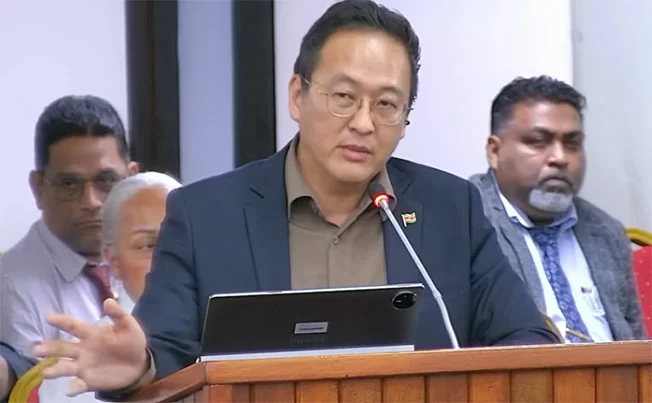
Public Works and Spatial Planning Minister Stephen Tsang confirmed the new direction during a budget debate for his department on Monday evening, responding to questions from opposition VHP party leader Asis Gajadien about the cross-border infrastructure project’s current status. “The government has decided to 100 percent finance the bridge itself,” Tsang told the National Assembly, stressing that the completed infrastructure will be unequivocally a Surinamese project. “Fact is that it must and will be a Surinamese bridge,” he added.
The Corantijn River forms the natural border between Suriname and Guyana, and the proposed bridge has long been framed as a landmark initiative to boost regional economic integration across the Guiana Shield and broader South America. It is designed to replace the existing ferry connection between South Drain in Suriname and Moleson Creek in Guyana, cutting transit times and significantly streamlining the movement of goods and people between the two neighboring countries.
Minister Tsang noted that multiple financing models for the fully domestically led project are currently under active review alongside Suriname’s Ministry of Finance, with the option of toll collection being among the options still on the table. “Everything is still open. All models are being examined together with the finance ministry,” Tsang said. Depending on which financing structure the government ultimately selects, a new tender process will almost certainly be required, he added.
Gajadien pressed the minister for clarity on the status of the tender process launched by the previous administration, as well as details of updated agreements with Guyana following the policy shift. While Tsang confirmed a new tender is likely, he offered no timeline for when the new bidding process would open. He also declined to comment on how the decision to take full control of the project will alter existing bilateral agreements with Guyana that were negotiated under the prior joint development plan.
For years, the bridge project advanced as a collaborative cross-border undertaking, with planning work carried out jointly by the two countries under Suriname’s previous administration. The new unilateral approach marks a sharp break from that earlier cooperation framework, though the full implications for bilateral infrastructure ties have not yet been disclosed by the Surinamese government.