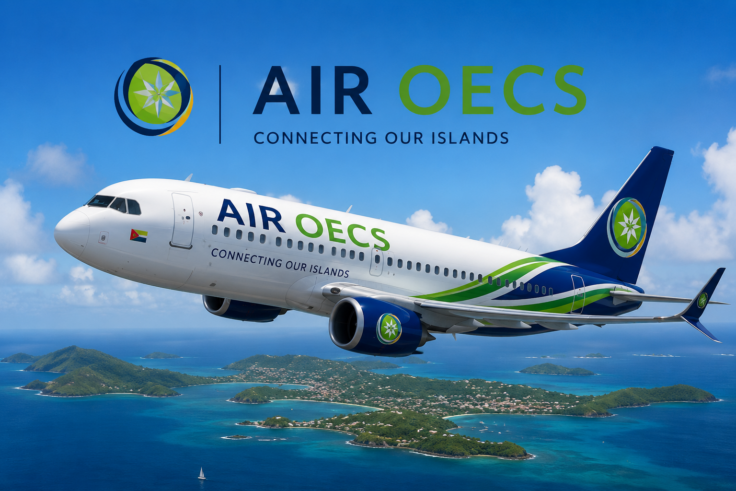
A years-long debate over launching a regional airline owned collectively by the Organisation of Eastern Caribbean States (OECS) is approaching a critical turning point, with a final feasibility assessment set for completion in the coming weeks. Antigua and Barbuda Prime Minister Gaston Browne announced Saturday that the Eastern Caribbean Central Bank (ECCB) is wrapping up the viability study that will greenlight or reshape the flagship integration project, after OECS leaders unanimously reaffirmed their commitment to the plan at the bloc’s 78th Authority Meeting.
Speaking during his regular weekly broadcast on Pointe FM, Browne confirmed that the project’s progression remains conditional on the study’s outcome, but leaders are optimistic about the results. “We would have all confirmed our commitment to an OECS Air, subject to the study that has been done by the Eastern Caribbean Central Bank,” Browne stated. “We expect, within a matter of weeks, that the Eastern Caribbean Central Bank would have completed their studies and that it will confirm the viability of this entity.”
Regional authorities have already secured a base layer of startup funding for the proposed carrier, drawing on a pool of long-unclaimed assets held by the ECCB. Browne disclosed that approximately US$50 million in proceeds have already been earmarked from deposits that have gone unclaimed by their original owners for between 25 and 30 years.
In a additional boost to the project, French delegates who participated in the recent OECS meeting have flagged potential additional financing from the European Union. Browne explained that the initiative meets eligibility criteria for two major EU development funding streams: the Interreg regional cooperation programme and the Gateway infrastructure support initiative. If this EU funding is secured, the new airline could launch with total capital exceeding US$100 million, according to Browne’s estimates.
Crucially, the project will move forward regardless of the outcome of the EU funding application. Browne emphasized that even if EU support does not materialize, the OECS already holds enough internal capital to launch the development phase of the airline. “If those two windows are not available, then at least we’ll have the US$50 million to work with within our own resources,” he said.
For the Eastern Caribbean bloc, the creation of a shared regional airline has long been framed as a cornerstone of deeper economic integration. Planners project that the carrier will cut through longstanding gaps in air connectivity between OECS member states, addressing a critical bottleneck that has held back growth in cross-border tourism, trade and regional mobility for decades. The upcoming ECCB viability study will set the course for the next phase of the project, outlining the timeline and operational structure for the new airline if approved.