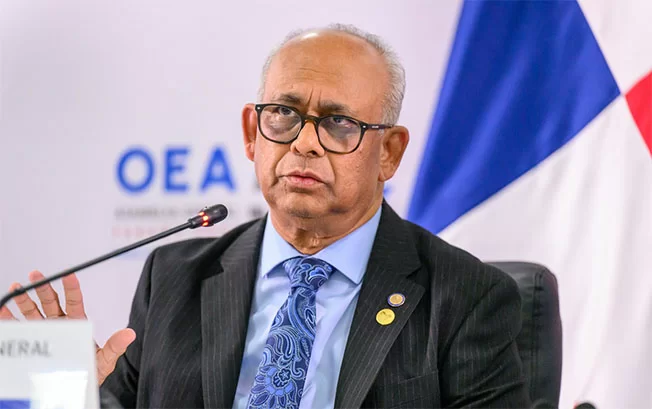
Following the conclusion of the 56th General Assembly of the Organization of American States (OAS) hosted in Panama, Secretary-General Albert Ramdin has underscored the intergovernmental body’s enduring centrality to advancing democratic governance, human rights protection, and cross-regional collaboration across the Western Hemisphere. In his closing remarks to reporters, Ramdin emphasized that no major challenge facing the hemisphere can be addressed effectively through isolated national action—collective, coordinated engagement is the only path forward.
Despite divergent policy positions among the OAS 35 member states, Ramdin noted that the assembly once again demonstrated the widespread commitment to maintaining open dialogue between nations. “The OAS is not just relevant to this region—it is necessary,” Ramdin stated during the press conference. He went on to outline the interconnected set of complex challenges currently facing countries across the Americas, ranging from growing threats to democratic institutions and transnational organized crime to mass migration, systemic economic uncertainty, accelerating climate change, and ongoing digital transformation. The long-unresolved deep crisis in Haiti also remained a top pressing concern for member states, he added.
Political developments across four nations—Nicaragua, Venezuela, Cuba, and Bolivia—occupied a prominent position on the assembly’s agenda, according to Ramdin. He reiterated the OAS longstanding call for the immediate, unconditional release of all political detainees held in Nicaragua, Venezuela, and Cuba.
For Bolivia, the General Assembly approved a resolution establishing an independent special mission to the Andean nation. In consultation with the Bolivian national government, the mission will conduct a comprehensive analysis of the country’s political and social landscape, before drafting evidence-based recommendations to strengthen democratic institutions, protect fundamental human rights, and advance inclusive national dialogue. Ramdin emphasized that this decision reaffirms the OAS core role as an impartial mediator that operates in full respect for member state sovereignty while working to advance regional stability and proactive conflict prevention.
On the topic of Haiti, Ramdin stressed that the dire situation in the Caribbean nation will remain a high priority for the OAS moving forward. The organization will continue its close coordinated work with Haitian national stakeholders, the Caribbean Community (CARICOM), the United Nations, and other international partners to develop sustainable solutions to the country’s overlapping security, humanitarian, and political crises.
Beyond high-profile political conflicts, the 56th General Assembly also addressed a broad range of cross-cutting policy priorities, including inclusive economic development, digital transition across the region, expanded access to mental health care, enhanced protections for people living with disabilities, and approval of the OAS 2027 institutional budget.
Ramdin highlighted the launch of the Private Sector Initiative of the Americas as one of the assembly’s most notable tangible outcomes. The new initiative brings together more than 300 private sector entrepreneurs from across the region to boost cross-border investment, drive inclusive economic growth, and strengthen business-focused regional collaboration.
Opening his closing address, Ramdin first extended words of solidarity and condolences to the populations of Venezuela, Colombia, Curaçao, and Aruba, which had been hit by a major earthquake shortly before the conclusion of the assembly. He expressed his sincere hope that the disaster would result in limited infrastructural damage and minimal loss of life.
Looking ahead, Ramdin noted that the 56th General Assembly sent a clear message: even amid a period of rising political polarization across the globe, the nations of the Western Hemisphere recognize the critical need for expanded dialogue, deeper cross-border cooperation, and stronger multilateral institutions.
“We depart Panama with a very clear message: the OAS has critical work to do across the hemisphere, we are the right organization to lead that work, and we are ready to take on this responsibility,” Ramdin said.