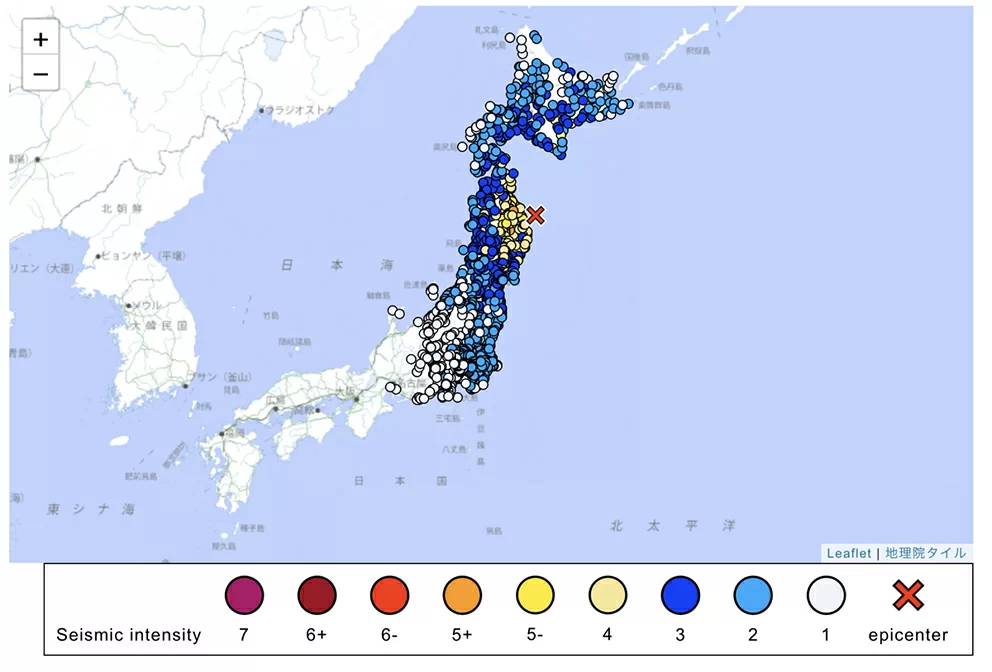
On Thursday morning, a powerful 7.2-magnitude earthquake hit off the northern coast of Japan, leaving at least 10 people injured and triggering widespread strong shaking across the region’s northern prefectures. The disaster comes just one day after two devastating earthquakes struck Venezuela Wednesday night, which have already claimed at least 164 lives and left the South American nation grappling with a deepening humanitarian crisis.
The epicenter of Japan’s latest seismic event was located off the shore of Iwate Prefecture, at a depth of roughly 44 kilometers below the ocean surface. Seismic monitoring data from the Japan Meteorological Agency recorded an exceptionally high intensity reading of over 6 on Japan’s 7-point domestic scale in Hashikami, a city located in neighboring Aomori Prefecture. An intensity reading at this level indicates extreme shaking: most people are unable to stand or walk steadily during the tremor, and unsecured furniture and household items frequently topple over.
As of Thursday afternoon, official reports confirm that at least 10 people have sustained minor injuries, most caused by falling debris and toppled objects during the quake. No fatalities or reports of severe structural damage have been confirmed so far. Critical rail services, including operations on the high-speed Tohoku Shinkansen line, were temporarily suspended immediately after the quake to allow for mandatory safety inspections of tracks and infrastructure, but all services have since resumed normal operations.
Japanese Prime Minister Sanae Takaichi reassured the public that no tsunami warning was issued for the event, but urged residents across northern Japan to remain alert for potential aftershocks in the coming days and weeks. All major nuclear facilities in the region, including the Fukushima Daiichi Nuclear Power Plant, reported no abnormal operations or radiation leaks following the tremor.
Japan sits along the Pacific Ring of Fire, a geologically active zone that circles the Pacific Ocean basin and is responsible for roughly 90% of the world’s annual earthquakes. Seismologists have noted that northeastern Japan has seen a surge in major seismic activity in recent months, including a 7.7-magnitude quake that struck the same region in April 2026. Researchers say Thursday’s quake may be linked to afterslip movement of tectonic plates, a post-major-quake phenomenon where plates continue to shift gradually weeks or months after an initial large seismic event. Experts have warned that the risk of an even larger earthquake in the region cannot be ruled out at this stage, making sustained public preparedness and vigilance a critical priority.