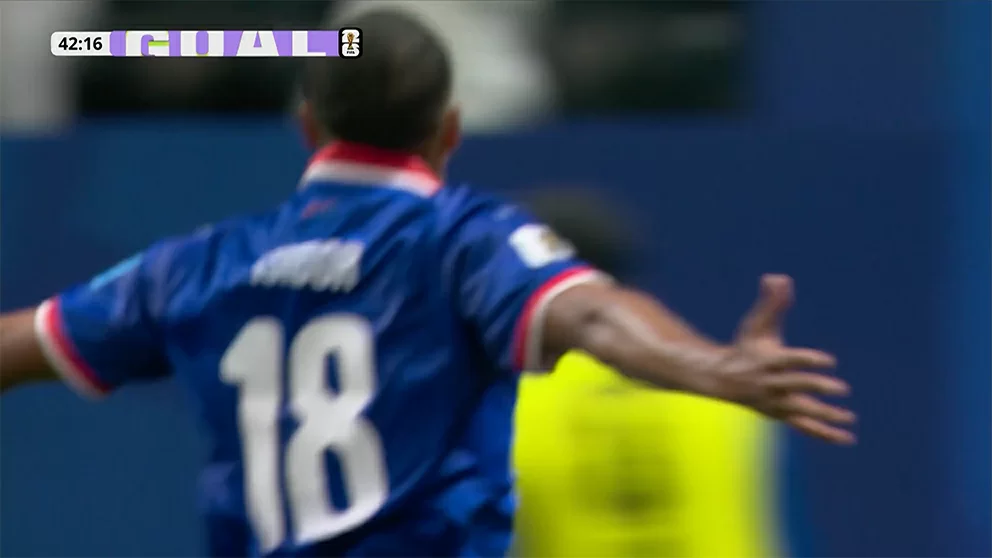
After more than half a century of waiting, Haitian football supporters across the United States experienced a moment decades in the making at the 2026 FIFA World Cup: their men’s national team scored its first World Cup goals in 52 years, turning an already historic tournament appearance into a deeply emotional celebration of identity and resilience for the country’s large diaspora community.
Haiti’s 2026 World Cup run came to an end after three group-stage matches, with early defeats to Scotland and Brazil eliminating the side before its final matchup against Morocco. But even in elimination, the team’s two goals against Morocco delivered a milestone that no final result could overshadow. For 52-year-old Murielle Lodvil, the 52-year gap between Haiti’s last World Cup goals and this new pair spanned her entire lifetime.
Lodvil was among hundreds of Haitian fans gathered to watch the match in New York’s Little Haiti neighborhood, where local bars and restaurants fell quiet as eyes locked onto screens to track every play. The first half delivered nonstop drama: an equalizer, a go-ahead goal, and another leveling strike from Haiti, sending the packed crowd into chaotic celebration. Though Haiti conceded two additional goals to end the match with a defeat, the outcome did nothing to dim the significance of the moment for Lodvil.
She had already splurged on birthday gift tickets to attend Haiti’s group stage match against Brazil at New York’s UBS Arena alongside her 41-year-old sister Barbara Albert, calling the entire experience one to treasure regardless of results. “That’s why this was so special for me: Haiti got to stand on this global stage,” Lodvil explained. “Every single moment of this experience counts, and those two goals were the highlight, no matter what the final score said.”
Albert echoed that sentiment, emphasizing that Haiti’s return to the World Cup after decades of absence was itself a massive source of pride for the global Haitian community. “Just being here, representing our country, was incredible. We’re so proud of our Haitian community, and we showed up for our team fully,” she said.
That widespread pride was on clear display at UBS Arena in Elmont, New York, the host venue for multiple 2026 World Cup group stage matches. New York State is home to the second-largest Haitian community in the United States, with roughly 113,000 Haitian-born residents recorded by the 2024 U.S. Census Bureau, and fans turned out in force to support their national side. By an hour before kickoff against Brazil, every Haitian flag stocked by local vendors had already sold out, while stacks of Brazilian flags still sat waiting for buyers. Thousands of fans, decked out in Haiti’s signature red and blue, wearing national team shirts and themed wigs, packed the nearly sold-out 19,000-capacity stadium, with only small scattered groups of opposition supporters in Brazil’s yellow and green breaking up the sea of Haitian color.
Among the crowd was Maude Schwartz, a 58-year-old pilates studio owner who moved to the U.S. from Haiti on a student visa in 1990. She waved a Haitian flag and danced with her family as the teams walked onto the pitch, calling the opportunity to watch her home country compete on a global stage in her adopted country a once-in-a-lifetime experience. “My whole family is here,” she said, gesturing to the crowd of cheering fans around her. But she also noted that not every member of her family could share the moment: her niece has repeatedly been denied a U.S. visa, barring her from attending the historic matches.
Schwartz’s experience reflects broader barriers that have kept many Haitian supporters from attending the 2026 World Cup, which is being co-hosted by the United States, Mexico and Canada. A travel ban on Haitian migrants first implemented during the Trump administration, expanded last year and extended again in January, has blocked many fans and even some team personnel from entering the country. The impact extended beyond fans: Haitian midfielder Woodensky Pierre was only able to travel to the U.S. to join the national squad 10 days before the team’s opening match against Scotland on June 13.
For Jean-Marc, a 55-year-old former Long Island Football League player born in the U.S. to Haitian parents, those travel restrictions run counter to the inclusive spirit of the World Cup. “This is a global event, and people shouldn’t be barred from entering this country just to share this moment,” he said, dressed in a Haitian team shirt and a red-and-blue wig. Jean-Marc spent part of his childhood in Haiti before returning to the U.S. in 1986, following the collapse of the dictatorial Duvalier regime, and called Haiti’s 2026 World Cup appearance “a landmark moment for every Haitian around the world, no matter where we live.”
In Flatbush, the Brooklyn neighborhood widely known as New York’s Little Haiti, local Haitian-Caribbean restaurant owner Nadege Fleurimond opened her venue BunNan for free watch parties during every Haiti match, so fans who could not get stadium tickets or travel to the arena could still celebrate together. Fleurimond moved to the U.S. from Haiti when she was 7 years old, and has watched immigration uncertainty touch nearly every Haitian family in the diaspora. For her, hosting the watch parties became a way to honor the dual identity that connects so many first- and second-generation Haitian Americans.
“I’m Haitian, and I’m also American,” she explained. “The United States gave me opportunities, access to education, and the chance to build my own business and create jobs for other people. But Haiti gave me my roots, my values, my resilience and my culture. This tournament reminded everyone that immigrants don’t have to choose one identity over the other.”
For Fleurimond, who grew up hearing constant narratives about what Haiti could not achieve rather than what it could, even qualifying for the 2026 World Cup was a victory in itself. “This proved that we belong in the rooms and on the stages that people often count us out of,” she said. And after 52 years of waiting, those two historic goals turned a historic tournament appearance into a moment the Haitian diaspora will never forget.