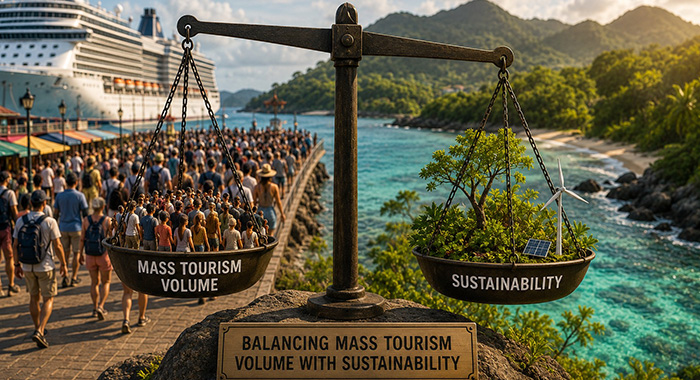
Every year, hundreds of millions of travelers cross international borders, powering one of the world’s largest global economic sectors. The latest data from UN Tourism underscores just how completely the industry has rebounded from the COVID-19 pandemic: international arrivals have hit 1.52 billion, fully erasing the losses of the lockdown era. But as the sector pulls in record-breaking revenue, a urgent, defining question has emerged for small developing island states: how can nations reconcile the urgent economic need for growing visitor numbers with the finite environmental, infrastructure and social carrying capacity of local communities?
For decades, St. Vincent and the Grenadines (SVG) stood out among Caribbean destinations as a quiet, unspoiled gem, often called the region’s best-kept secret. While many neighboring Caribbean nations built their tourism economies around sprawling concrete mega-resorts designed for mass visitor volumes, SVG maintained its identity rooted in the exclusive, secluded beauty of the Grenadines islands and the untamed rugged landscapes of its mainland.
Today, however, the Caribbean nation finds itself at a pivotal developmental turning point. Driven by expanded international flight access through Argyle International Airport and new investments from major global resort chains, SVG recently hit a historic milestone: 120,000 stay-over tourist arrivals, a new all-time record for the country.
The government’s landmark 30-year concession agreement with Global Ports Holding, which will invest up to EC$250 million to upgrade and expand the Kingstown Cruise Terminal, makes clear SVG’s strategic goal to scale its tourism capacity. The core challenge now is how the nation can adopt growth-focused changes without falling prey to the well-documented infrastructure and social pitfalls of mass tourism — a business model centered on moving huge numbers of visitors via mega-cruise ships, bulk charter flights and large multinational-owned resort chains. Getting this balance right is not just an environmental goal; it is critical to protecting SVG’s unique national identity.
To assess SVG’s current growth trajectory, sustainable development planners use the framework of carrying capacity: a metric that defines the maximum number of visitors a destination can host at one time without triggering severe environmental damage, eroding local residents’ quality of life, or diminishing the quality of the visitor experience itself. This framework acts as a necessary counterbalance to the unrelenting push for growth that defines mass tourism’s economic logic.
By design, mass tourism depends on rapid scaling and economies of scale: enormous cruise vessels, hundreds of hotel rooms, and bulk commercial air travel, all designed to generate large collective revenue through thin per-visitor margins and fixed head taxes. For a developing small island nation, the case for pursuing volume-driven growth is compelling on the surface. It delivers immediate, large-scale job creation in construction, hospitality and transport, while generating the foreign exchange needed to fund critical public services for local populations.
Yet without a enforced carrying capacity framework in place, chasing pure visitor volume will always push a destination past a dangerous tipping point. When raw arrival numbers become the only metric of success, the infrastructure built to support those visitors begins to crack. This reality has shifted the entire regional conversation across the Caribbean: instead of asking how many tourists a country can attract, leaders and planners now focus on a far more precise question: how well can an island’s limited infrastructure absorb the physical and social strain of high-volume arrivals? When this question is ignored, destinations quickly face the same severe economic and social pressures that many Caribbean nations already grapple with today.
The harmful outcomes of overshooting carrying capacity are not a distant example from other continents; the Caribbean itself offers a full spectrum of working models and their consequences.
In high-volume destinations like The Bahamas and St. Maarten, economies built on dense tourist arrivals face constant structural strain. When multiple mega-cruise ships dock on a single day, thousands of tourists flood small local hubs in hours. While municipalities collect head tax revenue, the increased costs of road repairs, waste management and public safety create a permanent, heavy drain on local public budgets.
In Jamaica, decades of prioritizing massive all-inclusive resorts with thousands of rooms has created deep social tensions around public access to coastlines. Data collected by the Jamaica Beach Birthright Environmental Movement (JaBBEM) shows that less than 1% of Jamaica’s shoreline remains fully free and open to the public, due to widespread private coastal development by resort operators.
SVG has already faced early signs of these tensions within its own archipelago, most notably during past public discussions about community access corridors on the island of Canouan. As the SVG mainland expands its hotel room stock, policymakers face the delicate task of upholding Vincentians’ constitutional right to access their own coastlines, ensuring local residents never become second-class citizens in their own country.
Beyond environmental and social strains, a second core issue in this debate is “economic leakage” — the share of tourist spending that leaves the destination country to line foreign corporate profits, pay for imported food from international supply chains, and cover salaries for foreign-owned management teams.
Charles “Max” Fernandez, Antigua and Barbuda’s Minister of Tourism and Investment, estimates that tourism leakage across the Caribbean reaches a staggering 80% of all visitor expenditure. Because small island states typically lack the robust domestic manufacturing base or commercial agricultural capacity to feed thousands of daily transient visitors, a large share of every dollar spent by tourists flows back out to foreign economic hubs.
This creates a structural policy challenge for SVG. If the nation transitions to a mass tourism model, it must simultaneously expand domestic linkages in agriculture, cultural production and fisheries. Without this parallel investment, SVG will bear 100% of the environmental damage from increased tourism while only retaining a small fraction of the generated wealth.
When a new generation mega-cruise ship docks in Kingstown, the immediate economic boost for local taxi drivers, street vendors and tour operators is undeniably valuable. But managing the physical footprint of thousands of arrivals in a single afternoon requires careful, data-driven planning to protect SVG’s irreplaceable natural assets.
As SVG works to rebuild its economy after the devastating impacts of the La Soufriere volcano eruption and Hurricane Beryl, the nation’s top priority must be building long-term structural resilience. As a climate-vulnerable archipelago, chasing high-volume mass tourism cannot only be about boosting short-term GDP growth; it is a high-risk development model that requires immediate domestic protections to absorb future shocks. If SVG invests in expanding tourism capacity, that growth must directly strengthen the nation’s ability to withstand the next inevitable ecological crisis.
This reality leads to a clear conclusion: the core goal of managing SVG’s tourism sector must shift from tracking raw passenger numbers to a deliberate “value over volume” strategy. Neighboring Caribbean nations have already proven this model works: Dominica has built a lucrative niche around its “Nature Island” branding, while Bonaire draws high-spending visitors with its strictly protected marine parks. Both have intentionally restricted large-scale mass development, and have shown that modern travelers are willing to pay a premium to visit unspoiled, uncrowded, ecologically protected destinations.
SVG holds a rare, golden opportunity to chart a unique middle path between the two extremes that define Caribbean tourism today. It does not need to choose between the crippling structural strain of high-density cruise hubs or the economic isolation of fully protected untouched eco-islands. Instead, by directing revenue from expanded flight access and modern transport hubs directly into supporting local agricultural cooperatives, protecting traditional cultural crafts, and enforcing strict marine conservation rules, SVG can build a uniquely resilient tourism model. The tourism sector SVG builds should lift all local residents, diversify the domestic economy, and never erode the island’s natural defenses that make it a desirable destination in the first place.