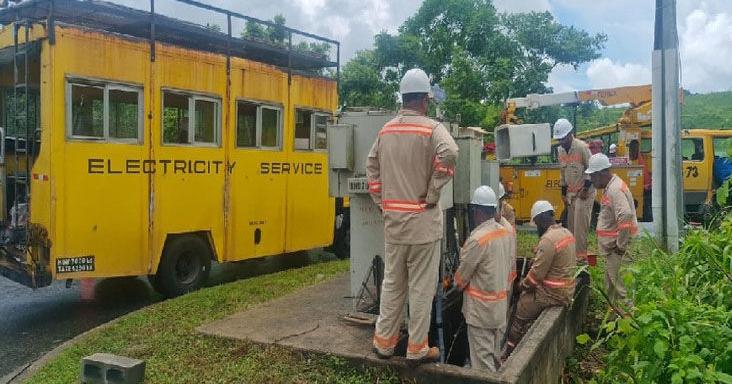
A deliberate act of cable vandalism in Princes Town, Trinidad and Tobago, left hundreds of residents across multiple local communities without power for nearly a day between Friday and Saturday, marking the second major attack on national electricity infrastructure in less than a month. The sabotage targeted critical high-voltage power infrastructure at the intersection of Seebalack Avenue and Pagee Trace, where perpetrators severed cables connected to a 12,000-volt circuit breaker. The damage also cut four primary high-voltage cables that feed 30 pad-mounted transformers serving the Housing Development Corporation’s (HDC) large-scale Fairfield housing development, triggering a widespread blackout that extended far beyond the development itself.
The affected areas included the full Fairfield Housing Development, as well as adjacent neighborhoods of Craignish, Indian Walk, Buen Intento, Mathilda and New Grant, leaving approximately 450 residential and commercial customers without power, according to an official statement released Saturday by the Trinidad and Tobago Electricity Commission (T&TEC). T&TEC emergency working crews deployed immediately after the outage was reported, working overnight through Friday and into Saturday to fully repair the damaged distribution hub. Power restoration was rolled out in phases: the first disconnected neighborhoods regained service four hours after crews arrived, the second phase of the Fairfield development had service restored by 11:05 a.m. Saturday, and the first phase of the development was fully reconnected by 12:30 p.m.
Local and national officials have issued urgent appeals for public assistance to identify and apprehend the perpetrators, warning that vandalism of critical public infrastructure carries severe risks for both the community and the vandals themselves. Dr. Aiyna Ali, Member of Parliament for Princes Town, emphasized that attacks on public utilities disrupt essential services that all residents rely on, and called on anyone with information about the responsible parties to contact Crime Stoppers anonymously at 474-TIPS (8477). “Together, we can help protect our communities and the services we all depend on,” Ali noted.
T&TEC echoed the appeal, adding a critical safety warning for the public: any tampering with high-voltage power infrastructure carries extreme risk of severe injury or fatal electrocution. The commission advised residents to avoid all unauthorised access to overhead lines, substations and related power equipment, and urged anyone with details of the vandalism to call T&TEC’s anonymous tip line at 474-8467.
Latchmi Narine, a local government councillor, described the incident as a total blackout that upended daily life across the affected region for hours. Speaking to the *Sunday Express*, Narine pointed out that vandalism against public infrastructure has become an increasingly serious problem across Trinidad and Tobago. She noted that the perpetrators appeared to have prior knowledge of power systems, as they managed to tamper with live high-voltage cables without being electrocuted – a dangerous coincidence that Narine called “really a sad situation for the country.” To prevent future attacks, Narine revealed plans to install permanent security cameras across vulnerable communities to deter potential vandals.
Many affected residents expressed frustration over the disruption to their daily routines. Kelly Williams, a Fairfield resident, told reporters he was in the middle of watching a World Cup football match when the neighborhood suddenly went dark, after he heard a loud bang that sounded like a transformer explosion. Williams said local rumors indicate the vandals targeted the cables to steal copper wiring, adding that outsiders were almost certainly responsible for the disruption. The outage left him particularly worried about the aquarium fish he keeps for relaxation, which rely on electric-powered filtration systems to survive.
Another resident, Anton Layne, called for harsh legal action against vandals to deter future attacks. “The authorities need to put strict laws and measures in place against vandalism. When they pick up with them, put them inside and throw away the keys,” Layne said.
This latest incident is not an isolated one: less than a month prior, on June 10, a would-be vandal suffered severe burn injuries after being electrocuted while attempting to tamper with infrastructure at T&TEC’s Brechin Castle substation. The intruder made contact with a 132-kilovolt breaker, triggering a system-wide voltage dip across large parts of the country at 9:45 a.m. that day. Security camera footage from the substation captured the man being stunned by the shock and falling to the ground, before he recovered, fled the scene and left his tools behind. He was apprehended shortly after the incident and taken for emergency medical treatment for his severe burns. T&TEC noted at the time that the national grid’s protective safety mechanisms worked as designed to prevent widespread outages, and the grid remained stable after the incident. The commission repeated its longstanding public safety warning following the June incident, reminding the public that any interference with power infrastructure carries potentially fatal risks.