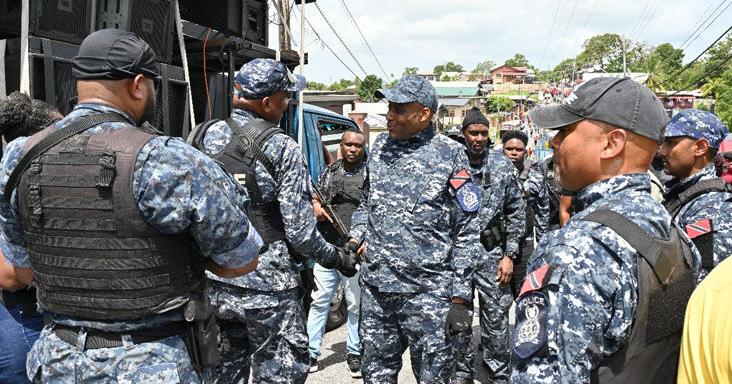
One year into his tenure leading the Trinidad and Tobago Police Service (TTPS), Commissioner Allister Guevarro has opened up about the service’s ongoing anti-misconduct efforts, public trust challenges, and legal barriers to greater transparency in policing. In a candid interview held Thursday at the Port of Spain Police Administration Building, Guevarro confirmed a striking statistic: 290 officers across the TTPS are currently suspended amid ongoing disciplinary or criminal proceedings – a figure that has not been made public by the current leadership until now.
The Commissioner emphasized that this large number of suspensions is not a sign of systemic failure, but rather proof that robust accountability mechanisms are active within the service. When he first took office, Guevarro noted, he was immediately confronted with a string of alleged misconduct cases, and he made rooting out corrupt and unethical actors within the TTPS a top priority from day one. “We try to root out the negative elements within the Police Service itself,” he stated.
To illustrate the service’s action against misconduct, Guevarro pointed to the high-profile case of Police Constable Stefon Khan. Khan was arrested and suspended earlier this year after an investigation found he had stolen $242,000 worth of marijuana seized as evidence from the Chaguanas Police Station, replacing the cannabis blocks with packages of wood and a ceramic tile. The officer was charged with misbehaviour in public office and brought before the court in May, a resolution that the public was broadly aware of – but Guevarro says that for most cases, the public never learns what action is taken after allegations first surface.
A core challenge the TTPS faces, Guevarro explained, is the widespread public perception that police misconduct is rarely punished. While initial allegations against officers often draw intense public and media attention, the subsequent disciplinary processes, arrests, and court proceedings rarely gain the same level of public interest. Even when the TTPS issues official statements about case outcomes, Guevarro noted that social media conversations still frequently question whether misconduct cases are ever actually prosecuted, with many users asking for updates on old cases months after announcements have been made.
The last time a similar suspension count was made public was in 2020, when then-Commissioner Gary Griffith revealed 280 officers were suspended with full pay, costing taxpayers an estimated $50 million annually. Guevarro did not address the cost of the current 290 suspensions in his comments, but he framed the current figure as evidence that multiple accountability bodies – including the TTPS’ own Professional Standards Bureau, internal disciplinary units, and the independent Police Complaints Authority (PCA) – are actively working to hold officers to account. “We are able to investigate, arrest and charge our own,” he said, adding that these systems demonstrate the TTPS’ commitment to removing officers who break the law or violate professional standards.
Guevarro also touched on public confidence in his leadership and the broader police service. He shared that internal polls conducted after his first 100 days in office showed he held an 80% public approval rating, but stressed that his personal popularity does not equate to public trust in the entire TTPS. “Guevarro is not the TTPS,” he said. “I am the leader of the organisation, and it is for me to take decisions and operate in a particular way with integrity and everything else that comes with the office.”
Beyond misconduct accountability, Guevarro highlighted a key legal barrier that limits the TTPS’ ability to build public trust through transparency: current restrictions on releasing evidence that is part of active court proceedings. He explained that this is most often an issue with body-worn camera footage, even in cases where the video clearly vindicates officers’ actions.
As an example, he cited a recent controversial shooting in Tunapuna, where an officer responded to a domestic violence call, was stabbed by a suspect, and fatally shot the man during the confrontation. The officer was wearing a body camera that clearly captured the unprovoked attack and the circumstances that justified the shooting, but Guevarro said the TTPS is legally prohibited from releasing that footage to the public to clear up misinformation about the incident. The same restriction applies to other high-profile pending cases, including the Joshua Samaroo matter, he added.
“Under our current laws, as long as that footage is to become part of evidence before the court, cannot be shown,” Guevarro explained, noting that releasing such information could be considered prejudicial to a fair trial and impact the final judicial outcome. “I still can’t even show that to the public.”
The Commissioner said he supports opening national discussions to reform policies around body-worn camera footage, pointing to existing frameworks in the United States and United Kingdom that allow for greater public disclosure in appropriate cases. However, he emphasized that any reform would require buy-in and changes from multiple stakeholders across the criminal justice system, including lawmakers and the Judiciary, not just the TTPS. Guevarro framed the issue as part of a broader national conversation about balancing transparency, public accountability, and fair administration of justice in Trinidad and Tobago.